About Veniliornis dignus (P.L.Sclater & Salvin, 1877)
Size and Weight
The yellow-vented woodpecker, Veniliornis dignus, measures 16 to 17 cm (6.3 to 6.7 in) in length and weighs 35 to 46 g (1.2 to 1.6 oz).
Sexual Dimorphism Note
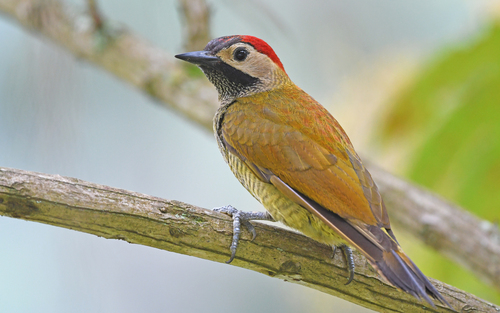
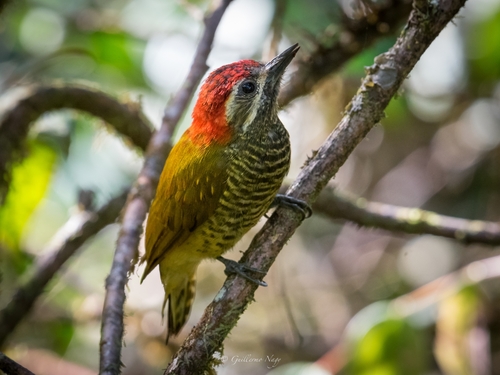
Males and females share identical plumage except for the pattern on their heads.
Nominate Adult Face Plumage
Adults of the nominate subspecies of both sexes have a mostly blackish olive face, with white stripes located behind and below the eye.
Male Head Plumage
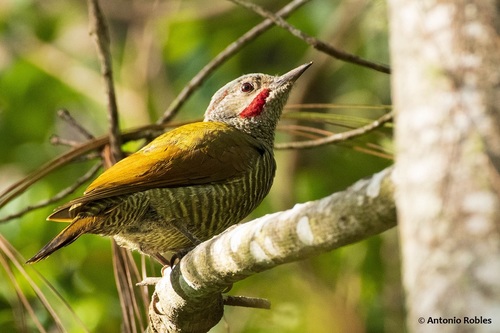
Males have red plumage from the forehead to the nape, with black feather bases visible through the red.
Female Head Plumage
Females have entirely blackish plumage in this head region.
Mantle and Back Plumage
For both sexes, the mantle and back are yellow-green with a bronze tinge.
Rump and Uppertail Coverts Plumage
The rump and uppertail coverts are barred with light and dark olive.
Flight Feathers Plumage
Flight feathers are brownish olive.
Tail Plumage
The tail is blackish with a yellow cast, and the outer two pairs of tail feathers have pale bars.
Underparts Plumage
The underparts are greenish white, turning yellow on the flanks and belly, and have heavy olive-blackish bars from the throat to the upper flanks.
Iris Color
The iris ranges from brown to red-brown.
Beak and Leg Color
The medium-long beak is blackish with a paler base, and the legs are dark olive-gray.
Juvenile Plumage
Juveniles are generally duller than adults, with greener upperparts, and both sexes have some red tips on their crown feathers.
Subspecies baezae Features
Subspecies baezae has a shorter beak than the nominate subspecies, and the barring on its underparts is blacker and extends further onto the flanks.
Subspecies valdizani Features
Subspecies valdizani has a longer beak than the nominate subspecies, with less well-defined barring on the rump and uppertail coverts.
Nominate Subspecies Range
The nominate subspecies of yellow-vented woodpecker occurs from Táchira in extreme southwestern Venezuela, south through the Colombian Andes to the Pacific slope of the Andes in northern Ecuador.
Subspecies baezae Range
Subspecies baezae is found on the eastern slope of the Andes in Ecuador.
Subspecies valdizani Range
Subspecies valdizani is found on the eastern slope of the Andes in Peru.
Habitat Preferences
This species inhabits humid montane forest, especially cloudforest, and is rarely found outside of mature primary forest.
Elevation Range
Most individuals live between 1,200 and 2,700 m (3,900 and 8,900 ft) in elevation, though the species occurs as low as 700 m (2,300 ft) in Peru.