About Vachellia xanthophloea (Benth.) Banfi & Galasso
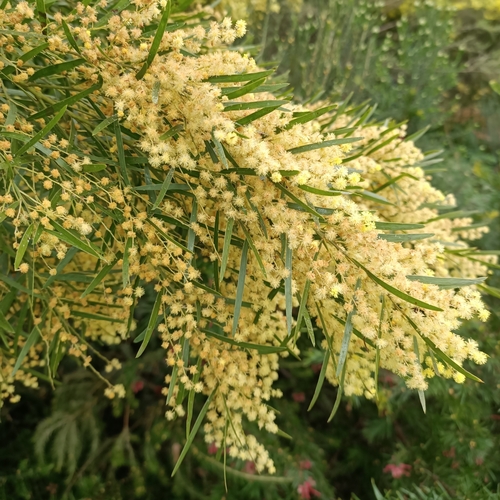
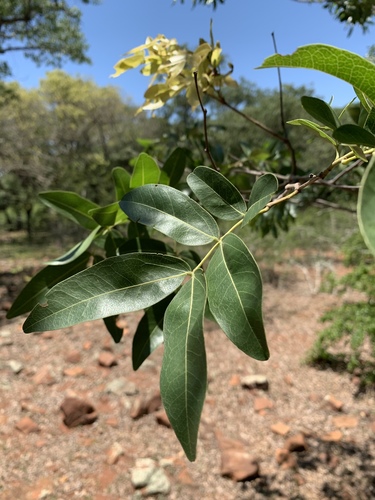
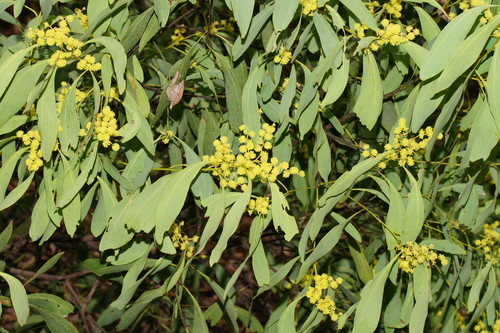
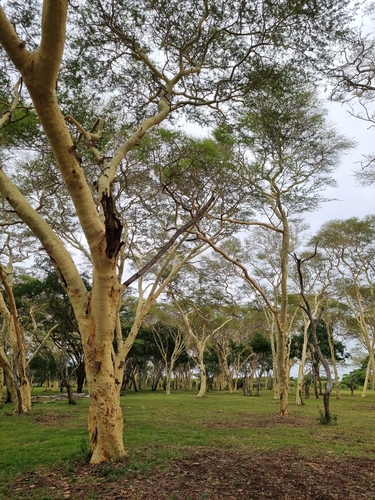
Vachellia xanthophloea (Benth.) Banfi & Galaso, commonly called the fever tree, is a tree that reaches 15 to 25 meters (49 to 82 feet) in height. Its characteristic bark is smooth, powdery, and greenish yellow; new twigs are purple, and flake off later to reveal the signature yellow bark. This is one of the few tree species where photosynthesis occurs in the bark. Straight, white spines grow in pairs from branch nodes. Its leaves are twice compound, with small leaflets that measure 8 mm × 2 mm (0.3 in × 0.1 in). It produces scented pale cream flowers arranged in spherical inflorescences, which grow clustered at nodes and toward the ends of branches. Its pale brown pods are 5 to 19 cm (2.0 to 7.5 in) long, straight, flat, and papery, and hold 5 to 10 elliptical, flattened green seeds. The segments of these pods are mostly longer than they are wide; as pods mature, they often break apart into small clusters of segments, each holding one individual seed. Maturing pods change color from green to pale greyish brown. Fever trees grow quickly but are short-lived. They tend to form single-aged stands, and experience whole-stand diebacks that researchers have variously attributed to elephants, changing water tables, and synchronous senescence. Vachellia xanthophloea grows near swamps, in riverine forests, on lake shores, and in semi-evergreen bushland and woodland with a high groundwater table. In seasonally flooded areas, it often forms dense single-species stands. Ecologically, its leaves and pods serve as food for livestock; young branches and foliage are eaten by African elephants; giraffes and vervet monkeys eat its pods and leaves. Bees forage on its flowers, and the tree is a favored nesting site for birds. Like other acacias and all members of the Fabaceae family, it is a nitrogen fixer that improves soil fertility. Its gum is part of the diet of the Senegal bushbaby (Galago senegalensis), especially during the dry season. In Kenya, butterfly species recorded feeding on Vachellia xanthophloea include the Kikuyu ciliate blue (Anthene kikuyu), Pitman's hairtail (Anthene pitmani), common ciliate blue (Anthene definita), African babul blue (Azanus jesous), Victoria's bar (Cigaritis victoriae), and common zebra blue (Leptotes pirithous). Thirty species of larger moths have also been recorded feeding on this tree. For human use, Vachellia xanthophloea is planted alongside farm dams and streams to control soil erosion, grown as a live fence or hedge, and used as an ornamental planting to provide shade and shelter in public amenity areas. It is also often planted as a source of firewood, though its gummy sap leaves a thick, black, tar-like residue when burned. Its valuable timber is pale reddish brown with a hard, heavy texture. Because it is prone to cracking, it needs to be seasoned before use, and is used to make poles and posts.