About Acacia fimbriata A.Cunn. ex G.Don
Description
Growth Habit
Acacia fimbriata A.Cunn. ex G.Don, commonly called fringed wattle, is a shrub or tree that usually reaches up to 6–7 m (20–23 ft) in height and 6 m (20 ft) in width.
Branchlet and Phyllode Features
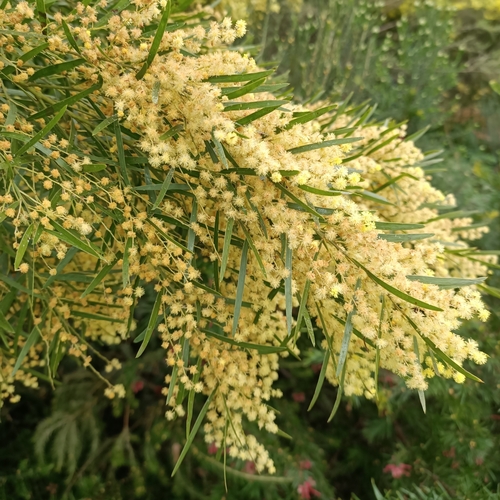
It has slender branchlets covered in short hairs, with linear to narrowly oblong or narrowly lance-shaped phyllodes. Phyllodes are typically 20–50 mm (0.79–1.97 in) long and 2–5 mm (0.079–0.197 in) wide, with thin edges that are sparsely to densely hairy.
Inflorescence Structure
Flowers are arranged in spherical heads held in racemes 15–75 mm (0.59–2.95 in) long, on peduncles usually 1.5–5 mm (0.059–0.197 in) long.
Flower Characteristics
The flower heads are 10–20 mm (0.39–0.79 in) in diameter, and contain 8 to 20 bright yellow flowers, which are sometimes paler yellow. Flowering occurs between July and November.
Pod Attributes
After flowering, this species produces straight to slightly curved seed pods. The pods are more or less flat, with roughly straight sides, have a firm papery texture, and measure 30–95 mm (1.2–3.7 in) long, 5–8.5 mm (0.20–0.33 in) wide, and are glabrous.
Seed Features
The seeds are oblong to elliptic, 4–5 mm (0.16–0.20 in) long, slightly shiny, and have a club-shaped aril.
Distribution and habitat
Geographic Range
Fringed wattle grows in coastal areas and adjacent tablelands. Its range extends from near Yeppoon, Carnarvon National Park and Ravenshoe in Queensland, and from Inverell to Nerriga in New South Wales.
Preferred Growing Conditions
It most often grows along rocky streams in Eucalyptus woodland, in rocky or sandy soils, or along the fringes of rainforest in more northern parts of its range.
Use in horticulture
Propagation and Hardiness
This plant can be propagated from seed, and is hardy in most growing situations where adequate water is available.
Horticultural Applications
It is suitable for use as a hedge or screening plant, can be grown in tropical environments, and is frost tolerant.