About Vachellia karroo (Hayne) Banfi & Galasso
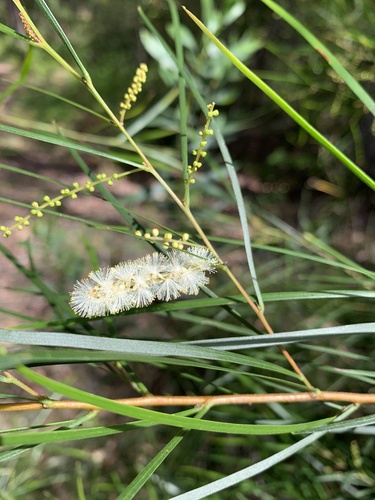
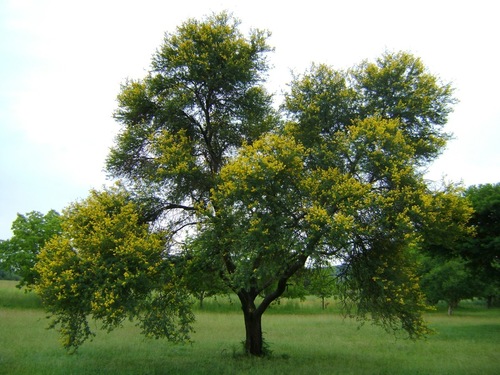
Vachellia karroo (Hayne) Banfi & Galasso can grow as a shrub or a small to medium-sized tree reaching up to 12 meters in height. It has a rounded crown, and it typically begins branching fairly low on its trunk. This species varies in shape and size, and reaches its maximum height of around 12 meters when growing in areas with good water access. Young branches have red bark, which darkens and becomes rough as the tree ages. An attractive reddish colour can sometimes be seen within the deep fissures of mature bark. Its leaves are finely textured and dark green. Abundant yellow flowers bloom in early summer, or after periods of good rainfall. The seed pods are narrow, flat, and crescent-shaped. They are green when young, turning brown and dry as they mature, then split open to release their seeds onto the ground. This tree bears formidable paired thorns, which are greyish to white, long and straight, growing up to 250 mm (ten inches) in length; these are the longest simple thorns of any dicot. Vachellia karroo grows naturally in open woodland and wooded grassland. It reaches its largest size in areas with annual rainfall between 800 and 900 mm, but it is also able to grow and thrive in very dry conditions, such as the Karoo region of western South Africa. It requires deep soils that let its roots spread widely. Across its entire native range, this tree is easily identifiable by its distinctive long white paired thorns and coffee-coloured bark, both of which are considered quite attractive. It shows little physical variation in the tropics, but becomes more variable in appearance at the southern end of its range. This species is widely cultivated in Asia, Australia, the Mediterranean region, India, and the Indian Ocean area. Vachellia karroo is used for chemical products, forage, domestic purposes, environmental management, fibre, food, drink, and wood. Its tough wood ranges from white to slightly yellowish, and rarely develops dark brown heartwood. Its large thorns require careful approach to the tree and careful handling of its branches. Like many acacias, edible gum seeps from cracks in the tree's bark, and this gum forms an important part of the winter diet of bushbabies. The gum can be used to manufacture sweets, similar to gum arabic, and was once economically important under the name "Cape Gum". In dry regions, the presence of Vachellia karroo indicates water, both above and below ground. This species, particularly its bark which can be chewed safely, is used in traditional medicine to treat oral thrush and ulcers. Its roots are also used medicinally: they may be chewed to act as an aphrodisiac, or powdered to treat dizziness. Across other regions of Southern Africa, the gum, bark, and leaves are used as a soothing agent and astringent to treat colds, conjunctivitis, and hemorrhage. Bark and leaves are also used to treat convulsions, stomach problems including nausea, and as a coagulant. Early naturalists used this tree's thorns to pin the insect specimens they collected. Vachellia karroo is very widespread across southern Africa, and different forms grow in some locations, which can make identification confusing. Its native range extends from the Western Cape through Zambia to Angola. In tropical Africa, it is replaced by the related species Vachellia seyal. The genus name Vachellia, originally described under the name Acacia, comes from the Greek word "akis", meaning a point or barb. The specific epithet "karroo" is an older spelling of "karoo", and the spelling cannot be changed due to the rules of botanical nomenclature.