About Ursus thibetanus G
Fur and Facial Markings
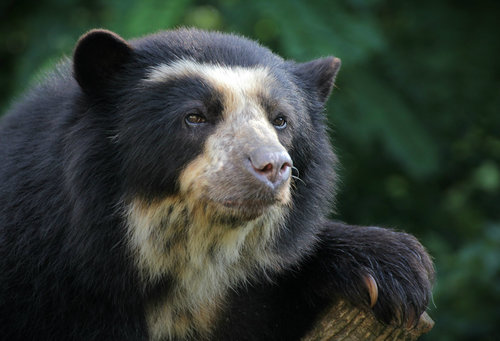
The Asian black bear (scientific name: Ursus thibetanus G) has black fur, a light brown muzzle, and a distinct whitish or creamy chest patch that is sometimes V-shaped. Its ears are bell-shaped, proportionately longer than the ears of other bears, and extend sideways from the head. It has a short tail, around 11 cm (4.3 in) long.
Body Length and Shoulder Height
Adult Asian black bears measure 70–100 cm (28–39 in) at the shoulder, and 120–190 cm (47–75 in) in total body length. Adult males weigh 60–200 kg (130–440 lb), with an average weight of about 135 kg (298 lb). Adult females weigh 40–125 kg (88–276 lb), and large females can reach up to 140 kg (310 lb).
Comparison to Brown Bear
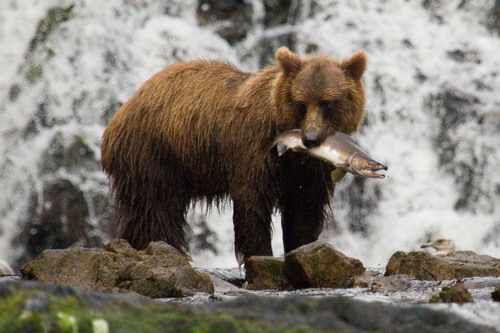
The Asian black bear shares a similar general body build with the brown bear (Ursus arctos), but is lighter and smaller. Its lips and nose are larger and more mobile than those of brown bears.
Skull General Characteristics
The skull of the Asian black bear is relatively small but massive, especially in the lower jaw. Adult male skulls measure 311.7 to 328 mm (12.27 to 12.91 in) in length and 199.5–228 mm (7.85–8.98 in) in width, while female skulls are 291.6–315 mm (11.48–12.40 in) long and 163–173 mm (6.4–6.8 in) wide.
Sagittal Crest Features
Compared to other bears in the genus Ursus, the Asian black bear's skull projections are weakly developed. The sagittal crest is low and short, even in older specimens, and makes up no more than 19–20% of the skull's total length. This differs from the brown bear, where the sagittal crest can make up as much as 41% of the skull's total length.
Jaw and Muscle Structure
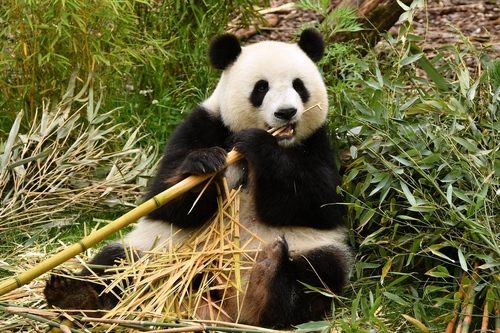
Although the Asian black bear is mostly herbivorous, its jaw structure is not as specialized for eating plants as the giant panda's. Asian black bears have much narrower zygomatic arches, and the weight ratio of the two pterygoid muscles is also much smaller in Asian black bears. The lateral slips of the temporal muscles are thicker and stronger in Asian black bears.
Limb Structure and Bipedalism
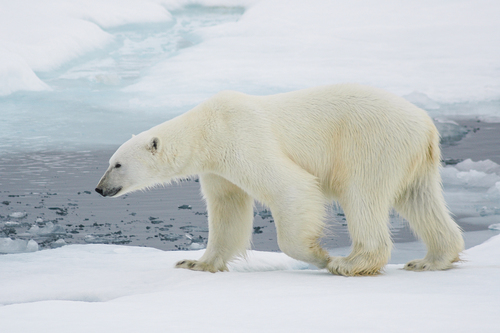
In contrast to the polar bear, the Asian black bear has a powerful upper body built for climbing trees, and relatively weak hind legs that are shorter than those of the brown bear and American black bear. An Asian black bear with broken hind legs can still climb effectively. It is the most bipedal of all bears, and can walk upright for over 400 m (0.25 mi).
Claw Characteristics
The heel pads on the Asian black bear's forefeet are larger than those of most other bear species. Their claws, which are primarily used for climbing and digging, are slightly longer on the fore foot, at 30–45 mm (1.2–1.8 in), than the back foot, at 18–36 mm (0.71–1.42 in). The claws are also larger and more hooked than those of the American black bear.
Size Comparison to Other Bears
On average, adult Asian black bears are slightly smaller than American black bears, though large males can exceed the size of several other bear species. The famed British sportsman known as the "Old Shekarry" wrote that an Asian black bear he shot in India probably weighed no less than 363 kg (800 lb), based on how many people it took to lift its body. The largest confirmed Asian black bear on record allegedly weighed 200 kg (440 lb).
Captive Weight and Senses
Zoo-kept specimens can weigh up to 225 kg (496 lb). Although their senses are more acute than those of brown bears, their eyesight is poor, and their hearing range is moderate, with an upper limit of 30 kHz.
Historical Distribution
During the Middle Pleistocene and early Late Pleistocene, the Asian black bear ranged from the Iberian Peninsula and the Balkans to the Ural Mountains. Today, it occurs very patchily across its former range, from southeastern Iran eastward through Afghanistan and Pakistan, across the Himalayan foothills of India and Myanmar to mainland Southeast Asia, with the exception of Malaysia.
Current Mainland Range
In mainland China, its range is patchy in the northeast and south, including Hainan, and it is absent from much of east-central China. Other separate population clusters exist in Taiwan, the southern Russian Far East, and North Korea. Small remnant populations survive in South Korea, and on the Japanese islands of Honshu and Shikoku.
Habitat Types
The Asian black bear typically inhabits deciduous forests, mixed forests, and thornbrush forests. In the Himalayas, it usually lives at elevations of around 3,500 m (11,480 ft) in the summer, but rarely goes above 3,700 m (12,000 ft). In winter, it descends to elevations below 1,500 m (4,920 ft). In Japan, it also occurs at sea level.
Global Population Estimate Status
There is no definitive global population estimate for the Asian black bear. Japan produced estimates of 8–14,000 bears living on Honshū, though the reliability of this estimate is now doubted. Russian biologists have presented rangewide estimates of 5–6,000 Asian black bears, though their reliability is also unclear.
Japanese Population Trend
According to the Mammal Society of Japan, the introduction of conservation policies by the Ministry of the Environment, alongside a decline in hunters due to an aging population, has led to a significant increase in the population and expansion of the range of the Japanese black bear. Estimates indicate that the population rose from approximately 15,000 individuals in 2012 to around 44,000 in 2023.
South Asian Population Estimates
Rough, uncorroborated density estimates have been made in India and Pakistan, resulting in estimates of 7–9,000 in India and 1,000 in Pakistan. Unsubstantiated estimates from China vary between 15 and 46,000, with an official government estimate of 28,000.
Activity Pattern
Asian black bears are diurnal, though they become nocturnal in areas near human habitations. They walk in processions ordered from largest to smallest individual. They are good climbers of both rocks and trees, and climb to feed, rest, sun, evade enemies, and hibernate.
Arboreal Behavior
Some older bears may become too heavy to climb. Half of an Asian black bear's life is spent in trees, and the species is one of the largest arboreal mammals. In the Ussuri territory of the Russian Far East, Asian black bears can spend up to 15% of their time in trees.
Tree Nest Construction
Asian black bears break branches and twigs to place under themselves when feeding on trees, which leaves many trees in their home ranges with nest-like structures at their tops. Asian black bears rest for short periods in tree nests located fifteen feet or higher above ground.
Hibernation Behavior
Asian black bears do not hibernate across most of their range. They may hibernate in their colder, northern ranges, though some bears simply move to lower elevations instead. Nearly all pregnant female Asian black bears hibernate.
Hibernation Den Characteristics
Asian black bears prepare their hibernation dens in mid-October, and sleep from November until March. Their dens can be hollow trees dug out 60 feet above ground, caves or holes in the ground, hollow logs, or steep, sunny mountain slopes. They may also den in abandoned brown bear dens.
Den Site Selection and Emergence
Asian black bears tend to den at lower elevations and on less steep slopes than brown bears. Female Asian black bears emerge from dens later than males, and females with cubs emerge later than females without cubs.
Home Range Size
Asian black bears tend to be less mobile than brown bears. With enough food, Asian black bears can stay within an area of roughly 1–2 km2 (0.39–0.77 sq mi), and sometimes even as small as 0.5–1 km2 (0.19–0.39 sq mi).
Vocalization Types
Asian black bears have a wide range of vocalizations, including grunts, whines, roars, and slurping sounds often made while feeding. They make what has been described as "an appalling row" when wounded, alarmed, or angry. They emit loud hisses when giving warnings or threats, and scream when fighting.
Social and Courtship Calls
When approaching other bears, they produce "tut tut" sounds, which are thought to be made by snapping the tongue against the roof of the mouth. During courtship, they emit clucking sounds.
Breeding Season Timeline
Within the Sikhote-Alin region, the Asian black bear breeding season occurs earlier than in brown bears, running from mid-June to mid-August. Birth also occurs earlier, in mid-January. By October, the uterine horns of pregnant females grow to 15–22 mm (0.59–0.87 in). By late December, the embryos weigh 75 grams.
Reproductive Maturity and Implantation
Female Asian black bears generally have their first litter at three years of age. Pregnant females generally make up 14% of the total population. Similar to brown bears, Asian black bears have delayed implantation.
Gestation and Newborn Characteristics
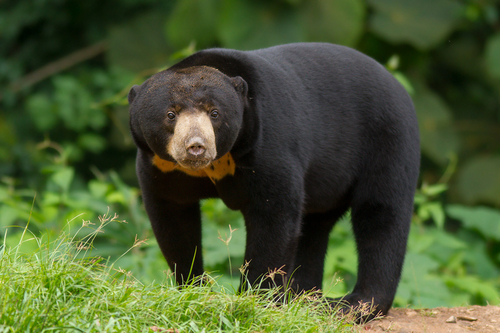
Sows usually give birth in caves or hollow trees in winter or early spring after a gestation period of 200–240 days. Cubs weigh 13 ounces at birth, begin walking at four days old, and open their eyes three days after birth. The skulls of newborn Asian black bear cubs bear a strong resemblance to those of adult sun bears.
Cub Growth and Development
Litters can consist of 1–4 cubs, with 2 being the average. Cubs have a slow growth rate, reaching only 2.5 kg by May. Asian black bear cubs nurse for 104–130 weeks, and become independent at 24–36 months.
Reproductive Interval and Lifespan
There is usually a 2–3 year interval before females produce their next litter. The average lifespan of an Asian black bear in the wild is 25 years, while the oldest Asian black bear in captivity died at 44 years of age.