About Helarctos malayanus (Raffles, 1822)
Etymology
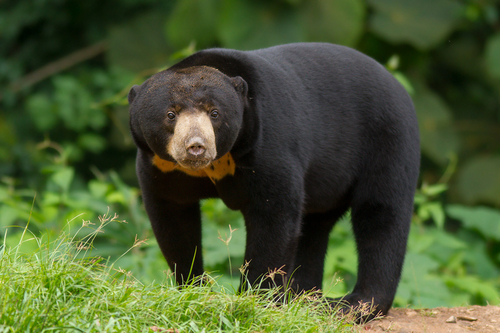
The sun bear (Helarctos malayanus (Raffles, 1822)) gets its common name from its distinctive orange to cream-coloured, crescent-shaped chest patch.
General Morphology
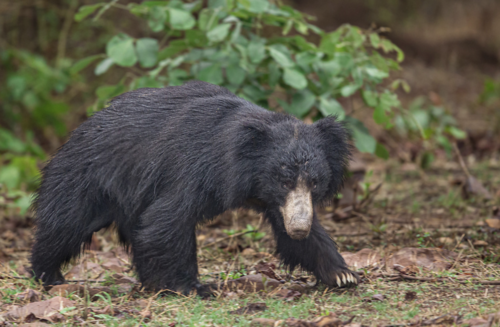
It is the smallest species of bear, with a stocky build, large paws, strongly curved claws, small rounded ears, and a short snout.
Body Size
Its head-and-body length ranges from 100 to 140 cm (39 to 55 in), and shoulder height reaches nearly 70 cm (28 in).
Sexual Dimorphism and Weight
Adult males are roughly 10 to 20% larger than females, and adults weigh between 25 and 65 kg (55 to 143 lb).
General Coloration
The snout can be grey, silver, or orange; fur is typically jet black, but may range from grey to red.
Fur Characteristics
Its fur is silky, fine, and the shortest of any bear species, an adaptation to its hot tropical habitat.
Chest Patch Appearance
The characteristic chest patch is most often U-shaped, but may also be circular or spot-like, and ranges in colour from orange or ochre-yellow to buff, cream, or even pure white.
Chest Patch Variation
Some individual sun bears do not have this patch at all.
Threat Display Behavior
When threatened, sun bears can stand on their hind legs to display the chest patch as an intimidation display toward enemies.
Juvenile Coloration
Infant sun bears are greyish black with a pale brown or white snout, and their chest patch is dirty white; older juveniles may have dark brown coats.
Adult Fur Structure
In adults, the underfur is particularly thick and black, while the longer guard hairs are lighter.
Shoulder Hair Patterns
Two hair whorls sit on the shoulders, from which hair radiates outward in all directions.
Neck and Chest Hair Patterns
There is a crest along the sides of the neck, and an additional whorl in the centre of the breast patch.
Paw Adaptations
The edges of the paws are tan or brown, and the soles have no fur, which is likely an adaptation for climbing trees.
Claw Morphology
Claws are sickle-shaped, and the front claws are long and heavy.
Tail Length
The tail is 3 to 7 cm (1.2 to 2.8 in) long.
Sympatric Similar Species
The sympatric Asian black bear has similarly shaped cream-coloured chest markings, but differs in its claw markings.
Feeding Adaptations
When feeding, the sun bear can extend its exceptionally long tongue to collect insects and honey.
Dentition and Bite Force
Its teeth, particularly the canines, are very large, and its bite force quotient is high relative to its body size, for reasons that are not well understood.
Bite Force Functional Hypothesis
One possible explanation is that this trait helps it frequently open tropical hardwood trees with its powerful jaws and claws to access insects, larvae, or honey.
Bite Force Measurement
For its body size, its bite force is very strong: a 50 kg (110 lb) sun bear produces a maximum bite force of 1907.3 to 2020.6 Newtons on the rear molar.
Head Morphology
The head is large, broad, and heavy in proportion to the body, while the ears are proportionately smaller, and the palate is wide in relation to the skull.
Climbing Adaptations
A number of unique anatomical traits, including inward-turned front feet, a flattened chest, and powerful forelimbs with large claws, all indicate adaptations for extensive climbing.
Subspecies Taxonomic Status
Currently, the status of sun bear subspecies is unsettled.
Synonym History
H. annamiticus, described from Annam in 1901, is not recognised as a distinct species and is treated as a junior synonym of H. m. malayanus.
Proposed Subspecies Rejection
In 1906, Richard Lydekker named the subspecies H. m. wardii for a sun bear skull, noting similarities to a purported Tibetan specimen with a thicker coat, but this Tibetan specimen was later confirmed to be an Asian black bear (Ursus thibetanus).
Monotypy Argument
Genetic differences between the two proposed subspecies are unclear, so some researchers consider the entire species monotypic.
Native Range
The sun bear is native to the tropical forests of Southeast Asia.
Range Boundaries
Its range is bounded by northeastern India to the north, and extends south through Bangladesh, Myanmar, Thailand, Cambodia, Laos, and Vietnam, all the way to Brunei, Indonesia, and Malaysia.
China Distribution Record
Its presence in China was only confirmed in 2017, when individuals were sighted in Yingjiang County, Yunnan Province.
Local Extirpation
The species is currently extinct in Singapore.
General Habitat Types
Throughout its range, sun bears primarily inhabit two main forest types: deciduous and seasonally evergreen forests north of the Isthmus of Kra, and non-seasonal evergreen forests in Indonesia and Malaysia.
Altitude Preference
They are typically found at low altitudes, for example below 1,200 m (3,900 ft) in western Thailand and Peninsular Malaysia, but elevation preferences vary across their range.
Indian Altitude Records
In India, larger populations have been recorded at elevations up to 3,000 m (9,800 ft) than in low-lying areas, most likely due to lowland habitat loss.
Northern Range Limitation
They occur in montane areas of northeast India, but do not extend farther north into the colder, unfavourable Himalayan region; their distribution is restricted to the northwest in part due to competition with sloth bears.
Mainland Sympatry
Across the remaining mainland range, which includes mixed seasonal forest types with monthly rainfall below 100 mm (3.9 in) for 3 to 7 months each year, the sun bear is sympatric with the Asian black bear.
Elevational Niche Partitioning
In mountainous areas, Asian black bears are more common than sun bears, probably because of a scarcity of the invertebrates that sun bears feed on.
Southern Habitat Types
In southern Thailand and Peninsular Malaysia, the main habitats are moist evergreen forests with a relatively stable climate and heavy rainfall year-round, alongside low-lying or montane dipterocarp forests.
Mangrove Habitat Use
Sun bears may inhabit mangroves, but only when mangroves are located close to their preferred habitat types.
Anthropogenic Habitat Use
Sun bears generally avoid heavily logged forests and areas close to human settlement, though they have been observed in farmlands, plantations, and orchards, where they are sometimes considered pests.
Plantation Crop Damage
A survey in Lower Kinabatangan Segama Wetlands found that while sun bears were feared in oil palm plantations, they were not common there; Bornean bearded pigs, elephants, and macaques cause far more crop damage.
Livestock Predation
Sun bears have been reported preying on poultry and livestock.
Pleistocene Fossil Range
Fossil evidence shows that sun bears occurred farther north during the Pleistocene, and may have ranged as far south as Java during the middle to Late Pleistocene.
Pleistocene Fossil Fauna
Middle Pleistocene sun bear fossils have been found in Thailand alongside Stegodon, gaur, wild water buffalo, and other living and extinct mammals.
Contemporary Population Trend
Today, the sun bear is locally extinct across most of its former range, especially in Thailand, and populations are declining in nearly all range countries.
Singapore Extinction Cause
It disappeared from Singapore between the 1800s and 1900s, likely due to extensive deforestation.
Range Population Gradient
Sun bear population sizes tend to decrease moving northward from Sundaland, and numbers are particularly low at the northern and western edges of the current range.
Gradient Origin
This pattern may have existed since prehistoric times, and is not solely a result of human activity.
Population Density
Population density varies across the species' range, from 4.3 to 5.9 individuals per km² (11 to 15 individuals per sq mi) in Khao Yai National Park to 26 individuals per km² (67 individuals per sq mi) in the Harapan Rainforest in southern Sumatra.
Arboreal Lifestyle
Of all bear species, the sun bear has the most arboreal lifestyle.
Climbing and Resting Habits
It is an excellent climber, and often sunbathes or sleeps in trees 2 to 7 m (6 ft 7 in to 23 ft 0 in) above the ground.
Resting Site Types
Its resting sites are most commonly fallen hollow logs, but it also rests in cavities of standing trees, in cavities under fallen logs or tree roots, and on high tree branches.
Swimming Ability
It is also an efficient swimmer.
Social Structure
Sun bears are generally solitary, though pairs (most often mothers and cubs) are sometimes seen together.
Sensory and Threat Behavior
Sun bears stand on their hind legs to get a wider view of their surroundings or detect distant scents; when threatened, they attempt to intimidate enemies by displaying their chest patch.
Vocalisations
Vocalisations produced by sun bears include grunts and snuffles while foraging for insects, and roars similar to those of male orangutans during the breeding season.
Alarm Vocalisation
Less commonly, sun bears give short barks when surprised.
Hibernation Absence
Sun bears do not hibernate, most likely because food resources are available year-round across their range.
Activity Pattern
They are primarily active during the day, though they are more often nocturnal in areas frequently visited by humans.
Cognitive Ability
Sun bears are noted for their intelligence: one captive individual observed sugar being stored in a cupboard locked with a key, and later used its claw to open the lock.
Facial Mimicry Ability
A 2019 study documented that sun bears can skillfully mimic the facial expressions of other sun bears, with a level of precision comparable to that seen in gorillas and humans.
Home Range Size
Sun bear home ranges vary in size across different areas.
Specific Home Range Measurements
In Borneo and Peninsular Malaysia, they range from 7 to 27 km² (2.7 to 10.4 sq mi), while in Ulu Segama Forest Reserve in Sabah they range from 8.7 to 20.9 km² (3.4 to 8.1 sq mi).
Predators
Tigers are the main predator of sun bears; dholes and leopards have also been recorded preying on sun bears, but such cases are relatively rare.
Predator Interaction Record
In one recorded incident, a prolonged fight between a tiger and a sun bear resulted in the death of both animals.
Python Predation Record
In another incident, a large reticulated python in East Kalimantan swallowed a wild female sun bear.
Human Interaction
Sun bears usually do not attack humans unless they are provoked, injured, or guarding cubs; their timid nature meant they were often tamed and kept as pets in the past, though they can act fiercely if surprised in the forest.
Reproductive Cycle
Sun bears are polyoestrous, and births can occur throughout the year.
Oestrus Duration
Oestrus lasts five to seven days.
Sexual Maturity Age
Sun bears reach sexual maturity between two and four years of age.
Gestation Period
Reported gestation lengths range from 95 to 240 days; pregnancies tend to be longer for zoo-kept sun bears in temperate climates, possibly due to delayed implantation or fertilisation.
Birthing Site
Births take place inside hollow tree cavities.
Litter Characteristics
A litter typically has one or two cubs, each weighing around 325 g (11.5 oz).
Neonatal Traits
Cubs are born deaf, with their eyes closed.
Cub Development Milestones
Their eyes open at around 25 days old, but they remain blind until 50 days after birth, and their sense of hearing improves over the first 50 days.
Cub Physiological Dependency
Cubs younger than two months old rely on external stimulation to defecate.
Cub Rearing Site
Cubs are kept on buttress roots at the base of trees until they learn to walk and climb properly.
Maternal Care
Mothers protect their cubs aggressively.
Offspring Dependency Period
Offspring stay with their mother for roughly the first three years of their lives.
Lifespan
In captivity, sun bears generally live for more than 20 years; one individual lived to 34 years of age.