About Glaucomys sabrinus (Shaw, 1801)
Scientific Nomenclature
This species, the northern flying squirrel, is scientifically known as Glaucomys sabrinus (Shaw, 1801).
Activity and Lifestyle
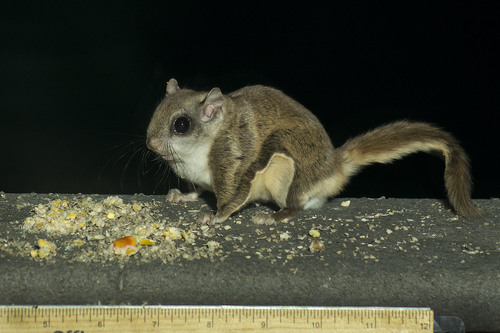
These are nocturnal, arboreal rodents.
Pelage Coloration
They have thick light brown or cinnamon fur on their upper body, greyish fur on the flanks, and whitish fur on their underside.
Morphological Features
They have large eyes, a flat tail, and long whiskers, a trait common to many nocturnal mammals.
Size and Weight
Adult northern flying squirrels measure 25 to 37 cm in total length, and weigh between 110 and 230 grams.
Primary Habitat Type
The northern flying squirrel inhabits coniferous and mixed coniferous forests across the northern part of North America.
Species Range
Its range extends from Alaska to Nova Scotia, south to the mountains of North Carolina and Tennessee, and west to Utah.
Cryptic Species Distinction
Humboldt's flying squirrel was formerly considered the same species as G. sabrinus, but it is now recognized as a distinct cryptic species.
Humboldt's Flying Squirrel Traits
Humboldt's flying squirrel is generally smaller and darker than the northern flying squirrel, and occurs in British Columbia, northern California, Washington, and Oregon.
Southern Appalachian Subspecies
Two subspecies of G. sabrinus live in the southern Appalachians: the Carolina northern flying squirrel, G. s. coloratus, and the West Virginia northern flying squirrel, G. s. fuscus.
Initial Endangered Classification
Both subspecies were originally classified as endangered.
West Virginia Subspecies Delisting
The West Virginia subspecies recovered enough to be delisted in August 2008.
Temporary Protection Restoration
In response to a court order, the U.S. Fish and Wildlife Service temporarily restored protections for the West Virginia northern flying squirrel on June 6, 2011.
Delisting Reinstatement
Following an appeal, the delisting was reinstated in March 2013.
San Bernardino Subspecies Distribution
Another subspecies, G. s. californicus, the San Bernardino flying squirrel, is found in the San Bernardino National Forest in California.
Endangered Listing Petition
In 2010, the Center for Biological Diversity petitioned the U.S. Fish and Wildlife Service to list the San Bernardino flying squirrel as an endangered species, but the request was ultimately denied.
USFWS Listing Denial Rationale
The U.S. Fish and Wildlife Service stated that a thorough status review using the best available science found the squirrel is abundant within its range, and that threats from habitat loss due to urban development, habitat fragmentation, wildfire, urban air pollution, and climate change do not pose significant threats to its long-term survival.
Center for Biological Diversity Counterargument
The Center for Biological Diversity argues that rising temperatures are reducing the San Bernardino flying squirrel's forest habitat, negatively affecting the availability of the truffles it feeds on, and that urban development also impacts the subspecies' range.