About Umbra pygmaea (DeKay, 1842)
Appearance
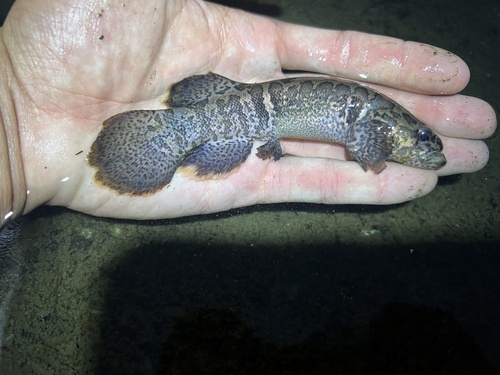
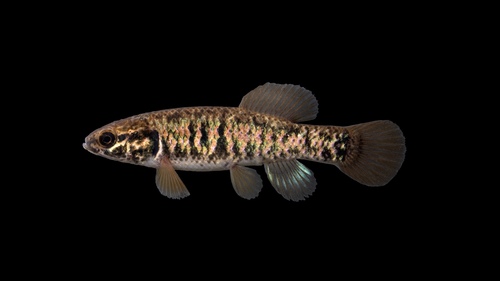
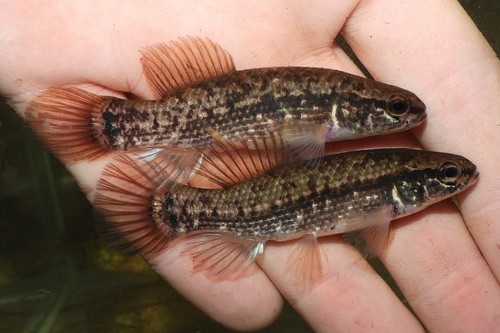
Umbra pygmaea, commonly known as the eastern mudminnow, is an elongated, stout-bodied fish. Its base color is brown or yellow-green, marked with around 10 or more dark, narrow lateral stripes separated by pale gaps, and it has no lateral line. The pelvic fin is positioned further back on the body, sitting below the dorsal fin.
Size
The species reaches a maximum total length of 15 cm (5.9 in).
Native Range
The native range of the eastern mudminnow extends along the Atlantic coast of North America from New York to Florida, reaching westward to Georgia. It has been introduced to Europe, where established populations occur in France, Belgium, Germany, the Netherlands, Denmark, and Poland.
Habitat and Tolerance
It typically inhabits still or slow-moving waters, most often in areas with dense aquatic vegetation, including heavily vegetated streams, swamps, and ponds. This species shows high adaptability to harsh habitats with low pH, extreme water temperatures, and low dissolved oxygen levels. At least one documented record exists of an eastern mudminnow surviving a full night out of water. In natural environments, it can be found in waters with pH ranging from 3.5 to 8.1, and its optimal growth occurs at pH 4.5 – a condition that is often harmful or fatal to most other fish species.
Reproductive Behavior
Eastern mudminnows display relatively complex reproductive behaviors. Males perform courtship displays, during which they quiver their bodies and display their fins.
Nesting
Both sexes participate in nest building; nests are located in algal cavities, under loose rocks, and in sand depressions. Females guard the nests, and males may also guard them.