About Trollius laxus subsp. albiflorus (A.Gray) Á.Löve, D.Löve & B.M.Kapoor
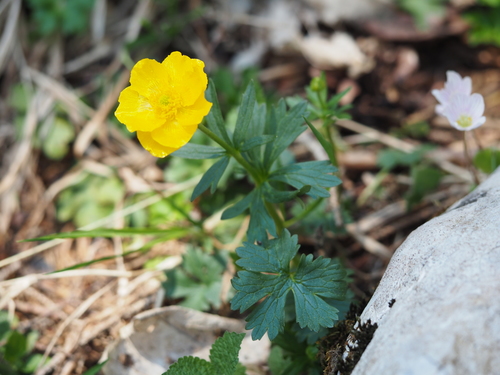
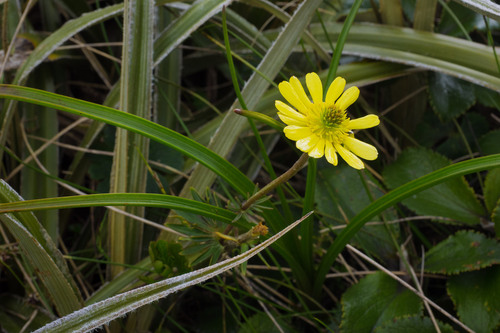
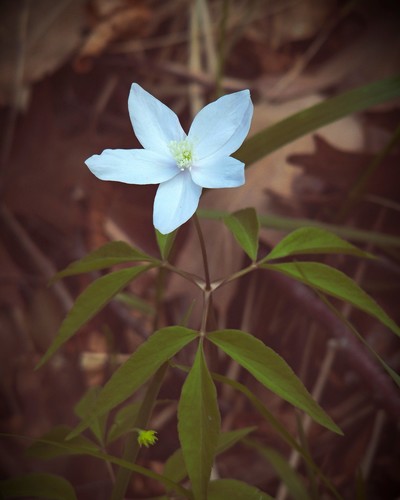
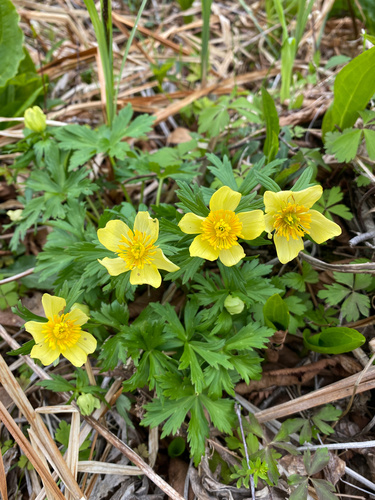
This herbaceous perennial flowering plant, Trollius laxus subsp. albiflorus, is easily identifiable by botanists when in bloom thanks to its showy, bright, globular flowers. When flowers are not present, other morphological traits can be used for identification. It has thick, fibrous roots and basal leaves. Plants produce one or more stems that grow 1 to 2 feet tall; each stem bears a single cream or pale yellow flower up to 5 cm in diameter, with 5 to 7 petal-like sepals. The true petals of this plant are reduced to staminodes that have basal nectar glands. Each leaf is made up of five three-lobed leaflets that spread horizontally from the tip of the petiole, and each leaflet has sharply toothed margins. All leaves grow from petioles that emerge at the base of the plant. Trollius laxus is a rare herbaceous perennial with a restricted range. It grows in small patches of groundwater-fed fens or other wetland habitats in the northeastern United States, where it can be locally abundant within calcium-rich fens. It is also found in Oregon, Washington, British Columbia, and the Rocky Mountains of Colorado. In the Rocky Mountains, it is one of the first species to flower in spring. The plant’s distribution is limited by both light intensity and hydrology. Wetlands and marshes have consistent groundwater discharge, leading to typically high water levels. This causes anoxia and ultimately reduces available nutrient levels. It is thought that T. laxus evolved to tolerate these low-nutrient conditions in order to face less competition for sunlight. Although T. laxus prefers wetter sites, it can also grow in drier conditions if sufficient sunlight is available. Higher sunlight increases plant biomass, but past a certain threshold growth plateaus or even declines. A combination of seasonal drying and very high light intensities can lead to competitive exclusion of T. laxus. To meet its specific requirements for light intensity and hydrology, T. laxus can only occupy a limited geographic range, which is one factor contributing to its restricted distribution. T. laxus grows predominantly in forested wetlands fed by cold alkaline groundwater. It is one of the first plants to flower each spring, blooming from mid-April to early May in Connecticut. Seeds ripen by mid-June and are dispersed passively by wind and water. It has few effective pollinators, which include sweat bees, cuckoo bees, and a fly species in the family Tachinidae. Molluscan herbivores such as slugs and snails cause leaf damage that impacts overall local plant community diversity; slug predation on T. laxus also reduces its seedling survival. Competition from neighboring plants and predation from herbivores both negatively affect T. laxus. Removing neighboring plants reduces predation risk for T. laxus and increases its growth and reproductive success. T. laxus may also grow in forested wetlands, and appears to be well-adapted to growing under closed forest canopies. Field observations confirm that both light availability and groundwater levels influence the growth and population vigor of T. laxus, and that the plant’s distribution may also be limited by competition with other plant species.