About Trioceros melleri (Gray, 1865)
Common Name and Endemic Status
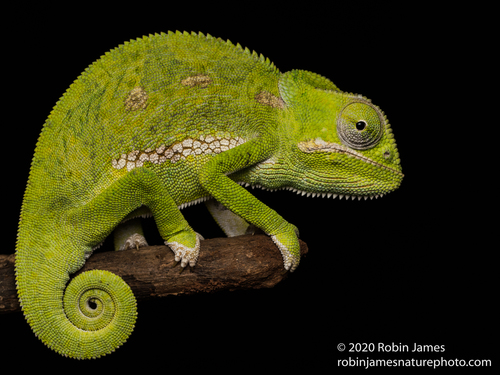
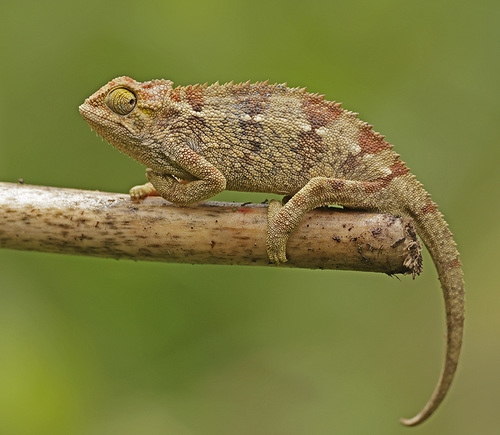
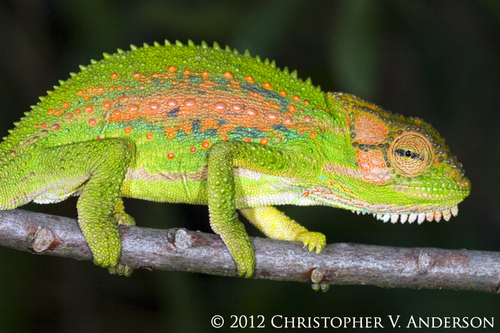
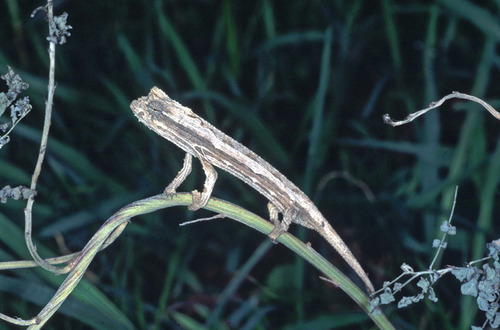
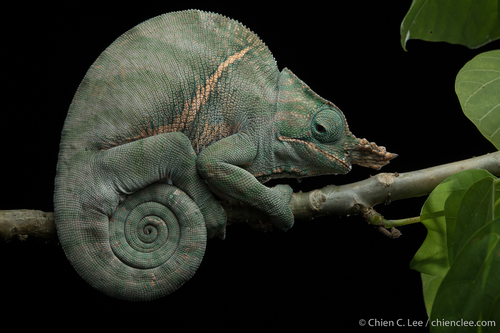
Trioceros melleri (Gray, 1865), commonly known as Meller's chameleon, is the largest chameleon species native to the African mainland.
Typical Adult Size and Weight
Adult individuals generally reach a total length of 30–61 cm (12–24 in, including the tail) and weigh between 300–500 g (11–18 oz), while exceptionally large specimens have been reported to reach up to 76 cm (30 in) in length and 600 g (21 oz) in weight.
Sexual Dimorphism in Size and Crests
Females are typically smaller than males, and have less developed dorsal and medial crests.
Head Shape Relative to Congeners
Compared to other species in the genus Trioceros, this species has a relatively small head that is elongated in shape, relative to its body.
Body and Tail Proportions
T. melleri has a stout body, and a relatively stubby tail that measures one third the length of its body.
Dorsal Crest Structure
A low, scalloped crest extends from just behind the head's casque through the proximal half of the tail.
Snout and Medial Crest Features
A sharp medial crest runs from the lizard's eyes to the tip of its snout, which bears a single small horn.
Occipital Lobe Characteristics
This species also has greatly enlarged occipital lobes.
General Scale Morphology
Its scales are heterogeneous, with differing shapes and sizes across different parts of the body, and large granular scales are distributed evenly across the trunk and limbs.
Distinctive Gular Region Scales
One of the species' most distinctive characteristics is the presence of longitudinal rows of large, granular scales in its gular region.
Flank Marking Color Variation
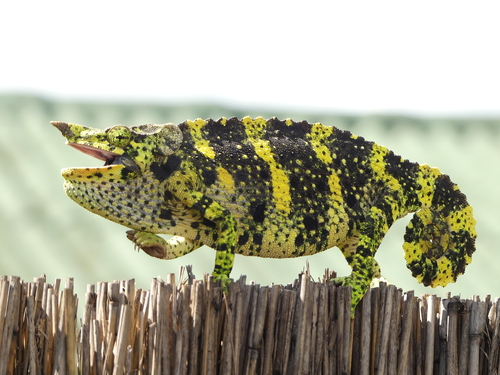
The spots and broad vertical bands on the chameleon's flanks can be brown, dark green, yellow, or even black.
Base Coloration and Color Change Ability
The species' base coloration is deep forest green with white stripes, but like most chameleons, it can change its color based on different circumstances.
Color Change During Handling or Feeding
When fed or handled, it may display black and white dots.
Color Change During Basking
When basking in the sun, the side of its body facing the sunlight can turn dark green or black, while the rest of the body remains much lighter.
Stress-Linked Color Patterns
Meller's chameleon exhibits specific color patterns linked to stress: mild excitement or stress shows as dark spotting over the chameleon's normal color, these dark green spots become black mottling as stress increases, and severe stress turns the chameleon first charcoal gray, then pure white with yellow stripes.
Coloration of Sick Individuals
A sick Meller's chameleon may be mottled with brown, gray, pink, or white.
Gravid Female Coloration
Gravid females are black, cream, and gray in color, with a visibly bulging body from holding eggs.
Prey Capture Tongue Range
Its long tongue can capture prey up to 51 cm (20 inches) away.
Habitat and Geographic Distribution
Trioceros melleri is relatively common in bushy savannas and woodlands across East Africa, and can be found in Malawi, northern Mozambique, and Tanzania.
Diet and Feeding Habits
Like most chameleons, Meller's chameleon is an obligate carnivore that feeds on insects, smaller lizards, spiders, crickets, worms, and caterpillars; large specimens have been recorded eating small birds.
Annual Clutch Size
Females produce a single clutch of up to 80 eggs each year.
Newborn Size
Newborn Meller's chameleons measure approximately 10 cm (4 inches) in length.
Captive Newborn Diet
In captivity, newborns must be fed Drosophilidae and tiny crickets for the first three weeks of life, after which they will accept house flies and larger insect prey including crickets, locusts, silkworms, and cockroaches.
Lifespan
This species can live up to twelve years.