About Furcifer balteatus (Duméril & Bibron, 1851)
Coloration
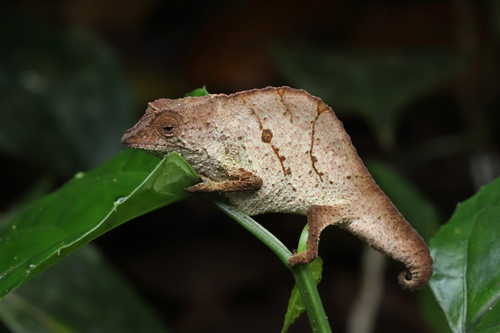
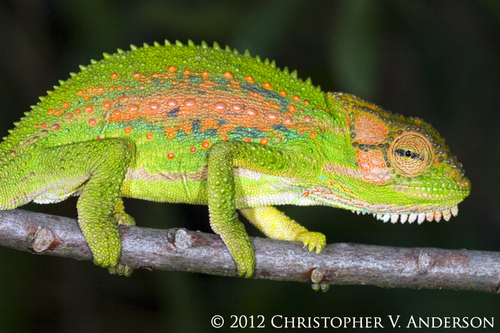
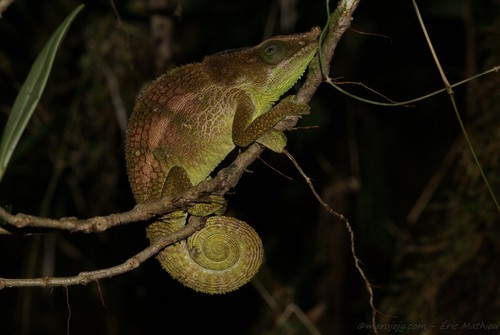
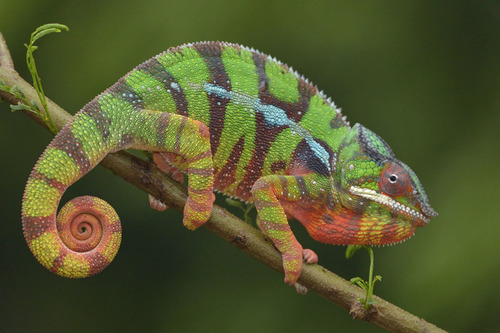
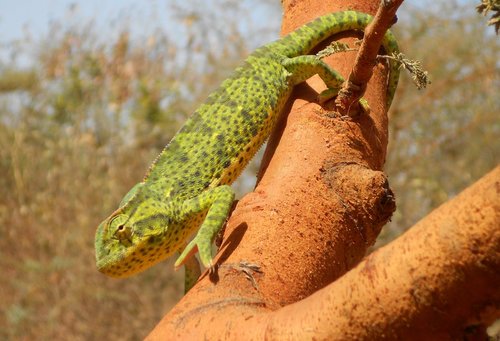
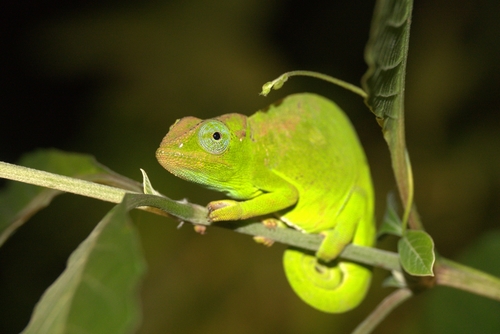
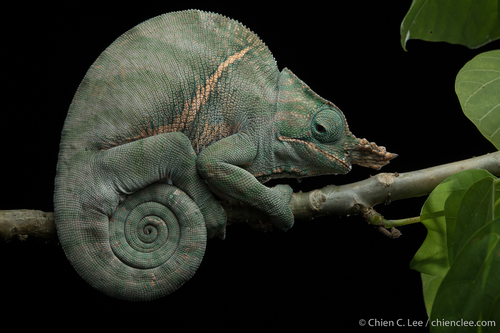
Though Furcifer balteatus is basically green, its colour can vary widely, and this colouration provides good camouflage in its arboreal habitat. It often has darker green diagonal stripes, with paler bands between these stripes, and usually has a distinct buff-coloured diagonal streak.
Size
Its body can reach up to 24 cm (9 in) in length, and the tail is at least as long as the body. Males have a pair of 1.5 cm (0.6 in) long horny projections on their heads.
Common Names
This species is commonly known as the two-banded chameleon or the rainforest chameleon.
Endemic Range
Furcifer balteatus is endemic to southeast Madagascar.
Habitat Climate
It occurs in Ranomafana, where the average temperature ranges between 14 and 20 degrees Celsius (57 and 68 degrees Fahrenheit), and annual rainfall is roughly 4,000 millimetres (160 inches).
Distribution
The total area it occupies is estimated at 1,971 square kilometres (761 square miles), and it has a patchy distribution.
Population Trend
The International Union for Conservation of Nature has recorded that this species' population is decreasing.
Elevation Range
Most sightings of Furcifer balteatus are from elevations between 800 and 1,050 metres (2,620 and 3,440 ft) above sea level, though some individuals have been found at lower altitudes.
Species Rarity
This is a rare species, and most sightings have been of single individuals.
Conservation Status
Some surveys have not found any members of the species, and the IUCN has ranked it as Endangered.
Habitat Threat
The main threat to this species is the degradation of its forest habitat.
Trade Regulation
Furcifer balteatus is a CITES-listed species, and exports from Madagascar have been banned since 1994.
Illegal Trade Threat
Even with this ban, the species is considered highly desirable in the pet trade, and illegal exports remain an additional threat.