About Trifolium pratense L.
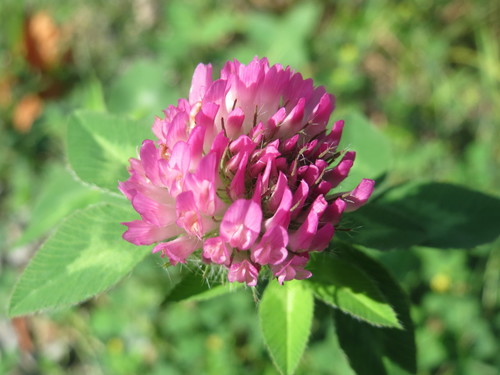
Trifolium pratense L., commonly known as red clover, is a herbaceous, short-lived perennial plant that varies in size, growing 20–80 cm (8–31 in) tall. It has a deep taproot that gives it drought tolerance and creates a good soil structuring effect. Its leaves are alternate and trifoliate, meaning they have three leaflets. Each leaflet is 15–30 mm (5⁄8–1+1⁄8 in) long and 8–15 mm (3⁄8–5⁄8 in) broad, and is green with a characteristic pale crescent in the outer half of the leaf. The petiole is 1–4 cm (1⁄2–1+1⁄2 in) long, with two basal stipules that narrow abruptly to a bristle-like point. Red clover produces dark pink flowers with paler bases, each 12–15 mm (1⁄2–5⁄8 in) long, clustered in a dense inflorescence. Bumblebees are the most common visitors to these flowers. Red clover is native to Europe, Western Asia, and northwest Africa, but has become naturalised on other continents including North America and South America. It was brought to Argentina and Chile over 100 years ago, though the exact details of its introduction are unclear. It has also been introduced to New Zealand. Bombus ruderatus, the large garden bumblebee, is an important pollinator of red clover that was also brought from Europe to South America and New Zealand. Red clover can be affected by bacterial and fungal diseases, including clover rot and red clover rust (Uromyces trifolii-repentis var. fallens). Additional issues for the species include parasitic nematodes (roundworms) and viruses. As a perennial, red clover provides consistent sustained growth. Its ability to fix nitrogen supports protein-rich growth, which in turn supports a wide range of wildlife including deer, turkeys, and rabbits. Red clover is widely grown as a fodder crop, valued for its nitrogen fixation that increases soil fertility, so it is also used as a green manure crop. Several cultivar groups have been selected for agricultural use, most of which are derived from T. pratense var. sativum. It has escaped cultivation and become naturalised in many temperate areas, including the Americas and Australasia. In Chile, red clover has become increasingly important for economic stability, making pollinator demand even higher. In India, the highest producer of red clover seed is the Fodder Seed Production Station Aru, run by the Agriculture Department of Kashmir. In 2019, the Indian Council of Agricultural Research deposited two red clover accessions in the National Gene Bank of India. Red clover is also grown as an ornamental plant. Its flowers and leaves are edible, and can be added as garnishes to any dish, or ground into flour. The flowers are often used to make jelly and tisanes, and are included in essiac recipes. Essential oil can be extracted from red clover flowers, and its unique scent is used in aromatherapy. The high visibility of the plant's pink flowers helps attract pollinators and wildlife, so conservation and wildlife remediation teams may use red clover when building wildlife bridges to connect fragmented habitats. In traditional Indian medicine, Trifolium pratense is believed to act as a deobstruent, antispasmodic, expectorant, sedative, anti-inflammatory, and antidermatosis agent. In alternative medicine, red clover is promoted as a treatment for a range of human health issues, including menopause symptoms, coughs, lymphatic system disorders, and various cancers. There is some evidence that red clover may reduce the frequency of hot flushes in menopausal women. There is no good quality evidence that red clover provides any benefit for preventing or treating cancer or any other disease. Because it contains coumarin derivatives, Trifolium pratense should be used with caution by people with coagulation disorders or people currently undergoing anticoagulation therapy. It is metabolised by the CYP3A4 pathway, so caution is needed when taking it alongside other drugs that use this same metabolic pathway.