About Trifolium aureum Pollich
Nomenclature and Taxonomy
Trifolium aureum Pollich, commonly called large hop trefoil, large trefoil, large hop clover, golden clover, or hop clover, is a species of flowering plant native to much of Eurasia.
Growth Form and Size
Large hop trefoil is a small erect herbaceous biennial plant that grows to 10–30 cm (4–12 in) tall.
Leaf Structure
Like all clovers, its leaves are divided into three sessile leaflets; each leaflet is 15–25 mm (0.6–1.0 in) long and 6–9 mm broad.
Inflorescence Characteristics
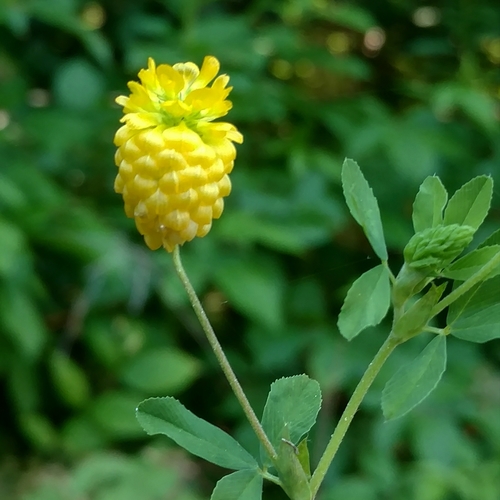
Its yellow flowers are arranged in small, elongated round inflorescences 12–20 mm in diameter, located at the end of the stem.
Flower Texture and Aging
Each individual flower is decumbent, and as the flowers age, they turn brown and take on a paper-like texture.
Fruit and Seed Features
The fruit is a pod that usually contains two seeds.
Similar Species Distinction
The closely related Trifolium campestre (hop trefoil) is a similar species, but it is shorter, has a spreading growth habit, and bears smaller leaves and flowers.
Leaflet Morphology Difference
Its middle leaflet also grows on a short rachis.
Native Eurasian Distribution
Trifolium aureum is native across most of Europe (it only occurs in northeast Spain), western and northern Asia, and the Middle East, including Ciscaucasia, western Siberia, Armenia, Azerbaijan, Georgia, northern Iran, Lebanon, and Turkey.
Additional Native Range
It is also native to the Canary Islands.
North American Naturalization
This species is widely naturalized in North America.
United States Distribution
It was first introduced to the United States via Pennsylvania in 1800, and now occurs in the western (as far north as Alaska) and eastern regions of the country, but is not found in the central U.S. and is rare in most southern states.
Canadian Distribution
In Canada, it is now found in all southerly provinces, with the possible exception of Manitoba.
Habitat Preferences
This plant is very common and grows well on poor, undisturbed ground.
Forage Use
While it likely has good nutritive value, perennial clover species are preferred for use as forage.