About Acacia binervia (J.C.Wendl.) J.F.Macbr.
Common Name and Growth Form
Acacia binervia, commonly known as coast myall, grows as an erect tree or spreading shrub, typically reaching up to 16 m (52 ft) in height.
Bark Characteristics
It has flaky, furrowed bark that ranges in color from dark brown to grey.
Branchlet and Phyllode Shape
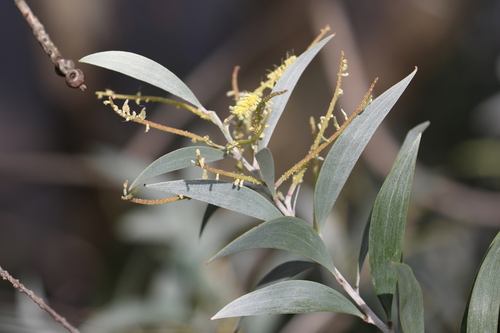
Its branchlets are flattened or angled at their tips, and its phyllodes are narrowly elliptic to sickle-shaped, measuring 60–150 mm (2.4–5.9 in) long and 5–23 mm (0.20–0.91 in) wide.
Phyllode Veins and Hairs
The phyllodes are prominently veined, and are usually densely covered in flattened whitish grey hairs that lie against the leaf surface.
Flower Color and Head Shape
The plant’s flowers are pale to bright yellow, and are held in rod-shaped flower heads 20–60 mm (0.79–2.36 in) long.
Raceme Structure
Up to five of these heads are arranged in a raceme that grows from leaf axils, with the raceme measuring 1–10 mm (0.039–0.394 in) long.
Peduncle Length
Each flower head sits on a peduncle that grows up to 5 mm (0.20 in) long.
Flowering Period and Seed Pod
Flowering occurs in spring, and after flowering the plant produces a linear seed pod that is 20–85 mm (0.79–3.35 in) long and 3–5 mm (0.12–0.20 in) wide.
Overall Distribution
This species is distributed from the Hunter Region of central New South Wales, south to Bungonia in the southwest of the state, and continues south into Victoria.
Victorian Population
There is a single recorded population of Acacia binervia near the upper Snowy River in Victoria.
Sydney Basin Soil Habitat
Within the Sydney basin, it grows on a range of well-drained soil types, including alluvial soils, and soils derived from sandstone, shale, or trachyte.
Plant Community Types
It occurs in multiple plant community types: dry sclerophyll forest, open woodland, and riparian (riverbank) forest.
Dry Sclerophyll Forest Associates
In dry sclerophyll forest, it grows alongside species such as yellow bloodwood (Corymbia eximia), grey gum (Eucalyptus punctata), narrow-leaved ironbark (Eucalyptus crebra), and mugga ironbark (Eucalyptus sideroxylon).
Open Woodland Associates
In open woodland, it associates with narrow-leaved ironbark and black cypress pine (Callitris endlicheri).
Riparian Forest Associates
In riparian forest, it grows with river peppermint (Eucalyptus elata) and gossamer wattle (Acacia floribunda).
Bushfire Regeneration
Ecologically, Acacia binervia regenerates after bushfire from a soil-stored seedbank: adult plants are killed by fire, after which seeds germinate and grow into new plants.
Fire Return Interval Requirement
A fire return interval of 10 to 50 years is required for this species’ population cycle to persist.
Toxicity to Livestock
Foliage (phyllodes) of Acacia binervia contain prussic acid, and the plant is reportedly toxic to grazing livestock.
Honey Industry Use
It is also useful to bees in the commercial honey industry.