About Trifolium arvense L.
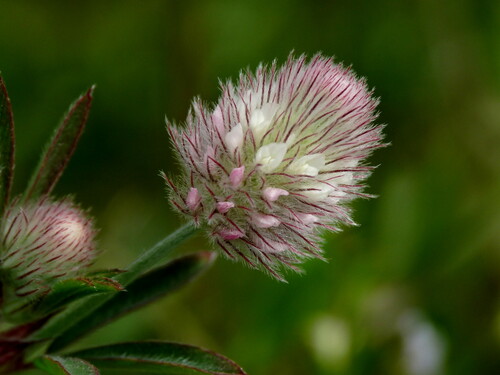
Trifolium arvense L. is a small erect herbaceous annual or biennial plant, growing 10–40 cm tall. Like all clovers, it has trifoliate leaves, divided into three slender, sessile leaflets that are 1–2 cm long and 3–5 mm broad. Leaflets sometimes bear small hairs and have finely serrated edges. Each leaf has a pair of stipules at its base, often tipped red. Flowers are grouped in a dense inflorescence 2–3 cm long and 1–1.5 cm broad. Each individual flower is 4–5 mm long, rosy white, and most noticeably characterized by many silky white hairs that tip the five sepals, which are much larger than the petals. These hairs, along with the roughly oblong shape of the inflorescence, are the inspiration for the plant's common name. Trifolium arvense is hermaphroditic, and pollination occurs either by bees or autogamy. Its flowering season runs from mid-spring to late summer. The fruit is a small pod holding a single seed. Trifolium arvense is native to Europe, and has been introduced to North America, where it now grows throughout the eastern United States, southern Canada, and the western United States along the Pacific Coast. It has also been recorded in parts of Hawaii, and is an invasive species in some areas of North America. Trifolium arvense flowers in early summer and does not require a cold period to trigger flowering. Larger, healthy plants may flower for a longer period. In wild populations, only plants large enough (with a dry weight greater than 0.01g) typically produce seeds. Flowers are mostly self-fertilized, but bee visits allow for some cross-fertilization. Seeds have a hard coat that lets them survive for long periods without germinating until the coat is damaged. Like most legumes, Trifolium arvense fixes nitrogen, so it is valued for growing on low-fertility soils to supply nitrogen to other crop species. It is also grazed by sheep and goats. Its nitrogen fixing ability depends on the size of nodules attached to its root system. Nodule size has a positive correlation with the community composition of microorganisms that carry out nitrogen fixation. In semi-arid areas, the percentage of fixed nitrogen originating from the atmosphere stays at a high level between 82% and 91%. Total nitrogen fixed by Trifolium arvense is higher in rainy seasons than in dry seasons. Medicinal use of Trifolium arvense has been recorded for both humans and animals. It is consumed as food by wild animals including rabbits, wild turkeys, and deer. However, because of its hairy flowers, feeding too much Trifolium arvense to horses or other livestock can cause abdominal obstruction that leads to death. Trifolium arvense also has mild allergenic properties that require caution. Scientists at AgResearch in New Zealand have genetically modified the common white clover (Trifolium repens) by inserting a single gene from Trifolium arvense. This genetically modified clover is able to reduce bloat in livestock and lower methane emissions, and is expected to be released around 2025.