About Tithonia rotundifolia (Mill.) S.F.Blake
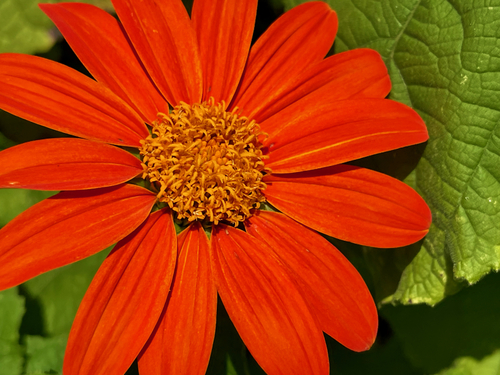
Tithonia rotundifolia (Mill.) S.F.Blake is a flowering plant that grows as a perennial in its native habitat, reaching up to 4 meters tall, while cultivated individuals only reach 0.8 to 1.5 meters. Its flowers are orange or red. In USDA zones cooler than Zone 10, it grows as an annual. Contrary to what its species epithet suggests, its leaves are deltoid to lanceolate, or occasionally broadly heart-shaped, and sometimes lobed. Leaves can grow up to 38 cm long and 30 cm wide, with subentire, crenate, or serrated margins. Lower leaves are usually three-lobed. The petiole can reach up to 40 centimeters in length. The upper surface of the leaf is gray, and the underside is hairy. This species grows naturally in Colorado, Florida, Louisiana, Mexico, Central America, Thailand, and the West Indies. It can be found on open fields, within shrubby vegetation, in ruderal sites, along road and highway edges, and in other disturbed areas, at altitudes below 1000 meters. Outside its native range, it is sometimes grown as an ornamental plant and has become naturalized in some of these cultivated areas. In Africa, it has been recorded growing at altitudes up to 1,580 meters above sea level. In cultivation, it is most often used in hedges to act as a background for other smaller plants. It grows well in poor to average, well-drained soil, and needs a location protected from wind to prevent its brittle stems from bending or breaking. It is propagated from seed, and seedlings are planted 30 to 50 centimeters apart. It requires full sun and fresh, nutrient-rich soil with plenty of humus. It tolerates drought well, but still needs additional water during long dry periods. It produces flowers from mid-summer until the first frost.