About Hymenoxys hoopesii (A.Gray) Bierner
Nomenclature
Hymenoxys hoopesii, previously classified as Dugaldia hoopesii, is a species of flowering plant in the daisy family. It is commonly known by the names owl's claws, orange sneezeweed, and yerba del lobo.
Native Habitat
This plant is native to the western United States, where it grows at moderate elevations in habitats including mountain meadows across the Rocky Mountains, Sierra Nevada, southern Cascades, and other mountain ranges. Its recorded distribution extends from Arizona, New Mexico, and central California northward to Montana and Oregon.
Plant Size and Growth Form
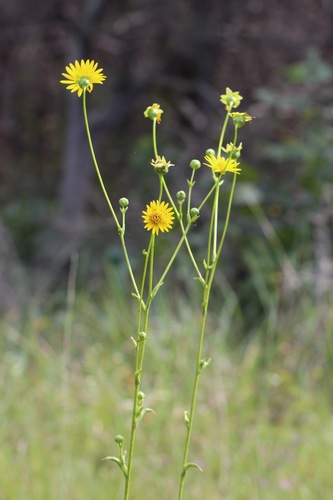
Hymenoxys hoopesii is an erect perennial herb that reaches up to roughly 1 meter (40 inches) tall.
Leaf Characteristics
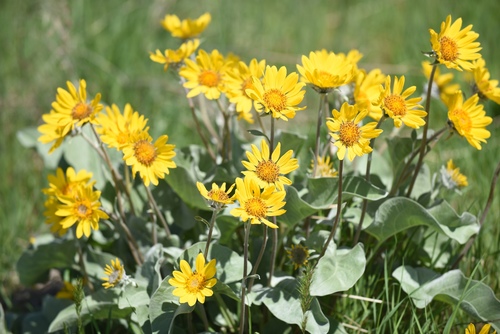
It produces smooth-edged leaves that can grow up to 30 centimetres (12 inches) long; leaves on the lower stem are oval-shaped, while those closer to the top are lance-shaped.
Blooming Period and Inflorescence
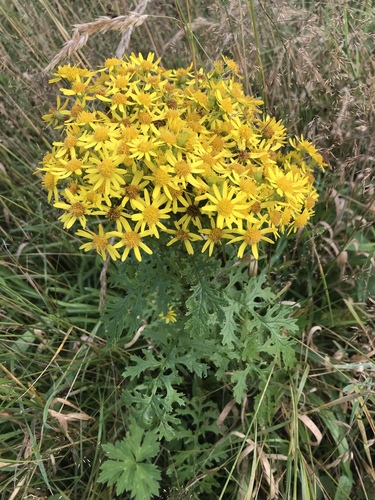
It blooms from July to September, producing an inflorescence that holds multiple flower heads on upright stalks called peduncles. Each flower head is lined at its base with hairy, pointed phyllaries.
Flower Head Structure
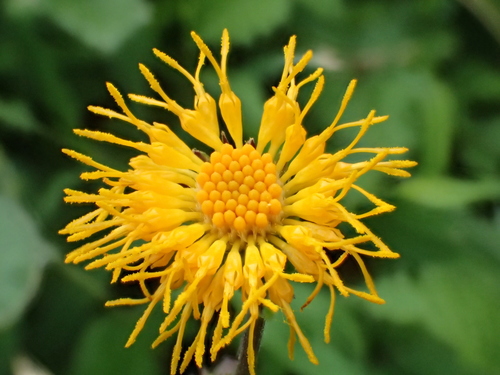
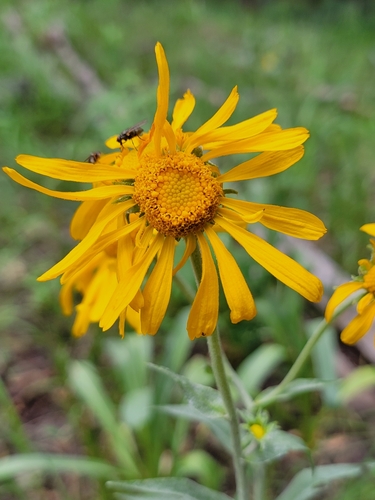
A single flower head can grow up to 7.5 cm (3 in) wide, with a central cluster of 100–325 tiny disc florets surrounded by a fringe of 14–26 orange or yellow ray florets, each of which measures up to 2.5 cm (1 in) long.
Fruit Characteristics
The fruit it produces is an achene topped with a pappus made of scales.
Livestock Toxicity
This species is toxic to livestock, particularly sheep.
Common Name Origin
Its pollen can trigger an allergic reaction, which is the origin of the common name "sneezeweed".
Medicinal Uses
Its root has been used medicinally to treat rheumatism, upset stomachs, and indigestion in infants.