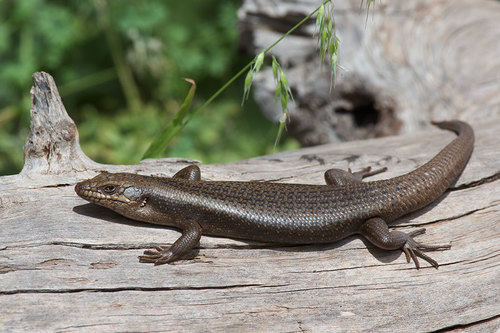
About Tiliqua scincoides (White, 1790)
Species Identification and Size
Tiliqua scincoides, the common blue-tongued skink, is a large terrestrial blue-tongued lizard that reaches over 60 cm (24 in) in total length including the tail, and weighs more than 1 kg (2.2 lb).
Body Structure
It has a stout body and short legs.
Coloration and Tongue Appearance
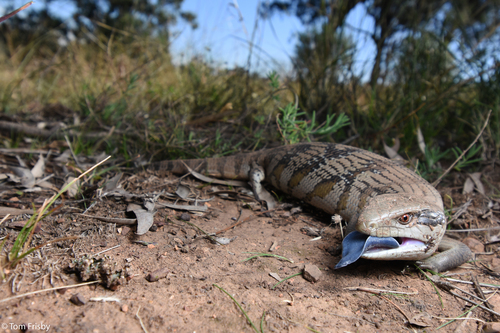
Its coloration is variable and generally follows a banded pattern, and its tongue ranges in color from blue-violet to cobalt blue.
Chemosensory Tongue Function
Like nearly all squamates, Tiliqua scincoides collects microscopic molecules from air and surfaces with the tip of its tongue, then delivers these molecules to a sensory organ on the roof of the mouth, which gives the lizard its sense of smell.
Prey Capture Mechanism
Blue-tongued skinks also use their tongues to catch prey: the tongue is coated in a sticky mucus that maintains surface tension as it moves, to pull captured insects back into the mouth.
Pet Popularity
Because of its distinctive blue tongue and curious temperament, it is a popular companion animal in Western countries.
Activity Pattern
Tiliqua scincoides is diurnal, meaning it is active during the day and rests at night.
Diet
It is omnivorous, feeding on insects, snails, frogs (including the toxic cane toad, which is fatal to the lizard), other reptiles, small birds, small mammals, carrion, and plant material such as fruit and green vegetation.
Reproduction Mode
This species is ovoviviparous: females retain fertilized eggs inside their bodies and give birth to live young, rather than laying egg clutches.
Litter Size
A female’s litter can contain between 5 and 25 live young, with the subspecies Tiliqua scincoides scincoides known to produce the largest litters.
Lifespan
Tiliqua scincoides is known to live for more than 30 years.
Habitat Range
It is an adaptable species that often occupies urban and suburban areas, including residential neighborhoods of Sydney.
Urban Ecological Role
It is generally considered a beneficial urban resident because it eats garden pests such as slugs and snails.
Anti-Predator Behavior
When threatened, instead of fleeing, blue-tongued skinks may hiss, lunge, inflate their bodies, and display their blue tongue to startle the perceived threat.
Subspecies Color Variation
Locally established subspecies of Tiliqua scincoides have a variety of distinct color variations.
Eastern Subspecies Morphology
For example, eastern blue-tongued skinks have green and yellow color phases, may or may not have bands across the eye area, and individuals from the Brisbane region look different from other eastern populations.
Captive Color Morphs
In captivity, breeders have developed albino (mostly white) and melanistic (mostly black) varieties.
Northern Subspecies Morphology
Northern subspecies are either the classic, standard appearance, or a more speckled form from the Kimberley region and Prince Regent National Park.
Selectively Bred Color Variations
Herpetology hobbyists have selectively bred captive blue-tongued skinks to produce exaggerated color variations, with different captive lines displaying red, yellow, orange, caramel, white, and other colors.
Tanimbar Subspecies Traits
Tanimbar blue-tongued skinks are the glossiest, and often occur in gold or silver color phases.
Population Temperament Differences
Wild Tanimbar and Kimberley Northern blue-tongued skinks have a reputation for being more aggressive than other populations of the species.