About Egernia striolata (Peters, 1870)
Taxonomy and General Morphology
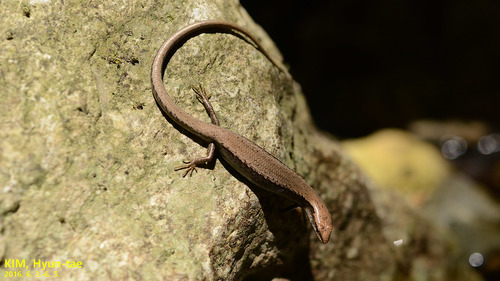
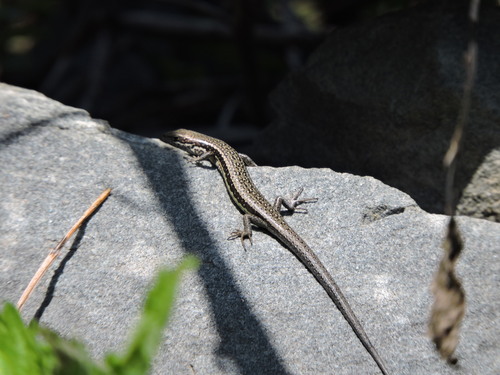
The tree-crevice skink, scientific name Egernia striolata (Peters, 1870), is a moderate-to-large, deep-headed species in the genus Egernia.
Dorsal Coloration
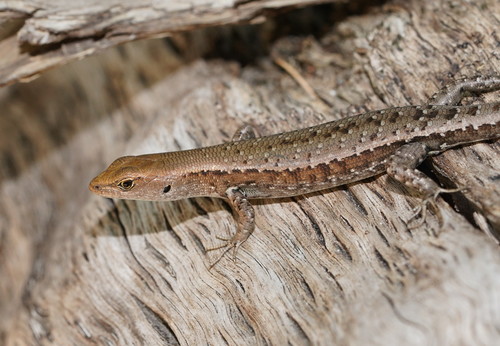
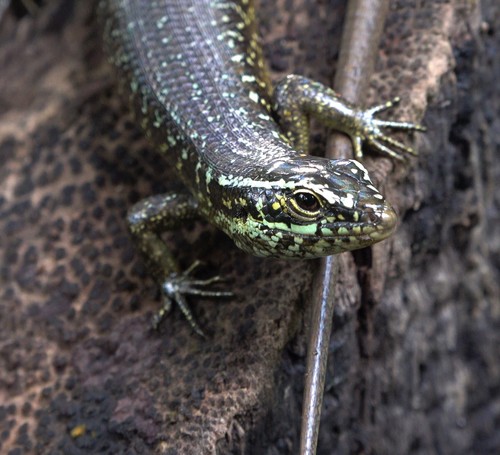
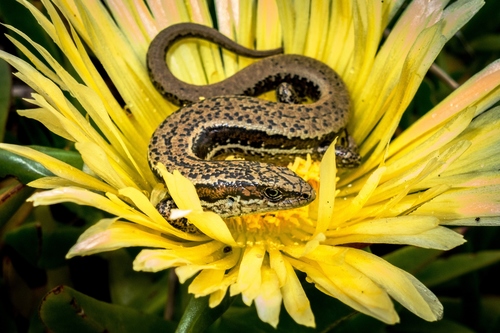
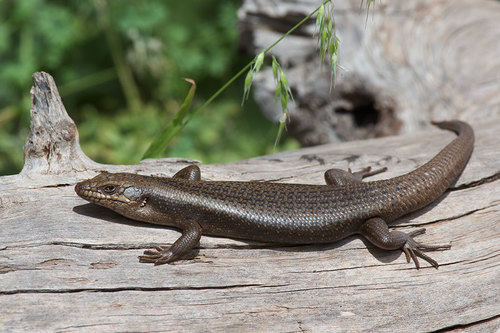
Its base color ranges from dark black to gray-brown, with a pale dorso-lateral stripe running from the head to the base of the tail. Scattered white spots and flecks sometimes appear on its torso.
Ventral Coloration
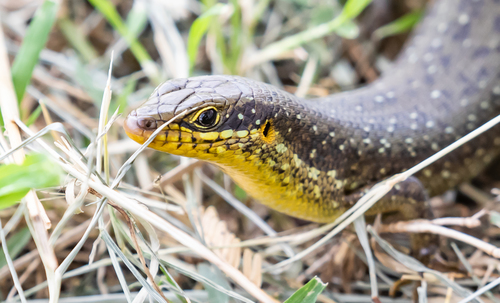
Ventral body surfaces are most often lemon-yellow or pale orange, while the ventral surfaces of the limbs and tail are whitish or grey.
Lateral Markings
A dark lateral band runs from the eye to the groin, and this band contains pale scales that form transverse bars.
Head and Sensory Features
The species has white or cream labial scales, vertically narrow pupils, and white auricular lobules.
Species Distinction
It can be distinguished from the related species Egernia kintorei by having fewer labial scales and more pointed ear lobules.
Nasal Scale Characteristics
In E. striolata, the nasal scales are moderately separated and only rarely narrowed.
Head Scale Patterns
Head scales have narrow brown or dark margins, and may occasionally bear white spots.
Native Range
This species is native to Australia.
Distribution in Western Australia
Its distribution extends across the arid zone of Western Australia, from the Pilbara and Great Sandy Desert south to Carnarvon and the Great Victoria Desert.
Areas of Absence
It is not found on the coast or higher altitudes of the Great Dividing Range, nor in central and eastern Queensland, or the outer ranges of southern Northern Territory and northwestern South Australia.
Arboreal Habitat Use
The tree-crevice skink is largely an arboreal (tree-dwelling) species that occupies hollow logs, cracks, and spaces behind the bark of both standing and fallen trees.
Regional Habitat Variation
In New South Wales, this species is rarely found dwelling on rocks, but this is not true across its full range; in South Australia, it frequently uses rocks, tree crevices, and exfoliating rock slabs.
Additional Habitats
Individuals have also been found under the leaf skirts of Xanthorrhoea species, and may even occur in human-modified habitats such as fence poles.
Habitat Structural Preference
This species strongly prefers structurally diverse, heterogeneous environments, and is much more abundant in habitats with greater diversity of crevices and rock sizes.
Juvenile Habitat Use
Immature lizards often occupy smaller rocks with fewer crevices, due to competition for more complex habitats.
Heliothermic Behavior
As a heliothermic species, tree-crevice skinks prefer elevated sites that provide access to more solar radiation; greater solar exposure improves their fitness, and lets them forage more effectively, defend their territories better, and maintain stable social groups.
Sociability Variation
Sociability in E. striolata varies with the habitat the population occupies. For example, in northern New South Wales where E. striolata commonly lives in tree stumps, individuals are less often found in groups, compared to South Australian populations that are mostly rock-dwelling.
Home Site Attachment
Members of the genus Egernia typically have strong attachments to a fixed home site.
Territorial Scent Marking
E. striolata is highly territorial, and tends to defecate in or next to its home site to create scat piles that mark territory.
Scat Recognition Ability
Individuals can distinguish between the scat of kin and scat from unknown individuals, which likely helps in territory identification.
Scat Pile Significance
Very large accumulated scat piles near the entrance of a home site can signal that an aggregation of individuals is present at the location.
Scat Pile Trade-Offs
Even though these large piles may risk advertising the skinks' presence to potential predators, the piles are still consistently made, indicating they serve an important function.
Social Function of Scat Piles
Other Egernia species that do not have similarly complex social interactions lack the ability to tell apart scats from different groups, which suggests large scat piles are used for social territorial marking.
Mating Season
The mating season of E. striolata falls in September and October.
Reproductive Physiology
This species is viviparous and has relatively simple type 1 placentas, though little research has been conducted on its full reproductive ecology.
Mating System
It prefers to mate monogamously, keeping a single mate for at least the full duration of a breeding season.
Litter Size
Each litter produces 2 to 6 offspring.
Family Group Structure
After giving birth, adults tend to form nuclear families with their offspring, and may live together with multiple generations of young, so aggregations commonly form consisting of a breeding pair of adults alongside juveniles and subadults of various ages.
Group Living Benefits
This group living provides protection for young individuals from predators and infanticide.
Sperm Storage Capability
Female E. striolata can produce offspring without having mated recently; they have even been documented producing offspring after over a year with no access to mates. This is possible because females can store sperm from males after mating, allowing them to reproduce later even under challenging ecological conditions.
Sperm Storage Advantages
This sperm storage capability also gives females an advantage in situations of sexual conflict, and lets females avoid inbreeding by allowing selective control over which sperm they use to fertilize eggs.
Size and Maturity
Newly born E. striolata measure 47 to 55 mm in length, and reach full adult maturity at 100 to 118 mm.
Life History
Juveniles generally stay with their parents in the family unit until they are fully grown before dispersing; full maturity usually takes 2 to 3 years, though this process can take up to 5 years, and the species can live up to 10 years.