About Thymus serpyllum L.
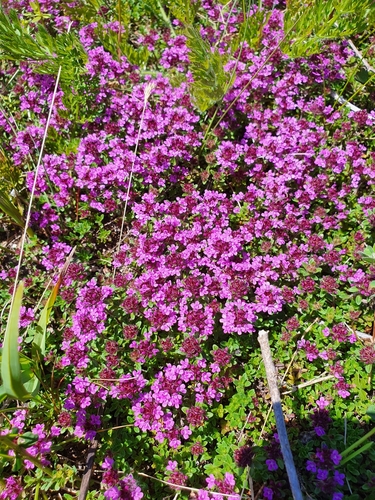
Wild thyme (Thymus serpyllum L.) is a creeping dwarf evergreen shrub that grows up to 10 centimetres (4 in) tall. It produces woody stems up to 10 cm long and has a taproot. It grows into matlike colonies, rooting from the nodes of its squarish, limp stems. Its leaves measure 3–8 mm long, grow in opposite pairs, are nearly stalkless, and have linear elliptic round-tipped blades with untoothed margins. In summer, the plant produces erect flowering shoots. The flowers are 4–6 mm long, most often pink or mauve, and rarely white. They have a tube-like calyx and an irregular straight-tubed, hairy corolla. The upper petal is notched, while the lower petal is larger than the two lateral petals and bears three flattened lobes that form a lip. Each flower has four projecting stamens and two fused carpels. The mature fruit is a dry, four-chambered schizocarp. Wild thyme is native to the Palearctic realm covering Europe and Asia. It grows in thin soils, and can be found on sandy heaths, rocky outcrops, hills, banks, roadsides, and riverside sand banks. In ecosystems, wild thyme is a food source for the larvae of both the common blue butterfly and large blue butterfly, and it is also attractive to bees. Creeping and mounding variants of Thymus serpyllum are used as border plants and ground cover around gardens and stone paths. It can also be used to replace a bluegrass lawn for xeriscaping low to moderate foot traffic areas, because it tolerates low water and poor soils. It has also been used to "upholster" herb seats, similar to camomile seats, providing a fragrant surface for sitting. Several cultivars have been developed; the cultivar 'Pink Chintz' has earned the Royal Horticultural Society's Award of Garden Merit, and 'Elfin' is a miniature creeping form. As a culinary herb, wild thyme can be used similarly to common cultivated thyme, and has a milder flavor.