About Thymus camphoratus Hoffmanns. & Link
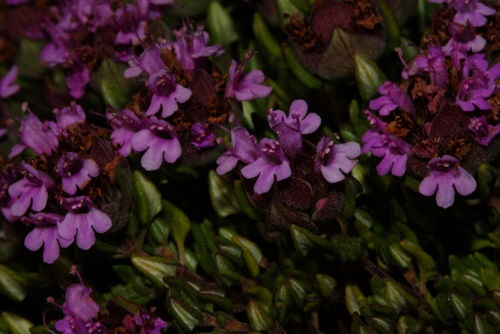
Thymus camphoratus Hoffmanns. & Link is an erect subshrub that grows 15 to 30 cm (6 to 12 inches) tall. Its young stems are quadrangular in cross-section and covered in very short hairs. The leaves measure 6–8 by 2–4.5 millimetres (1⁄4–5⁄16 by 1⁄16–3⁄16 inches), shaped ovate-triangular or rhomboidal, with margins rolled inward along their upper half. Leaf tips are acute or subobtuse; the leaf underside is whitish and covered in dense woolly hairs, while the upper surface becomes more hairless with age or remains finely hairy. Both leaf surfaces are densely covered with yellowish, spheroidal glands. The inflorescence is capituliform, 10–15 mm (3⁄8–9⁄16 inches) in diameter. Bracts measure 7–9 by 5–8 mm (1⁄4–3⁄8 by 3⁄16–5⁄16 inches), are broadly ovate, often pale pinkish or reddish, hairy, and bear scattered spheroidal glands, glandular hairs, and prominent visible veins on their underside. The calyx is 4–6 mm (3⁄16–1⁄4 inches) long and flared; its upper teeth are 0.7–1 mm (1⁄32–3⁄64 inches) long, equal in size, and not ciliated. Flowers are 5–8 mm (3⁄16–5⁄16 inches) long, pink or purple, with a lower lip that has large, nearly equal-sized lobes. This species has purple anthers that extend beyond the corolla. Its fruits are ellipsoid, dark brown, and measure 0.7–0.9 mm by 0.6–0.7 mm. The chromosome count for this species is 2n = 30, equal to 15 chromosome pairs. Thymus camphoratus is native to southwest Portugal, and occurs most notably within the Southwest Alentejo and Vicentine Coast Natural Park. It grows in heathlands and xerophilic scrub on stabilized dunes formed from limestone-based sands, and is always found growing close to the coast.