About Thunbergia gregorii S.Moore
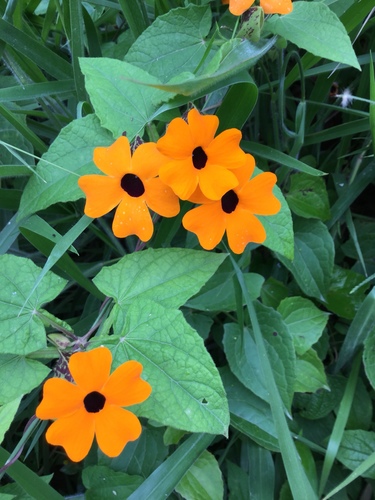
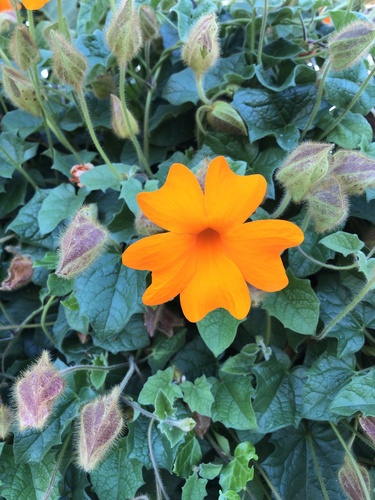
Thunbergia gregorii, commonly called orange clockvine or orange trumpet vine, is a herbaceous perennial climbing plant in the family Acanthaceae. It is native to East Africa and is sometimes grown as an ornamental vine. It is distinguished from its close relative Thunbergia alata (black-eyed Susan vine) by its bright, solid all-orange flowers; T. alata has a characteristic dark "black eye" marking at the center of its flower that is absent in T. gregorii. The species was first described by Spencer Le Marchant Moore in 1894, and was named in honor of John Walter Gregory. Within the genus Thunbergia, T. gregorii is most closely related to T. alata, and both species are classified in the subgenus Parahexacentris. The common name "clockvine" comes from the vine's growth habit of spiraling upwards in a clockwise direction. T. gregorii is an evergreen vine that typically grows 8 to 10 feet tall when climbing; if not provided with support, it can spread to form a large extensive groundcover. This species is native to East Africa and is pollinated by bees. It is hardy down to -1 °C. In warmer climates, T. gregorii produces flowers far more profusely, and can even flower year-round; in cooler climates, it only flowers during summer and autumn. It has been awarded the Royal Horticultural Society's Award of Garden Merit. Propagation of this species is done via cuttings harvested in summer.