About Threnetes ruckeri (Bourcier, 1847)
Size
The band-tailed barbthroat, Threnetes ruckeri, measures 10 to 11 cm (3.9 to 4.3 in) in total length. Males weigh 5.5 to 7 g (0.19 to 0.25 oz) and females weigh 5 to 7 g (0.18 to 0.25 oz).
Nominate Male Upperparts
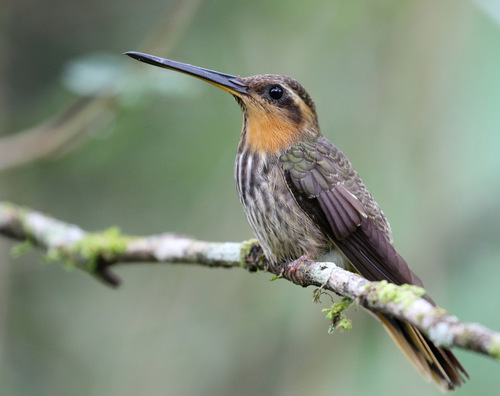
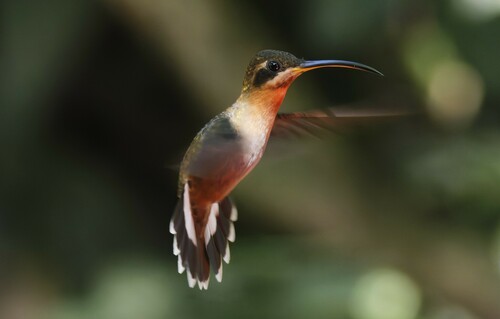
The adult male of the nominate subspecies T. r. ruckeri has bronze-green upperparts, a dark ear patch, a dark chin, and a dusky malar stripe. Its tail is dark, with white bases and tips to the feathers that create a black band near the end of the tail.
Nominate Male Underparts & Bill
This subspecies has an ochraceous throat, gray underparts with scattered green feathers, and a nearly straight bill. Like other hermit hummingbirds, male and female band-tailed barbthroats have similar plumage.
Female Plumage & Bill
Females differ from males by having a somewhat more decurved bill, and less plumage contrast between the throat, breast, and belly. Young birds look similar to adults, but have ochraceous edges on their feathers.
T. r. venezuelensis Throat Patch
The subspecies T. r. venezuelensis has a somewhat larger ochraceous throat patch than the nominate subspecies.
T. r. ventosus Plumage
The subspecies T. r. ventosus has a much larger, bright orange throat patch, and an ochraceous tinge to its belly.
Subspecies Range Overview
Three subspecies of band-tailed barbthroat have distinct geographic ranges.
T. r. ventosus Distribution
T. r. ventosus, the northernmost subspecies, occurs from eastern Guatemala and Belize, through Honduras, Nicaragua, and Costa Rica, into Panama.
T. r. ruckeri Distribution
The nominate T. r. ruckeri ranges from northern and western Colombia south through western Ecuador almost to Peru.
T. r. venezuelensis Distribution
T. r. venezuelensis occurs in northwestern Venezuela.
Habitat
The species inhabits the understory and edges of primary forest and old second growth, as well as semi-open shrublands, thickets, and plantations.
Elevational Range
Its elevational range extends from sea level up to 1,200 m (3,900 ft).