About Theobroma speciosum Willd. ex Spreng.
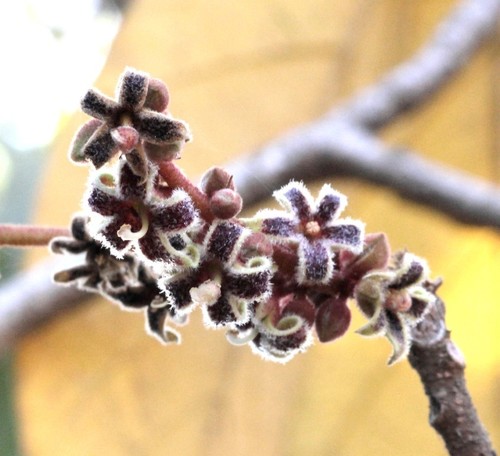
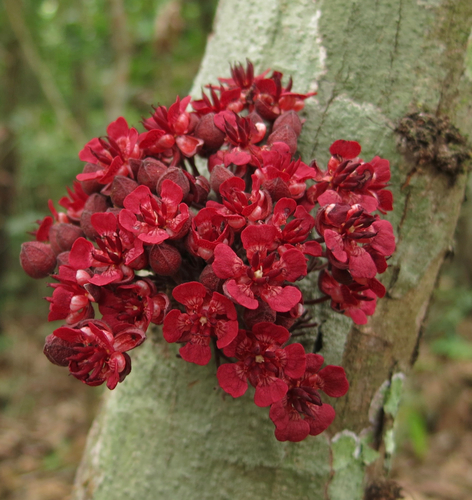
Theobroma speciosum is an evergreen tree that reaches up to 15 meters (49 feet) in height. It has a straight trunk, with horizontally growing (plagiotropic) side branches, and a small canopy. Its leaves are simple, leather-textured (coriaceous), covered with hairs (trichomes), and arranged in a distichous pattern, meaning leaves alternate between opposite sides of the stem. The species produces red flowers that grow in dense clusters directly on the trunk. Its fruits measure around 10 centimeters (3.9 inches) long. Each fruit contains roughly 20 seeds enclosed in white flesh, which is itself surrounded by a capsule. Theobroma speciosum is native to Bolivia, Brazil, Peru, and Venezuela. In Brazil, it has been recorded in the states of Acre, Amapá, Amazonas, Maranhão, Mato Grosso, Pará, and Rondônia. Ecologically, the fruit of Theobroma speciosum serves as a food source for primates and rodents, and its flowers are pollinated by flying insects. As a food source for humans, the fruit flesh is eaten by the Ka'apor and Tacana peoples. The seeds are used to make chocolate, and may also be used to produce cocoa butter substitutes. The flowers of Theobroma speciosum are edible, and contain high concentrations of antioxidants.