About Theobroma cacao L.
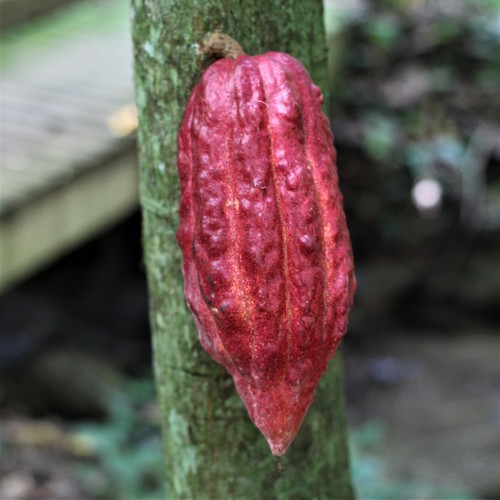
Theobroma cacao L., commonly known as cacao, has alternate, entire, unlobed leaves that measure 10–50 cm (4–20 in) long and 5–10 cm (2–4 in) wide. It is naturally distributed across a range from southeastern Mexico to the Amazon basin. Two main hypotheses about the domestication of T. cacao existed originally: one proposed two separate domestication centers, one in Mexico's Lacandon Jungle and another in lowland South America. More recent studies of DNA diversity patterns do not support this hypothesis. One study sampled 1,241 trees and sorted them into 10 distinct genetic clusters. It also identified areas including the region around Iquitos, on the border of modern Peru and Ecuador, where members of multiple genetic clusters originated more than 5,000 years ago. This lead to the development of the Nacional cocoa bean variety, and the findings suggest this region was the original site of T. cacao domestication. It is likely that cacao was first domesticated for the pulp surrounding its beans, which is eaten as a snack and fermented into a mildly alcoholic beverage. Another study refined this domestication hypothesis by comparing DNA sequences with climate model data and known suitable growing conditions for cacao. This study linked the area of the highest cacao genetic diversity to a bean-shaped region that covers Ecuador, the border between Brazil and Peru, and the southern section of the Colombia-Brazil border. Climate models show that 21,000 years ago, at the peak of the last ice age when habitat suitable for cacao was greatly reduced, this area remained suitable and acted as a refugium for the species. Cacao trees grow well as understory plants in humid forest ecosystems. This holds true even for abandoned cultivated cacao trees, which makes it difficult to tell truly wild cacao trees apart from trees descended from originally cultivated stock. In 2023, cocoa beans were cultivated on approximately 11,650,000 hectares (28,800,000 acres) globally. Both large agroindustrial plantations and small-scale producers grow cocoa beans, and the majority of global production comes from millions of smallholder farmers with small plots. A cacao tree begins producing pods when it is four or five years old. A mature tree may produce up to 6,000 flowers in one year, but only develops around 20 pods. Around 1,200 seeds (equivalent to 40 pods) are required to produce 1 kilogram (2.2 pounds) of cocoa paste. Historically, chocolate makers have recognized three main cultivar groups of cacao beans used to make cocoa and chocolate: Forastero, Criollo, and Trinitario. The Criollo group is the most prized, rare, and expensive, and was the cacao bean used by the Maya. Only 10% of chocolate is made from Criollo, which is generally considered less bitter and more aromatic than any other cacao bean. In November 2000, cacao beans grown in Chuao were granted an appellation of origin under the title Cacao de Chuao. 80% of chocolate is made from beans of the Forastero group. The most common and widespread variety within Forastero is Amenolado, while varieties such as Arriba (including the Nacional variety) are less common in Forastero production. Forastero trees are considerably hardier and more disease-resistant than Criollo trees, which makes Forastero cacao beans cheaper to produce. Major cocoa bean processors include Hershey's, Nestlé, and Mars. Chocolate is produced from T. cacao through a multi-step process involving harvesting, fermenting the cacao pulp, drying, and extraction. Roasting T. cacao with superheated steam has been found to be superior to conventional oven roasting, as it produces cocoa beans of the same quality in a shorter processing time. Ancient texts describe multiple cacao mixtures used for ceremonial, medicinal, and culinary purposes. Some of these mixtures included maize, chili, vanilla (Vanilla planifolia), and honey. Archaeological evidence of early cacao use, while relatively sparse, includes recovered whole cacao beans from Uaxactun, Guatemala, and preserved cacao tree wood fragments from sites in Belize including Cuello and Pulltrouser Swamp. Analysis of residues from ceramic vessels has found traces of theobromine and caffeine in early formative vessels from Puerto Escondido, Honduras (dated 1100–900 BC) and middle formative vessels from Colha, Belize (dated 600–400 BC). The same analysis methods were used to detect chocolate residues in four Classic Period (around 400 AD) vessels from a tomb at the Maya archaeological site of Rio Azul. Since cacao is the only known Mesoamerican commodity that contains both of these alkaloid compounds, it is likely that these vessels were used to hold cacao drinks. Cacao is also explicitly named in a hieroglyphic text on one of the Rio Azul vessels. It is also believed that the Aztecs ground cacao and mixed it with tobacco for smoking. Cacao was domesticated by the Mayo Chinchipe people of the upper Amazon around 3,000 BC. In Maya mythology, the gods discovered kakaw (cacao) in a mountain that also held other delicious foods for people. According to the myth, the Plumed Serpent gave cacao to the Maya after humans were created from maize by the divine grandmother goddess Xmucane. The Maya held an annual festival in April to honor their cacao god, Ek Chuah. The event included sacrificing a dog with cacao-colored markings, additional animal sacrifices, offerings of cacao, feathers, and incense, and an exchange of gifts. In a similar Aztec (Mexica) creation story, the god Quetzalcoatl discovered cacao (called cacahuatl, meaning "bitter water") in a mountain filled with other edible plants. Cacao was regularly offered to the Aztec pantheon of deities; the Madrid Codex depicts priests lancing their ear lobes as an act of autosacrifice and covering cacao with blood as an acceptable sacrifice to the gods. The cacao beverage was only used for ritual by men, as it was considered an intoxicating food unsuitable for women and children. In pre-Columbian Mesoamerican civilizations, cacao beans served both as a ritual beverage and a major form of currency. At one point, the Aztec empire received a yearly tribute of 980 loads (called xiquipilli in Classical Nahuatl) of cacao, alongside other goods. Each load held exactly 8,000 beans. High-quality cacao beans had significant buying power: 80 to 100 beans could purchase a new cloth mantle. Counterfeit cacao beans used as currency were already known to exist during the Aztec empire.