About Thalictrum flavum L.
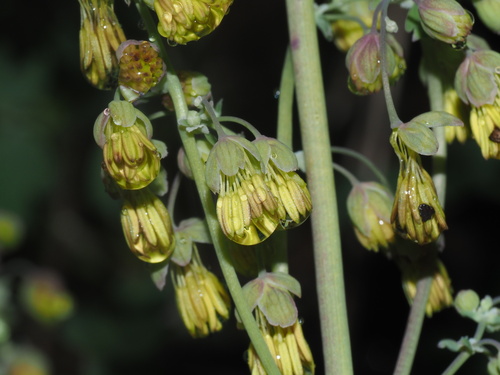
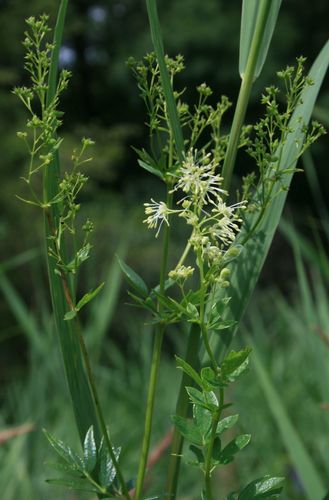
Thalictrum flavum L. has fibrous roots and wedge-shaped dark green leaves that are paler green on the underside and divided into multiple segments. It blooms from June to August. Its flowers have short sepals that are actually white, plus longer erect yellow stamens; the numerous stamens give the entire flower a yellow appearance. After flowering, each flower head produces three fruits. This species is very widespread, native to temperate regions of Asia, Northern Africa, and Europe. In Northern Africa, it occurs in Algeria. In Europe, it is found across Eastern Europe (Belarus, Estonia, Latvia, Lithuania, Ukraine), Middle Europe (Austria, Czech Republic, Germany, Hungary, Poland, Slovakia, Switzerland), northern Europe (Denmark, Finland, Ireland, Norway, Sweden, United Kingdom), southeastern Europe (Albania, Bosnia and Herzegovina, Bulgaria, Croatia, Italy, Montenegro, North Macedonia, Romania, Serbia), and southwestern Europe (France and Spain). In Asia, it occurs in the Caucasus (Azerbaijan and Georgia), the Russian Federation (Amur and Primorye), China (Xinjiang), Kazakhstan, Siberia, and Turkey. It has naturalized in the United Kingdom, where it grows in southern and western England, Scotland, and Ireland. Its typical habitat includes grasslands, marshy fields, fens, and riverbanks. It is pollinated mainly by flies and bees, and its seeds are dispersed by wind. Larvae of the Marsh Carpet moth (Perizoma sagittata) live on this plant, feeding on its seeds and flowers. In UK folk medicine, the plant’s foliage has been used as a purgative.