About Thalassoma nigrofasciatum Randall, 2003
Nomenclature
This species, commonly called the black-barred wrasse, has the scientific name Thalassoma nigrofasciatum Randall, 2003.
Adult Body Coloration
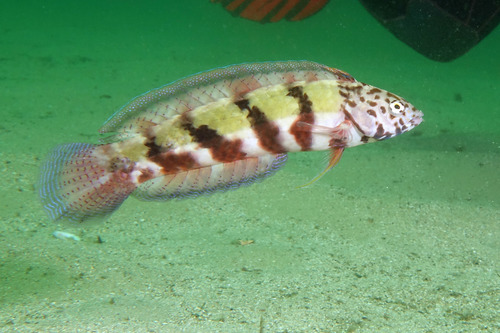
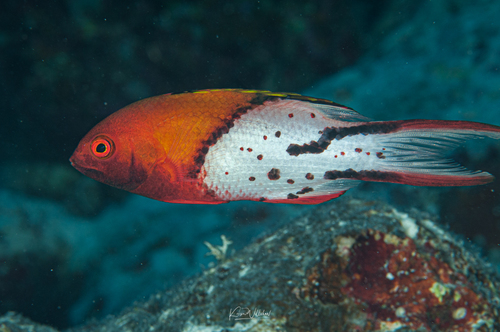
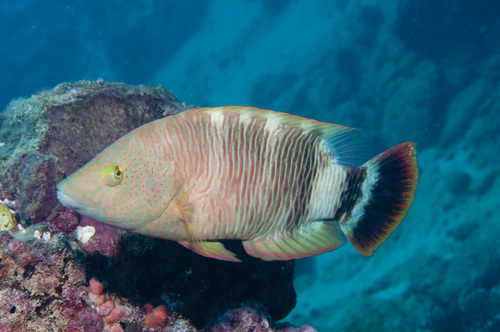
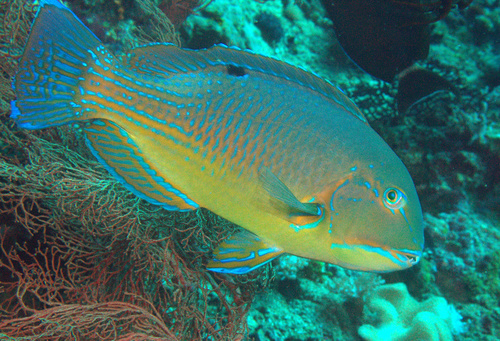
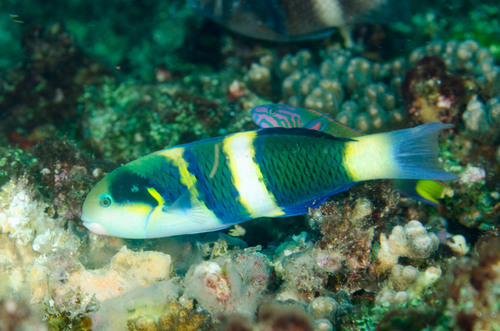
Adult black-barred wrasses are blackish on their upper bodies, while the lower half of the head, chest, and belly are white. A short vertical white to yellow stripe originates above the base of the pectoral fin, and two additional broad white to yellow stripes run along the fish's flanks. The tail of this species is yellow.
Sexual Dimorphism
In females, pale body areas are mostly white, while in males these pale areas are more yellow. Males also have a pale pink chin, long thin filaments on the lobes of the caudal fin, and pink patches on the lower parts of the head and chest.
Size
The largest recorded male measured 20 centimetres (7.9 in) in standard length.
Similar Species
Black-barred wrasse is frequently confused with the closely related similar species Jansen's wrasse (Thalassoma janseni).
Distribution
The black-barred wrasse is distributed in the southwestern Pacific Ocean. Its range extends from eastern Papua New Guinea and the Solomon Islands south to the Great Barrier Reef, Lord Howe Island, Norfolk Island, the Kermadec Islands, New Caledonia, and Tonga; it has also been recorded in Niue.
Habitat
This species inhabits tidal pools and both inner and outer reefs, at depths from 0 to 15 metres (0 to 49 ft).
Social Behavior
It can be found either alone or in small groups.