About Thalassoma hardwicke (Bennett, 1830)
Size and Fin Structure
Thalassoma hardwicke, commonly called the sixbar wrasse, grows to a maximum total length of 20 cm (8 in). Its dorsal fin contains 8 spines and 12 to 14 soft rays, while its anal fin contains 3 spines and 11 soft rays.
Body Coloration
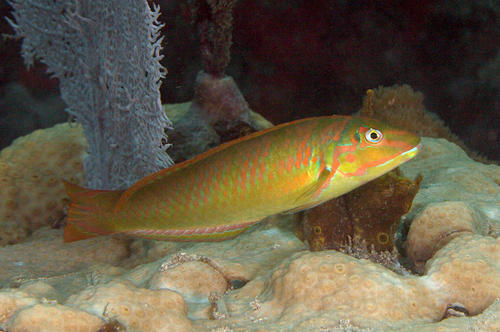
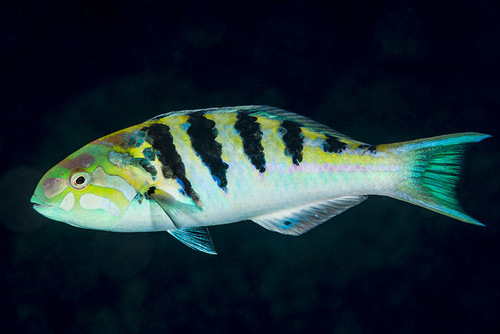
This is a greenish fish with four dark bars on its upper body, plus two additional saddle-shaped bars over the caudal peduncle. Larger adult individuals have a number of pink streaks that radiate from near the eye on the head.
Taxonomic History
Thalassoma hardwicke was first formally described in 1830 by English naturalist John Whitchurch Bennett (1790–1853) under the original name Sparus hardwicke, with its type locality recorded as the south coast of Ceylon.
Etymology
The specific name honors Bennett's friend and fellow naturalist, Major-General Thomas Hardwicke (1756–1835).
Distribution Range
The sixbar wrasse is native to the tropical Indo-Pacific, found between 30°N and 32°S. Its range stretches from East Africa and Madagascar to Japan, Indonesia, the Philippines, northern Australia, and various island groups in the Western Pacific.
Habitat
It inhabits coral reefs, reef slopes, and lagoons, occurring down to depths of 15 m (50 ft) or more.
Ranging and Feeding
This species is diurnal, and individuals maintain a home range larger than 1,000 m² (11,000 ft²). It forms small groups and feeds on planktonic and benthic crustaceans, foraminiferans, small fish, fish eggs, and fish larvae.
Breeding Traits
During the breeding season, males and females form breeding pairs. At this time, males develop brighter coloring and a black spot in the center of the caudal fin.
Tool Use Observation
One captive sixbar wrasse in an aquarium was observed using a rock as an anvil. The fish was given pellets that were too hard to chew and too large to swallow, so it carried each pellet to a specific rock and broke the pellet into smaller pieces there. It repeated this behavior using the same rock on multiple occasions, showing it could remember how to solve the problem of hard, large food pellets.
Aquarium Trade Status
The sixbar wrasse is sometimes sold in the aquarium trade.
Tank Requirements
It does best in a large tank with a sandy base and multiple rocks that provide caves and crevices for shelter and hunting.
Aquarium Feeding Behavior
It may move objects around inside the aquarium to find tubeworms, molluscs, and other invertebrates underneath them. It also feeds on shrimps, crabs, and small fish, and bashes larger prey against rocks to break it into pieces.
Captive Behavioral Notes
This species can jump out of open aquariums, and will bury itself in sand when it feels frightened.