About Tephrosia purpurea (L.) Pers.
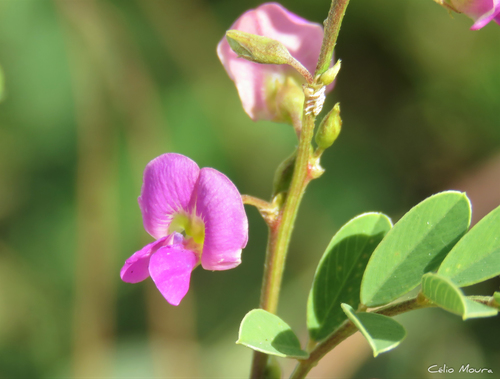
Tephrosia purpurea (L.) Pers. has leaflets that are obovate-oblong, somewhat wedge-shaped, equal-sided, and silky in texture. The mid-rib is usually folded longitudinally, and the leaflets have distinct parallel transverse veins. Its legume fruits are typically 25 to 51 mm (1 to 2 inches) long, and hold six or seven brownish seeds. The plant produces purple flowers in its growing season, which are most attractive in January. It usually reaches a height of 45–50 cm (18–20 inches), and can grow on mountains at altitudes over 910 m (3,000 ft). Both diploid cytotypes with 22 chromosomes and tetraploid cytotypes with 44 chromosomes have been recorded for this species. The roots of Tephrosia purpurea are deep, reaching 3 metres or more into soil, which helps the plant absorb moisture from the soil. Moisture is stored in the root cortex, which is protected by a thin periderm. This stored water in the cortex supports the plant's growth and reproduction during drought periods, allowing it to thrive in arid and semi-arid conditions, and survive low-rainfall periods in winter and summer. Roots grow faster than the plant's shoots: even when the above-ground shoot is only 1 cm long, the root system may already be 30 cm (12 inches) or more in length. Regional morphological variations have been observed: plants in Egypt's Eastern Desert may produce smaller pods, leaves, and leaflets, while plants from oases have densely pubescent spreading hairs. The subspecies apollinea can be differentiated from the nominate subspecies purpurea by several traits: subspecies apollinea has longer pods, at 3.5–5 cm, sometimes up to 5.5 cm, compared to 3–4 cm for nominate purpurea; it has a wider range of seeds per pod, generally 7–9, and as low as 3, compared to generally 5–6, and sometimes 7 for nominate purpurea; its pods curve upwards rather than downwards; and its leaflets have 9 lateral veins rather than 7. This species is distributed across north-eastern Africa (Djibouti, Egypt, Eritrea, Ethiopia, Somalia, Sudan), Western Asia (Iran, Israel, Jordan, Oman, Saudi Arabia, South Yemen, United Arab Emirates, Yemen including Yemeni Socotra island), and South Asia (India, Pakistan). In India, it is recorded in the western states of Gujarat, Maharashtra, and Rajasthan. Classified as a leguminous desert forb, Tephrosia purpurea typically grows in areas with relatively deep soil, especially in semi-arid regions, wadi areas, terraces, slight inclines, and hills. In Saudi Arabia, it has been found growing scattered alongside Zilla spinosa, Rhanterium epapposum, Astragalus spinosus, Gymnocarpos decandrum, Achillea fragrantissima, and Halothamnus bottae on the edges of desiccated lakes. It is well documented in Egypt and Sudan; in 1866, the Pharmaceutical Journal recorded it as a contaminant in Alexandrian senna, found growing in cultivated fields in valleys east and south of Assouan, on the Elephantine Islands opposite Assouan, along the Nile, and near Edfou and Hermonthis. In Israel, it grows in the Judean Desert, Dead Sea Valley, Negev hills, and Eilat. In Yemeni wadi areas, it most often grows on desert alluvial shrubland alongside Fagonia indica, Cymbopogon schoenanthus, and Boerhavia elegans. A specimen of Tephrosia purpurea was collected by Harry St John Bridger Philby in 1936 at Raiyan, around 240 km (150 mi) northeast of Sana'a. On Socotra, the Yemeni island off the Arabian Peninsula coast, it is typically found in Croton shrubland on lowland plains at altitudes from sea level to 100 metres, growing on overgrazed soil alongside Cassia holsericea. A 2000s vegetation analysis of northern Socotra's woodlands found the species growing alongside Achyranthus aspera, Ageratum conyzoides, Bidens chinensis, Forsskaolea viridis, Hibiscus vitifolius, Indigofera coerulea, Leucas urticifolia, Setaria adhaerens, and Solanum incanum. It is also found in the United Arab Emirates, and in Oman, where it lives in the Jiddat al-Harasis desert and dominates the beds of wadis in mountains such as Jebel Shams. Tephrosia purpurea is recorded as unpalatable, but its seeds are a preferred food of sandgrouse that live in the scrub-desert of northern Sudan, and the butterfly Colias croceus is known to feed on it. Its unpalatability has let it colonize overgrazed landscapes in parts of the Middle East, especially at lower altitudes. This species is known to be toxic to goats: an early 1980s study found that 11 out of 12 goats died between 1 and 40 days after receiving daily oral doses of fresh or dried Tephrosia purpurea shoots. Dosed goats showed adverse reactions including dyspnoea, limb and joint weakness leading to movement instability, changes in fat composition, catarrhal enteritis, and hemorrhage in the heart, lungs, and intestinal mucosa. Rotenoids extracted from the plant's seeds caused 100% mortality in Aphis craccivora when applied at a concentration of 0.1% over 48 hours. Tephrosia purpurea is used as a fish poison for fishing. Its leaves and seeds contain tephrosin, which paralyzes fish. Larger doses are lethal to fish, but do not affect mammals and amphibians.