About Tephrodornis pondicerianus (Gmelin, 1789)
Physical Description
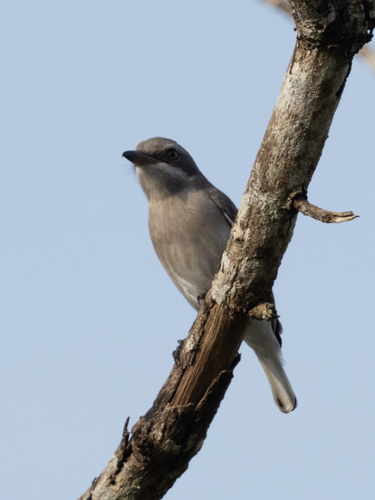
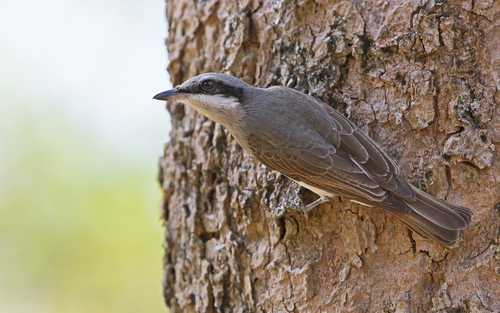
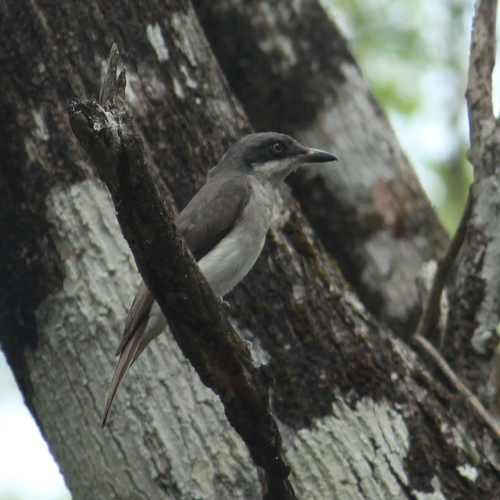
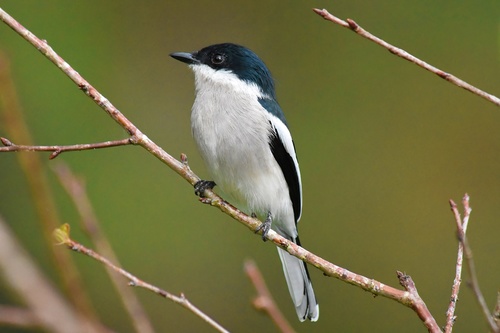
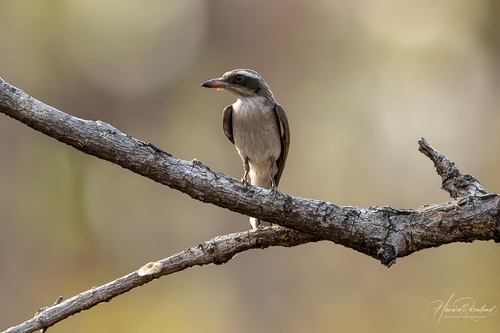
The common woodshrike (Tephrodornis pondicerianus) is dully ashy brown, and like other woodshrikes, it has a large head and a strong hooked beak. It has a broad creamy brow above a dark cheek patch, and white outer tail feathers that contrast with its dark tail.
Juvenile and Subspecies Traits
Young individuals have streaks and spots on the crown, white spots on the mantle, a streaked underside, and heavily marked breast. The northern race pallidus is pale brown on its upperparts, and has brown rather than black central tail feathers (rectrices).
Social Structure and Vocalizations
Common woodshrikes are usually found in pairs. They have a loud whistling song composed of several notes, and their usual call is a plaintive weet-weet followed by a series of quick whi-whi-whi-whee.
Feeding Behavior
They feed mainly on insects, and sometimes on berries. They mostly glean food from branches and leaves within trees, but will sometimes make aerial sallies or descend to the ground to feed.
Perching Habit
They have a characteristic habit of adjusting their wings, raising them over the tail shortly after alighting on a perch.
Nesting Period and Structure
They nest in summer, before the rainy season, building a cup-shaped nest on a bare tree fork. The nest is constructed from fibres and bark, held together with cobwebs, and covered with pieces of bark and lichen. It is lined with silky plant fibres.
Reproduction Details
The usual clutch size is three eggs. Both parents take part in incubation, but it is thought that only the female feeds the young.
Rearing of Young
Young birds are fed insects and berries. In some years, pairs may raise two broods.
Recorded Parasites
Several parasites have been recorded from this species. The protozoan Haemoproteus tephrodornis was described in 1935 by Froilano de Mello from a common woodshrike specimen collected in Goa.
Nematode Parasite
The spirurid nematode Oxyspirura alii, named after S. Mehdi Ali, was described from a specimen found in the eye cavity of a common woodshrike from Hyderabad.
Tick Parasites
The tick species Haemaphysalis bispinosa and Haemaphysalis intermedia have also been recorded on this species.