About Telopea speciosissima (Sm.) R.Br.
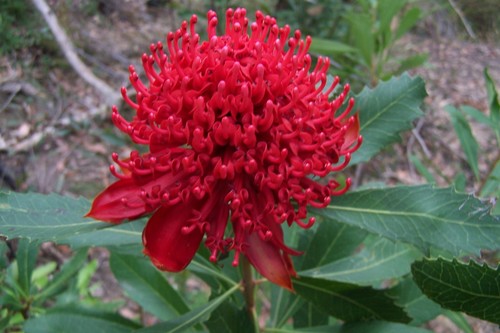
Telopea speciosissima, commonly known as the New South Wales waratah, is a large, erect shrub that reaches up to 3 or 4 metres (9.8 or 13.1 ft) in height, and grows one or more stems. The stems arise vertically or nearly vertically from a large woody base called a lignotuber, and are not much branched. After flowering finishes in late spring, a new growth spurt occurs, and new shoots often grow from old flowerheads. Its dark green leaves are arranged alternately, usually have coarse teeth, and measure between 13 and 25 cm (5 to 10 in) long. Flowerheads develop over winter, wrapped in leafy bracts, begin swelling in early spring, then open to reveal their distinctive striking inflorescences. Exact flowering timing varies across New South Wales: flowering can start as early as August in the northern parts of the species' range, and end by November in southern, higher elevation areas. Occasional spot flowering may also happen around March in autumn. The domed flowerheads are crimson, measure 7–10 cm (3–4 in) in diameter, and hold up to 250 individual flowers. They are cupped by a whorl of leafy bracts that are 5 to 7 cm (2 to 3 in) long, and also red. Shape and colour variations are common: some flowerheads are more globular or cone-shaped than dome-shaped, bracts may be whitish or dark red, and the stigma tips of some inflorescences may be whitish, creating contrast with the rest of the red flowerhead. An individual flowerhead reaches full size about two weeks after first emerging from its bracts, and lasts for another two weeks before the flowers fade and fall. In the first stage of development, the small individual flowers (called florets) stay unopened, and the whole flowerhead remains compact, before the florets mature and split open to expose the stigma, style, and anther. The anther is sessile, meaning it has no filament, and sits next to the stigma at the end of the style. The outermost florets open first, and blooming progresses toward the centre of the flowerhead. As this happens, the flowerhead becomes darker and more open in appearance, and starts to attract birds and insects. The ovary sits at the base of the style, on top of a stalk called a gynophore, and seed pods develop from this structure. A crescent-shaped nectary sits at the base of the gynophore. Mature seed pods reach 8–15 cm (3–6 in) long. As pods mature, they change colour from green, to yellow, and finally turn russet red-brown. They become leathery before splitting open in early winter, and release the winged seeds they contain inside. In wild populations, only two or three seed pods develop per flowerhead, but cultivated plants may produce anywhere from 5 to 50 pods per flowerhead.
This species is native to New South Wales, Australia, where it occurs from the Watagan Mountains south to Ulladulla, and has a relatively widespread distribution across the Central Coast region. It most commonly grows as an understory shrub in open forest on sandy soils, in areas with moderately high annual rainfall that averages around 1,200 mm (47 in). Dappled shade from eucalyptus (Eucalyptus) trees reduces sunlight reaching the waratah by around 30%. Much of the species' range falls within the Sydney Basin, an area with one of Australia's highest human populations and most intense urban development. The impact of habitat fragmentation and shorter intervals between bushfires on the gene pool of this outcrossing species remains unclear. While most populations are largely protected within national parks and conservation reserves in the Sydney area, most populations are small, with fewer than 200 individual plants, and are often located near developed urban areas.
Telopea speciosissima is a pyrogenic-flowering species, meaning it relies on flowering after bushfires, followed by production and dispersal of non-dormant seeds, to take advantage of the favourable growing conditions created in a fire-altered environment. Among the woody resprouter shrubs of southeastern Australia, it is one of the slowest to produce new seedlings after bushfires, taking at least two years. The species resprouts from its lignotuber, a swollen woody base that sits mostly under the soil, storing energy and nutrients to support rapid growth of new shoots after a fire. Two years after a fire, waratahs typically dominate the understorey, before being overtaken by slower-growing banksias (Banksia) and wattles (Acacia). Fire also removes diseases and pests from the area, and prolific flowering often occurs in the post-fire period. The prominent positioning and striking colour of T. speciosissima and many of its relatives in the subtribe Embothriinae (found across Australia and South America) strongly indicates the group is adapted to bird pollination, and has been for over 60 million years. Honeyeaters, particularly the New Holland honeyeater (Phylidonyris novaehollandiae) and the crescent honeyeater (P. pyrrhopterus), are frequent visitors to the flowerheads, though a field study at Barren Grounds found New Holland honeyeaters carry relatively little pollen. The eastern pygmy possum (Cercartetus nanus) also forages among the species' flowerheads. While the New South Wales waratah was long thought to be protandrous (meaning male reproductive structures finish activity before female structures become receptive on the same plant), analysis of the timing of pollen viability and stigma receptivity has found significant overlap between the two stages. The species is confirmed to be self-incompatible, so it requires cross-pollination with plants of different genetic backgrounds to reproduce successfully.
The New South Wales waratah was a popular garden plant by the early 20th century. It was first introduced to the United Kingdom in 1789, and was first recorded flowering in the UK in 1809 at Springwell, the villa of E. J. A. Woodford Esq. The Royal Horticultural Society awarded the species an Award of Merit in 1914, and a First Class Certificate in 1922. Early on, waratah flowers were harvested from wild bushland for commercial sale, but by the early 20th century some plantspeople grew concerned that urban development was destroying wild native bushland, particularly areas known for wildflowers. Percy Parry of Floralands in Kariong developed the concept of "Preservation by Cultivation" and researched commercial cultivation of waratahs and other native Australian plants. At the same time, the New South Wales Government was seeking to reduce wild collection of flowers and plants, and considered banning wild collection entirely in 1944. After observing Parry's successful cultivation work, the government introduced compulsory licensing for wildflower collection in 1945. Working with his wife Olive, Parry promoted cultivation and shared knowledge over fifty years, and received an Order of Australia medal in 1981. After the Parrys, Howard Gay and Arch Dennis pioneered waratah cultivation in Monbulk in the Dandenong Ranges in the 1940s, followed by Sid Cadwell in Dural and Frank Stone in the Blue Mountains who also established cultivation in those areas. The growing movement to cultivate and preserve native Australian plants led to the founding of the Society for Growing Australian Plants in 1957, and the waratah was heavily featured in the first edition of the society's journal Australian Plants.
Today, New South Wales waratahs are grown commercially in Australia north of Sydney and in the Dandenong Ranges near Melbourne. They are also grown commercially in New Zealand, Israel, and Hawaii, where commercial cultivation began in 1961. A major challenge for commercial production is that the flowering season at any single location is generally short, totalling five weeks, with only small numbers of blooms produced in the earliest and latest weeks of the season. The cut flower season can be extended by growing plants at different latitudes. Cut waratah blooms have a vase life of 10 to 14 days, and cut flowers can be partially revived by soaking in water. Although the species naturally grows on deep sandy soils, it has adapted well to other deep, well-drained soils, especially where natural slopes provide good drainage. Despite naturally occurring in woodland with partial shade, waratahs produce the most flowers in full sun, though they can tolerate the dappled shade cast by eucalyptus trees. Heavy pruning after flowering reinvigorates plants and promotes more abundant flowering the following season. Waratah blooms are very easily damaged by wind, so they benefit from some protection from prevailing winds. The blooms attract birds to cultivated gardens. The species grows easily from fresh seed, but named cultivars must be propagated from cuttings to retain their original characteristics. Several species of fungi infect the roots of waratahs, causing significant ill health or death. Typical symptoms of fungal infection include yellowing leaves, wilting, blackening and dieback of part or all of the plant, or a lack of proteoid roots. The most common fungal pathogen is the soil-borne water mold Phytophthora cinnamomi, which causes more problems in cultivated plants than in wild populations. Large plantings at the Royal Botanic Gardens in Sydney and at Mount Annan, planted before the 2000 Summer Olympics, were completely devastated by this disease. Rhizoctonia solani can cause damping off or root rot, and is an uncommon pathogen. Cylindrocarpon scoparium and C. destructans (now reclassified as Nectria radicicola) are also uncommon causes of infection, and lead to decay of the plant's crown. While fungal infections are significant issues, poor drainage or poor soil conditions are more common causes of poor plant health than fungi. The larvae of the Macadamia leafminer (Acrocercops chionosema), a moth, burrow within waratah leaves and disfigure them, which is mainly a problem because it lowers the value of cut flower crops. A more damaging pest is the larger caterpillar of another moth, the Macadamia twig girdler (Xylorycta luteotactella), which can burrow into and disfigure developing flowerheads.