About Adenanthos sericeus Labill.
Growth Habit
Adenanthos sericeus Labill. most commonly grows as an upright, spreading shrub, but occasionally develops into a small tree reaching up to 5 m (16 ft) in height.
Branch Characteristics
Its erect branches are covered in short hairs when young, and lose these hairs as they age.
Leaf Structure
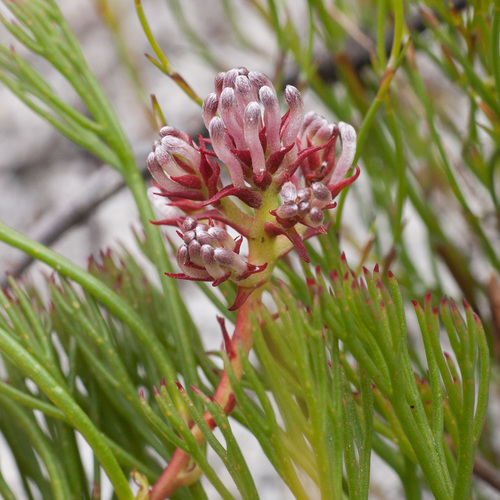
Leaves can grow up to 40 mm (1.6 in) long, and repeatedly divide in groups of three into 5 to 50 narrow segments called laciniae. These laciniae are circular in cross-section, with a diameter of less than 0.5 mm (0.02 in).
Flower Arrangement
The red flowers occur singly or in small groups, hidden within foliage at the ends of branches.
General Flower Morphology
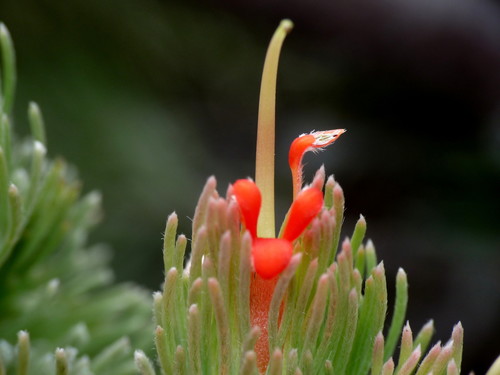
Like most other Proteaceae, each flower consists of a tubular perianth made of four united tepals, ending in a structure called a limb, plus a single pistil; the stigma of the pistil is initially trapped inside the limb, and is released when the flower opens (anthesis).
Perianth Features
For A. sericeus, the perianth is bright red, around 28 mm (1.1 in) long, hairy on its outer surface but hairless and smooth inside.
Style and Stigma Behavior
The style is approximately 40 mm (1.6 in) long; much longer than the perianth, it stays sharply bent as long as the stigma is trapped inside the limb, then springs into an erect position once the stigma is released.
Fruit Characteristics
The fruit is an oval-shaped achene around 5 mm (0.2 in) long.
Overall Distribution Range
This species has a disjunct distribution that spans roughly 500 km (300 mi) along the south coast of Western Australia.
A. sericeus subsp. sericeus Range
A. sericeus subsp. sericeus occurs mostly around King George Sound, extending west to Torbay Inlet and east almost to Cape Riche, and sometimes grows very close to the sea.
Subspecies Distribution Gap
There is a gap of over 300 km (200 mi) between this subspecies and populations of A. sericeus subsp. sphalma at Cape Le Grand.
Additional A. sericeus subsp. sphalma Population
An additional group of A. sericeus subsp. sphalma occurs 100 km (60 mi) further east at Cape Arid.
Soil Preferences
Both subspecies are calcifuge, meaning they only grow in siliceous sands formed from weathered granite. As a result, most populations are associated with granite monadnocks.
Population Abundance
Although the species' overall range is restricted, it is locally common and often the dominant species in the areas where it grows.
Associated Plant Species
A. sericeus subsp. sphalma is often found growing alongside Nuytsia floribunda, Kunzea baxteri, and Xanthorrhoea species.
Flowering Periods
Both subspecies flower throughout the year, though A. sericeus subsp. sphalma peaks in flowering between August and December.
Disease Susceptibility
A. sericeus is susceptible to Phytophthora cinnamomi dieback.
Garden Ornamental Value
While A. sericeus's flowers are not prominent, it is valued as an attractive garden plant for the color and texture of its dense foliage. It tolerates salt-laden winds very well, making it an excellent screening plant for coastal areas.
Christmas Tree Use
In the Albany area, branches or whole potted A. sericeus plants are used as Christmas trees, as young plants have the shape of small pine trees but have a soft, silky texture.
Fertiliser Response
A study of controlled-release fertiliser use on potted A. sericeus found that the plant benefits from increasing fertiliser levels, unlike other species that stop showing improved growth at lower fertiliser levels.
Propagation Methods
The species is propagated by cuttings, which root easily, but care must be taken to avoid over-misting the foliage, which will cause rot.
Cultivation Requirements
A. sericeus requires very good drainage, and grows poorly in humid areas. It lacks a lignotuber, so it only tolerates light pruning.
Cultivars
Several cultivars of A. sericeus are now available, including two that were developed and propagated in Israel.
Commercial Foliage Use
The species' silvery foliage is used commercially in the cut flower industry. It has an unusually long vase life: tests have recorded a vase life of 30 days, regardless of treatment or harvest time of year.