About Tectona grandis L.f.
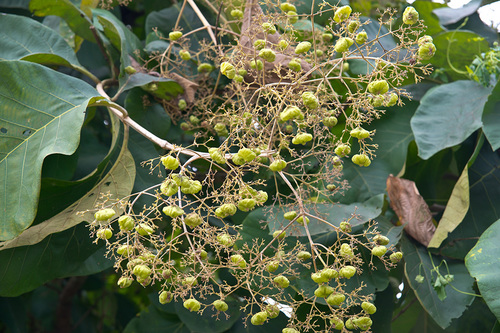
Tectona grandis L.f., commonly known as teak, is a large deciduous tree that can reach up to 40 m (131 ft) in height, with grey to greyish-brown branches, and is widely recognized for its high-quality wood. Its leaves are ovate-elliptic to ovate, measuring 15–45 cm (5.9–17.7 in) long and 8–23 cm (3.1–9.1 in) wide, borne on robust petioles 2–4 cm (0.8–1.6 in) long, with entire leaf margins. Fragrant white flowers grow in panicles that are 25–40 cm (10–16 in) long and up to 30 cm (12 in) wide, blooming from June to August. The corolla tube is 2.5–3 mm long, with obtuse lobes 2 mm wide. Teak produces fruit from September to December; the fruits are globose, with a diameter of 1.2–1.8 cm. Teak flowers are weakly protandrous: anthers mature before the stigma, and pollen is shed within a few hours of the flower opening. Flowers are primarily pollinated by insects (entomophilous), but can occasionally be pollinated by wind (anemophilous). A 1996 study found that in teak's native range in Thailand, major pollinators are species in the bee genus Ceratina. Tectona grandis is one of three species in the genus Tectona. The other two species, T. hamiltoniana and T. philippinensis, are endemics with relatively small native distributions in Myanmar and the Philippines, respectively. Tectona grandis is native to India, Bangladesh, Sri Lanka, Indonesia, Myanmar, northern Thailand, northwestern Laos, and southern Vietnam. It grows in a wide range of habitats and climatic conditions, from arid areas with only 500 mm (20 in) of annual rain to very moist forests with up to 5,000 mm (200 in) of annual rain. Most typically, though, areas where teak grows have an average annual rainfall of 1,250–1,650 mm (49–65 in), with a 3–5 month dry season. Teak's natural oils make it useful for exposed locations, and make its timber resistant to termites and other pests. It remains durable even when not treated with oil or varnish. Timber from old-growth teak trees was once thought to be more durable and harder than plantation-grown teak, but studies show plantation teak performs equally well as old-growth teak in erosion rate, dimensional stability, warping, and surface checking, though it is more susceptible to colour change from UV exposure. The vast majority of commercially harvested teak is grown on teak plantations in Indonesia, managed by Perum Perhutani, a state-owned forest enterprise that oversees the country's forests. Most teak harvested in Indonesia is used to produce outdoor teak furniture for export. Nilambur, in Kerala, India, is also a major teak producer, and hosts the world's oldest teak plantation. Teak consumption raises several environmental concerns, including the disappearance of rare old-growth teak. However, teak's popularity has led to growth in sustainable plantation teak production across forestry plantations in the seasonally dry tropics. The Forest Stewardship Council offers certification for sustainably grown and harvested teak products. Propagation of teak via tissue culture for plantation use is commercially viable. Teak plantations were widely established in Equatorial Africa during the colonial era. These timber resources, along with oil reserves, were at the heart of the 2014 South Sudanese conflict. Most of the world's teak is exported by Indonesia and Myanmar. There is also a rapidly growing market for plantation-grown teak in Central America (Costa Rica) and South America. As remaining natural teak forest hectares are depleted, growth of teak plantations in Latin America is expected to increase. Hyblaea puera, commonly called the teak defoliator, is a moth native to southeast Asia that is a teak pest; its caterpillar feeds on teak and other tree species common in the Southeast Asian region. Teak has a high oil content, high tensile strength, and tight grain that make it particularly suitable for applications requiring weather resistance. It is used to make outdoor furniture and boat decks, and also for cutting boards, indoor flooring, countertops, and as a veneer for indoor finishings. While it is easily worked, the silica present in teak wood can cause severe blunting of edged tools. Over time, especially when exposed to sunlight, teak weathers to a silvery-grey finish. It is used extensively in India to make doors, window frames, furniture, columns, and beams for homes, as it is resistant to termite attacks and damage from other insects. Mature teak commands a very good price, and is widely grown in forest areas by forest departments of different Indian states. Teak was also used in the construction of the Kaaba in Masjid al-Haram, Mecca, the holiest structure in the Islamic faith. Teak tree leaves are used to make Pellakai gatti (jackfruit dumpling), where batter is poured into a teak leaf and steamed; this use is found in the coastal district of Udupi in the Tulunadu region of South India. Teak leaves are also used in gudeg, a dish of young jackfruit from Central Java, Indonesia, and give the dish its characteristic dark brown colour. Teak is used as a food plant by the larvae of moths of the genus Endoclita, including E. aroura, E. chalybeatus, E. damor, E. gmelina, E. malabaricus, E. sericeus and E. signifer, as well as other Lepidoptera including the turnip moth.