About Tamias quadrivittatus (Say, 1823)
Physical Traits
This species, the Colorado chipmunk (Tamias quadrivittatus), is the largest of the three chipmunk species found in Colorado's Front Range, alongside the smaller least chipmunk and Uinta chipmunk. Adults average around 62 grams (2.2 ounces) in weight.
Key Identifying Features
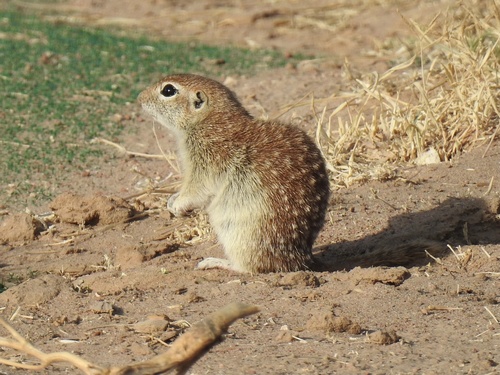
Unlike ground squirrels, chipmunks have a distinct stripe running across the face under the eye. There are no visible size or form differences between males and females of this species.
Vocalization Purpose
Vocalizations play a key role in defending the Colorado chipmunk's territories.
Recognized Subspecies
Three subspecies of Tamias quadrivittatus are currently recognized: T. q. australis is found in the Organ Mountains of New Mexico, T. q. oscuraensis in the Oscura Mountains of New Mexico, and the nominate subspecies T. q. quadrivittatus ranges across Colorado, northern New Mexico, northern Arizona, and eastern Utah.
Core Habitat Range
The Colorado chipmunk primarily lives in coniferous forests of the Southern Rocky Mountains.
Northern Elevation Boundaries
In northeastern Colorado, competition with the higher-elevation Uinta chipmunk strictly bounds its range, and the Colorado chipmunk mainly occurs in open woodlands between 1,500 metres (4,900 ft) and 2,100 metres (6,900 ft).
Southern Elevation Boundaries
In southern Colorado, where Uinta chipmunks are not present, the Colorado chipmunk inhabits montane forests and meadows up to 3,200 metres (10,500 ft).
Isolated Population Habitats
Isolated populations in the Oscura and Organ Mountains of New Mexico have different habitat preferences than northern populations. Colorado chipmunks in the Oscura Mountains are closely tied to old-growth pinyon-juniper woodland, while those in the Organ Mountains rely on cool microclimates formed by arroyos.
Litter Frequency Factors
The number of litters a Colorado chipmunk produces each year ranges from one to two, depending on the elevation of its habitat.
Mating Period
Mating most often happens in spring, right after chipmunks emerge from their burrows. Females are only receptive to mating for a couple of days after they leave their burrows.
Gestation and Birth
Around one month after mating, females give birth to litters of 5 to 8 altricial (underdeveloped at birth) young.
Weaning Timeline
Young chipmunks are weaned between 40 and 50 days after birth.