About Tamarindus indica L.
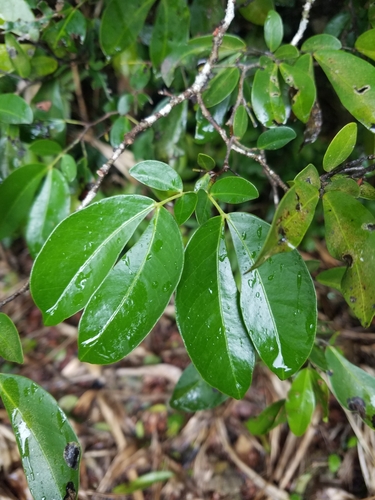
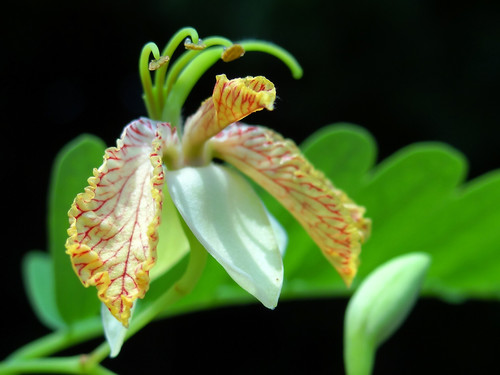
Tamarindus indica L., commonly known as tamarind, is a long-lived, slow-growing tree that reaches a maximum crown height of 25 to 30 meters (82 to 98 feet). It has an irregular, vase-shaped dense foliage crown that can grow up to 12 m (39 ft) wide, and its trunk may reach a circumference of 7.5 m (25 ft). Tamarind grows best in full sun, and tolerates clay, loam, sandy, and acidic soil types. It has high resistance to drought and wind-borne salt typical of coastal areas. As a tropical species, it is sensitive to frost. Its evergreen leaves are alternately arranged and paripinnately compound; leaflets are bright green, elliptic-ovular, pinnately veined, and less than 15 centimetres (6 inches) in length. The pinnate arrangement of opposite leaflets creates a billowing effect when moved by wind. As the tree matures, branches droop from a single central trunk; in agricultural settings, branches are often pruned to improve tree density and simplify fruit harvest. Tamarind timber has hard, dark red heartwood and softer, yellowish sapwood. Its flowers bloom inconspicuously, are elongated with red and yellow coloring, measure 2.5 cm (1 in) across, and have five petals. They grow in small racemes, and are yellow with orange or red streaks. Flower buds are pink due to their four pink sepals, which are shed when the flower opens. Tamarindus indica is indigenous to tropical Africa, where it grows in the wild. It has been cultivated on the Indian subcontinent for thousands of years, so it is sometimes incorrectly reported to be indigenous there. It grows wild in Oman, particularly in Dhofar, on the sea-facing slopes of mountains. It most likely reached South Asia via human transportation and cultivation several thousand years ago. Today it is widely distributed across all tropical regions, from Africa to South Asia and Australia. In Madagascar, the fruit and leaves of this tree are a well-known favorite food of ring-tailed lemurs, and can make up as much as 50 percent of the species' annual food resources when available. In the 16th century, Spanish and Portuguese colonists introduced tamarind to Mexico and Central America, and to a lesser extent South America, where it eventually became a common staple ingredient in regional cuisine. Most parts of the tamarind tree (including wood, bark, flowers, leaves, pulp, and seeds) have a range of environmental, commercial, and culinary uses. Tamarind trees are planted as shade and ornamental trees, commonly grown along highways and in public parks. In folk medicine, tamarind fruit is used as a poultice placed on the forehead of people suffering from fevers in Southeast Asia. The fruit has natural laxative effects that ease constipation. In Java, extracts of steamed and sun-dried old tamarind pulp, called asem kawa, are used to treat skin problems such as rashes and irritation; one traditional practice holds that diluted tamarind can be ingested as an abortifacient. Different parts of the tamarind plant are used for other folk medicine purposes around the world. In northern Nigeria, tamarind roots are believed to help treat leprosy. In American folk medicine, tamarind pulp is recognized as a laxative, and used to relieve symptoms of sunstroke and sore throats. In Thailand, tamarind pulp is made into tablets that people use in the belief it will support weight loss. In Brazil, tamarind pulp is used for its supposed hydrating effects. In India and Cambodia, powdered tamarind seeds are used in an attempt to treat dysentery. In Ethiopia, softened tamarind seeds are used as a potential treatment for parasitic worms. To improve germination, tamarind seeds can be scarified or briefly boiled before planting. Seeds retain their ability to germinate for several months if stored in dry conditions. Tamarind is a traditional food plant in Africa. While it is not grown on a large commercial scale, it has potential to improve nutrition, boost food security, support rural development, and maintain sustainable land care. The tree is widely cultivated across India, most notably in the states of Maharashtra, Chhattisgarh, Karnataka, Telangana, Andhra Pradesh, and Tamil Nadu. In the late 20th century, extensive tamarind orchards in India produced 250,000 tonnes (250,000 long tons; 280,000 short tons) annually. It has been naturalized for a long time in Indonesia, Malaysia, Sri Lanka, the Philippines, the Caribbean, and the Pacific Islands. Among ASEAN nations, Thailand has the largest tamarind plantations, followed by Indonesia, Myanmar, and the Philippines. In parts of Southeast Asia, tamarind is called asam. In the United States, tamarind is grown as a large-scale commercial crop, with net production second only to India; cultivation is concentrated in southern states, particularly south Florida. It is also grown as a shade tree along roadsides, in dooryards, and in parks.