About Cynometra ramiflora L.
Cynometra ramiflora L. is a tree that reaches 10 to 20 meters in height. Its trunk can grow up to 60 cm in diameter at breast height, and it may be buttressed, multistemmed, with a red blaze visible in longitudinal cuts through the bark.
Leaf Characteristics
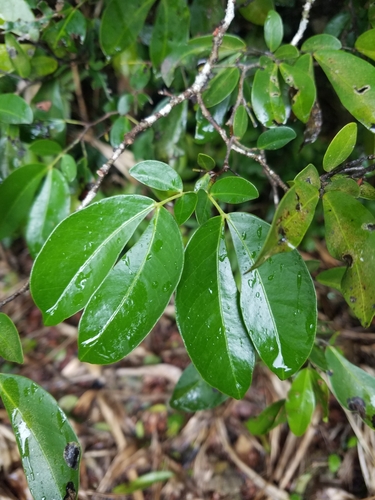
Its leaves are compound, typically with one pair of leaflets, and rarely two pairs. New leaves are pink. Lateral veins form loops well inside the margin of the leaf blade.
Floral Features
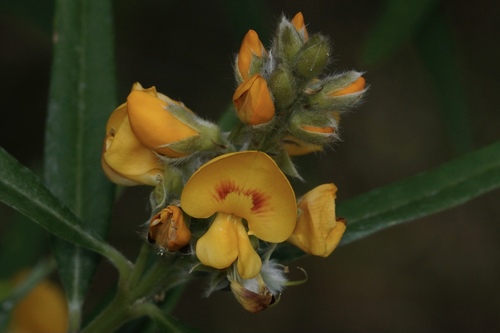
The inflorescence axis grows up to 20 mm long, holds up to 20 flowers, and has white petals.
Fruit Characteristics
The fruit is an asymmetrical, roughly globose woody nut, measuring approximately 45 × 39 × 34 mm, colored rust brown, and contains a single seed.
Flowering and Fruiting Timing
Flowering has been recorded in August and October for cultivated individuals, while fruiting has been recorded in October in Queensland and in May for cultivated plants.
Distinguishing Traits in Australia
In Australia, C. ramiflora can be distinguished from other members of the Cynometra genus by glabrous leaf rachises and petiolules (these are minutely hairy or glabrescent on Christmas Island), globose fruit with a small beak near the apex of the dorsal side, and its pink new leaves.
General Habitat Preferences
This species grows on rocky and sandy seashores, along tidal rivers, on the landward side of mangrove forests, and in inland forests up to 400 m in elevation. It occurs most often in environments that experience flooding or have consistently high soil moisture, and can grow in primary, secondary, and disturbed forests.
Saipan Population Habitat
In the native limestone forest of Saipan, the largest island of the Northern Mariana Islands, it is a canopy co-dominant with Pisonia grandis, and is one of the most common understorey species alongside Guamia mariannae.
Australian Range Habitat
At Cape York Peninsula (Queensland) and Christmas Island, it grows in mangrove forests and adjacent rainforest, especially in seasonally flooded areas, at elevations from sea level up to 20 m.
Cambodia Habitat
In Cambodia, it grows in back-mangrove forests and freshwater flooded forests.
Native Distribution
The native distribution of Cynometra ramiflora includes New Caledonia, Caroline Islands, Solomon Islands, Guam, Federated States of Micronesia, Northern Mariana Islands, Queensland (Australia), Bismarck Archipelago, New Guinea, Maluku, Palau, Lesser Sunda Islands, East Timor, Sulawesi, Philippines, Borneo, Java, Sumatra, Christmas Island, Singapore, Malaysia, Thailand, Cambodia, Nicobar Islands, Andaman Islands, Bangladesh, India, and Sri Lanka.
Naturalized Distribution
It has also been naturalized in the Society Islands, including Tahiti.
Queensland Local Distribution
In Queensland, the species is only known from the tip of Cape York.
Myanmar Local Distribution
In Myanmar, it occurs in the Tanintharyi Region, Ayeyarwady Region, and Rakhine State.
Faunal Food Sources
In Manusela National Park on Seram, eastern Indonesia, the fruit of C. ramiflora is eaten by the red-cheeked parrot Geoffroyus geoffroyi, while the flowers or nectar are fed on by the Seram friarbird Philemon subcorniculatus. It also acts as a food source for the Nolidae moth Carea costiplaga Swinhoe, 1893.
Timber Uses
Cynometra ramiflora produces hard, heavy timber that is used in small volumes for construction, including door posts. The wood is also used for tool handles, wood craft, and ornamental work.
Ornamental and General Medicinal Uses
The species is cultivated as an ornamental, and its leaves, roots, and seeds are harvested for use in traditional medicine.
Cambodia Local Uses
In Cambodia, the wood is used for temporary construction and makes excellent firewood.
India Local Medicinal Uses
In India, leaves are boiled in cow's milk, mixed with honey, and applied externally to treat skin diseases. Seed oil is also applied externally for skin diseases, while the root is used as a purgative and cathartic.
Sumatra Cultural Significance
Among the Rejang people of southwestern Sumatra, C. ramiflora is one of the most commonly designated sialang trees: these are tall, prominent forest trees that host a nest of the honeybee Apis dorsata. Each sialang tree is believed to have a sacred occupant, usually a female deity (sometimes called Sernad Belelkat), that owns the bees, nest, and honey. Gathering wild honey from these trees is considered an act that enters the perilous realm of the spirit world, requiring appropriate precautions.