About Tamandua tetradactyla (Linnaeus, 1758)
Species Introduction
The southern tamandua (Tamandua tetradactyla) is a medium-sized anteater, with considerable size variation tied to environmental conditions.
Body and Tail Length
Its head and body length ranges from 34 to 88 cm (13 to 35 in), and it has a prehensile tail 37 to 67 cm (15 to 26 in) long.
Weight and Sexual Dimorphism
Adult southern tamanduas weigh 1.5 to 8.4 kg (3.3 to 18.5 lb), and males and females show no significant size difference.
Limb Structure and Locomotion
Like its close relative the northern tamandua, the southern tamandua has four clawed digits on its forefeet and five on its hind feet, and walks on the outer surfaces of its forefeet to avoid puncturing its palms with its sharp claws.
Tail Adaptations
The underside and tip of the tail are hairless, an adaptation that helps the species climb and hold onto branches.
Snout and Tongue Structure
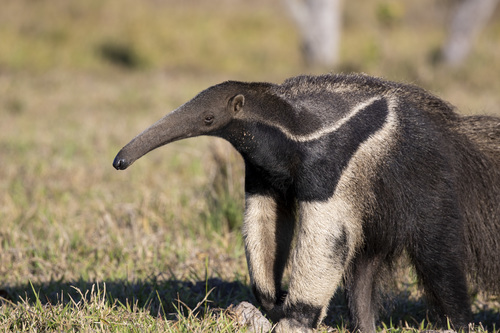
It has a long, downcurved snout with an opening only as wide as the diameter of a stick, through which its tongue is extended.
Species Distinguishing Features
While some skull shape differences between southern and northern tamanduas exist, the easiest way to distinguish southern tamanduas is by their slightly longer average ear length: about 5 cm (2.0 in), compared to 4 cm (1.6 in) for northern tamanduas.
Taxonomic Classification Challenges
Individual and geographic variation in southern tamanduas has made taxonomic classification of the species difficult.
Southeastern Population Coloration
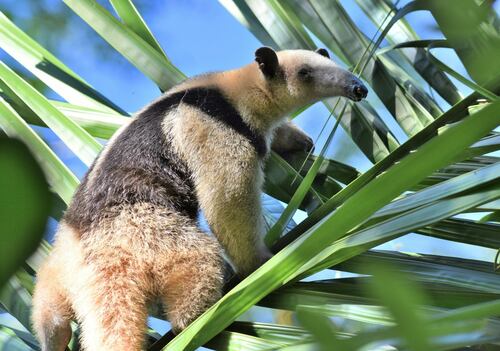
Individuals from the southeastern portion of the species' range are strongly vested, with black markings extending from the shoulder to the rump; the black patch widens near the shoulders and encircles the forelimbs, while the rest of the body is blonde, tan, or brown.
Northern and Andean West Population Coloration
Individuals from northern Brazil and Venezuela west of the Andes are solid blonde, brown, or black, or only lightly vested.
Trinidad Population Coloration
Almost all individuals from Trinidad are solid blonde.
Geographic Range and Elevation
Southern tamanduas are found in Trinidad, and across South America from Venezuela to northern Argentina, southern Brazil, and Uruguay, at elevations up to 1,600 m (5,200 ft).
Habitat Types
They inhabit both wet and dry environments, including tropical rainforest, savanna, and thorn scrub.
Preferred Habitat Features
They are most common in habitats near streams and rivers, particularly those with dense vines and epiphytes, where their prey is believed to be abundant.
Evolutionary History
The oldest fossil tamanduas date to the Pleistocene of South America, though genetic evidence indicates the southern tamandua diverged from its closest relative, the giant anteater, in the late Miocene, 12.9 million years ago.
Mating Cycle
Female southern tamanduas are polyestrous, and mating generally occurs in the fall.
Estrous and Gestation Periods
The estrous cycle lasts approximately 42 days, and gestation ranges from 130 to 190 days.
Offspring Production
Females give birth to one offspring per year.
Newborn Appearance
Newborn southern tamanduas do not resemble adult individuals, and their coat color ranges from white to black.
Juvenile Behavior
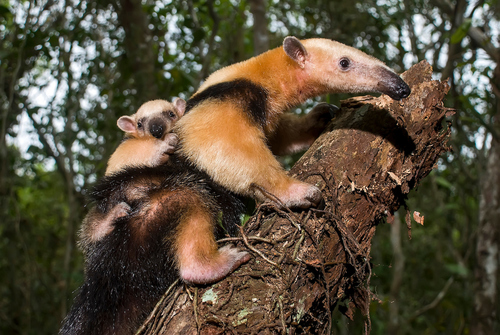
Young anteaters ride on the mother's back for several months to up to a year, and the mother sometimes leaves her offspring on a safe branch while she forages.