About Tamandua mexicana (Saussure, 1860)
Physical Appearance
The northern tamandua (Tamandua mexicana) is a medium-sized anteater. It has a prehensile tail, small eyes and ears, and a long snout.
Fur Coloration
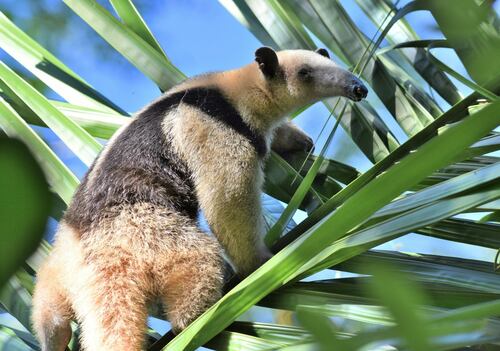
Most of its body is covered in pale yellow fur, with a distinctive black fur patch covering the flanks, back, and shoulders that roughly resembles the shape of a vest. The upper surface of the tail is furred for about one third of its length, and the rest of the tail is hairless.
Limb and Body Measurements
Northern tamanduas have five toes on their hind feet, but only four toes on their fore feet. Males and females are similar in size and color; their total body length including the tail ranges from 102 to 130 centimetres (40 to 51 in), with the tail itself measuring 40 to 68 centimetres (16 to 27 in).
Adult Weight
Adult individuals weigh between 3.2 to 5.4 kilograms (7.1 to 11.9 lb).
Southern Tamandua Similarity
This species closely resembles the closely related southern tamandua. Unlike the northern tamandua, which always has the distinct black vest pattern, southern tamanduas vary greatly in appearance across their range.
Southern Tamandua Appearance Variation
Some southern tamandua populations are entirely pale, pale with an incomplete vest, or entirely dark; others do have the same black vest seen in northern tamanduas. The two species are more reliably distinguished by differences in size, ear length, skull shape, and the number of tail vertebrae.
Range Separation
Their geographic ranges also do not overlap.
Diet Adaptation Overview
Like other anteaters, the northern tamandua is highly adapted to its specialized diet. It has a long, extendable tongue covered in sticky saliva that it uses to pick up ants and termites.
Tongue Muscle Structure
Unusually well-developed tongue muscles attach to a large hyoid bone and are rooted to the top of the sternum. The entire oral cavity is modified to fit this long tongue, and is so elongated that the back of the soft palate sits level with the fifth cervical vertebra near the base of the neck, instead of at the top of the pharynx as it does in most other mammals.
Jaw and Dental Features
The jaw muscles and mandible are reduced in size, and the mandible is particularly fragile. As with other anteaters, the northern tamandua has no teeth.
Arboreal Adaptation Overview
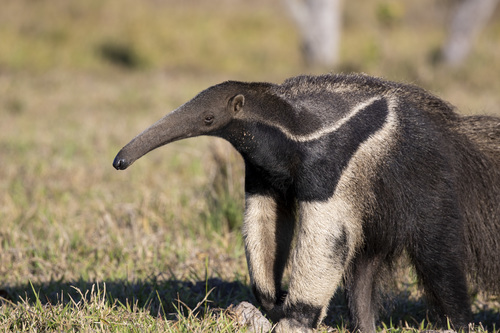
In addition to adaptations for its diet, and unlike the giant anteater, the northern tamandua is also adapted for an arboreal, tree-dwelling, lifestyle. Specialized toe muscles and a tough thick pad on the palms make the forefeet prehensile, allowing the anteater to grip onto protruding branches and other surfaces while climbing.
Claw Adaptation
The middle toe of the forefeet also carries an unusually large claw, and the toe has enough muscle and leverage to rip open wood to reach ants inside it.
Geographic Range
Northern tamanduas live in forests ranging from southern Mexico, through Central America, to western Colombia, western Venezuela, western Ecuador, and the northwestern corner of Peru. Within this range, they have been recorded living in many different forest types including evergreen forest, deciduous forest, mangrove swamps, cloud forests, and secondary forest.
Subspecies Classification
Four subspecies of Tamandua mexicana are currently recognized: T. m. mexicana, found in Mexico, Guatemala, Belize, Honduras, and El Salvador; T. m. instabilis, found in Venezuela and northern Colombia; T. m. opistholeuca, found in Nicaragua, Costa Rica, Panama, and most of Colombia; and T. m. punensis, found in Ecuador and Peru.
Breeding Cycle
Northern tamanduas have no defined breeding season, and females can enter oestrus at any time of year. Males find fertile females by detecting their scent, and court females through repeated sniffing and swatting with their claws.
Mating and Gestation
During mating, males use their strong fore limbs and tails to hold females in place. Gestation lasts between 130 to 190 days, and a single offspring is born each time.
Offspring Development
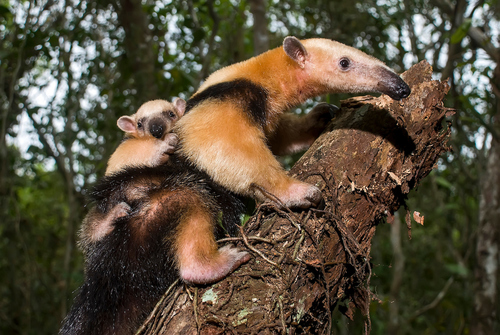
The young anteater first shelters in a nest inside a hollow tree, but later travels by clinging to its mother's back. Young northern tamanduas leave their mother at around one year of age, and the species has been recorded living up to 9.5 years in captivity.