About Syngnathus louisianae Günther, 1870
Taxonomy
Chain pipefish, scientifically named Syngnathus louisianae Günther, 1870, belongs to the family Syngnathidae.
Body Form
This is an elongate fish whose body is encased in bony plates.
Head and Fin Structure
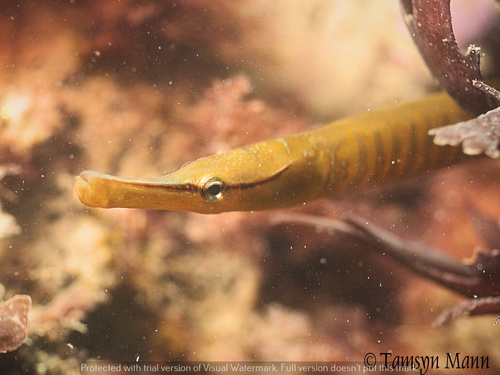
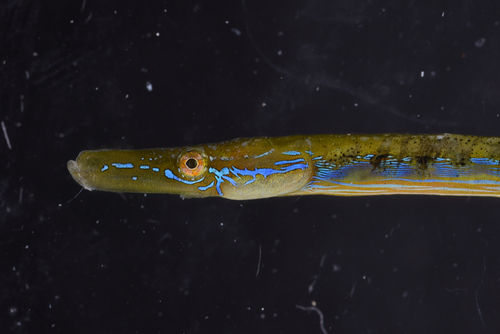
It has a moderate-sized head, a rounded caudal fin, a long snout, and a small terminal mouth.
Fin Morphology
Its dorsal fin is moderate in length, its anal fin is greatly reduced, and it has no pelvic fins.
Abdomen Characteristics
The abdomen is flat or concave, and may have a very small keel.
Trunk and Tail Ridges
The inferior trunk and tail ridges are not interrupted.
Male Reproductive Structure
Males of this species develop a brood pouch along the tail.
Fin Ray and Body Ring Counts
This species has 33 to 36 dorsal rays, 2 anal rays, 14 pectoral rays, 20 trunk rings, and 35 to 36 tail rings.
Size
The chain pipefish is one of the largest pipefish species found in the western North Atlantic, reaching a maximum total length of 381 mm (15 inches).
Base Body Coloration
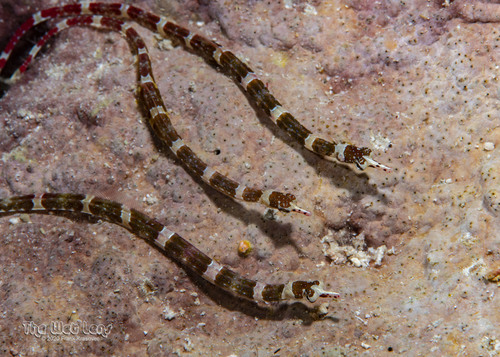
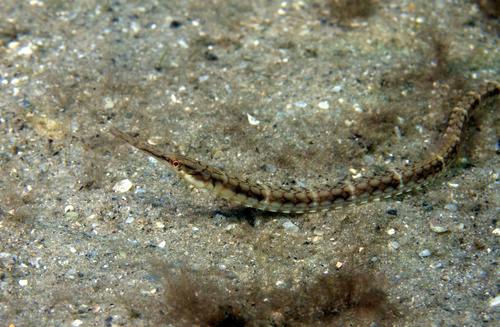
Its body typically has a pale background color ranging from white to light brown, with a dark brown stripe running along the sides that extends onto the snout.
Body Band Pattern
Lighter circular bands wrap around the body between each body ring; these bands do not extend onto the ventral surface of the trunk area, but are visible along the tail.
Fin Coloration
The anal, pectoral, and dorsal fins are usually unpigmented, though they may have some scattered melanophores. The caudal fin is dusky in color.
Inshore Habitat
Chain pipefish are common in seagrass beds, or among the stems of marsh grasses and reeds, in near-shore areas along the Northern Gulf of Mexico.
Offshore Juvenile Habitat
Juvenile chain pipefish can also be found in surface waters up to at least 80 km offshore.
Distribution Range
Their distribution ranges from New Jersey and Maryland southward along the Atlantic coast and Gulf coasts, and they also occur in Tabasco and Campeche, Mexico.
Larval Development Notes
No information is currently available on the larval development of this species, though larvae are initially held within the male brood pouch.
Reproductive Strategy
Male S. louisianae give birth to live young; eggs are transferred from females to a specialized brood pouch (marsupium) carried by males.
Brood Pouch Trait
Unlike most seahorses, Syngnathus pipefishes incubate eggs in an inverted pouch.
Fertilization and Incubation
Fertilization takes place after the female transfers the eggs, and incubation continues until embryos develop into juveniles.
Reproductive Timing
Based on the occurrence of brooding males and newly hatched larvae, reproduction happens primarily during spring and early summer, from April to July, but occurs through most months of the year in Mississippi, with the exception of December and February.
Brooding Male Location
Brooding males are most commonly found offshore.
Egg Characteristics
Fertilized eggs are small, measuring between 0.6 and 1.4 mm in diameter. They are arranged in one to two layers, in up to 10 transverse rows.
Brood Size
A single male can brood between 454 and 898 eggs, with the number depending on the male's body size.