About Phyllopteryx taeniolatus (Lacepède, 1804)
Nomenclature and Taxonomy
The common seadragon, also called the weedy seadragon, has the scientific name Phyllopteryx taeniolatus. It is a marine fish that belongs to the order Syngnathiformes, a group that also includes pipefishes, seahorses, trumpetfishes, and other similar species.
Body Coloration
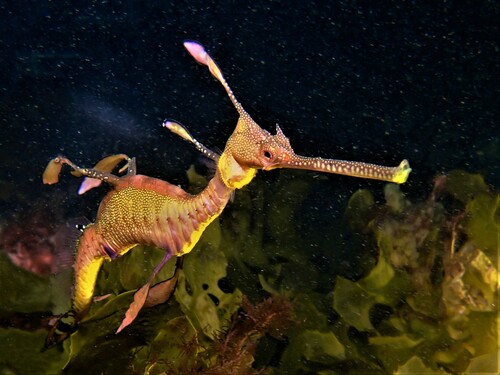
Adult common seadragons are reddish in color, with yellow and purple striped markings.
Camouflage and Protective Structures
They have small, leaf-shaped appendages that look like kelp or seaweed fronds, which help them camouflage, and a set of short spines for protection.
Feeding Anatomy
Like seahorses and other syngnathids, common seadragons have a tubular snout and a fused, toothless jaw, which they use to capture small invertebrate prey very quickly.
Sexual Dimorphism
Males have narrower, darker bodies than females.
Fin Structure
Common seadragons have a long dorsal fin along their back and small pectoral fins on either side of their neck, which help them maintain balance.
Size
The species can reach a total length of 45 cm, or 18 inches.
Official Emblem Status
The common seadragon is the official marine emblem of the Australian state of Victoria.
Distribution Range
This species is endemic to Australian and island coastal waters in the eastern Indian Ocean, northern Southern Ocean, and southwestern Pacific Ocean. It is found along the entire southern coastline of the Australian continent, including Tasmania and other offshore islands. It is regularly observed from the area around Port Stephens, New South Wales, to Geraldton, Western Australia, and also off the coast of South Australia and the Great Australian Bight.
Depth Range
Common seadragons live in coastal waters that are around 10 m (33 ft) to 30 m (98 ft) deep.
Habitat
They are associated with rocky reefs, seaweed beds, seagrass meadows, and any structures that have been colonized by seaweed.