About Synanceia verrucosa Bloch & Schneider, 1801
Coloration
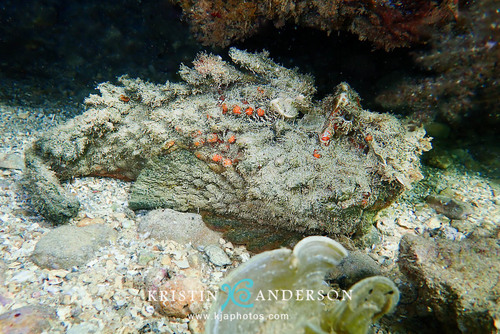
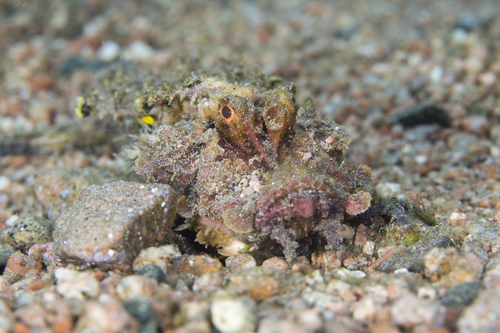
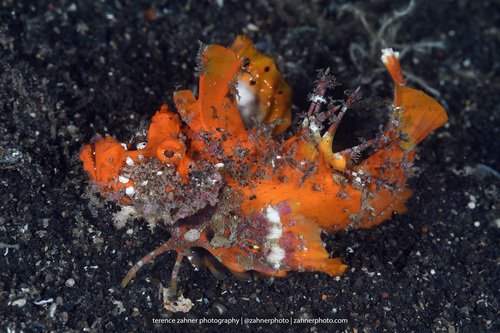
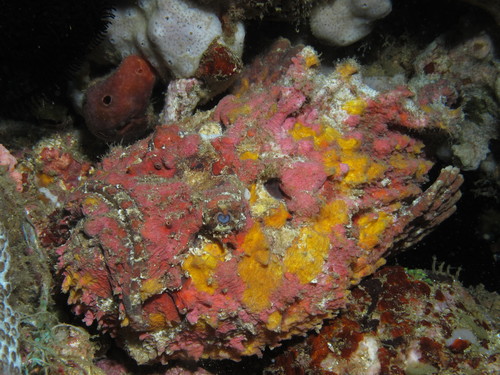
Synanceia verrucosa, commonly called the reef stonefish, is typically brown or grey, and may have patches of yellow, orange, or red.
Fin Structure
Its dorsal fin holds 12 to 14 spines and 5 to 7 soft rays, while its anal fin has 3 spines and 5 or 6 soft rays. Its dorsal spines are all equal in length, each covered by a thick skin sheath that holds venom glands at the spine's base.
Skin Characteristics
This species has scaleless skin covered in numerous warts, and its skin is tough and rough overall.
Head Morphology
It has a wide, flattened head, small upward-pointing eyes that sit in front of a deep pit, with a smaller pit located underneath the eyes. Its pectoral fins are fleshy.
Size
The maximum recorded total length of this species is 40 cm (16 in), though 27 cm (11 in) is a more typical size.
General Distribution
This stonefish lives primarily north of the Tropic of Capricorn. It is the most widespread species in the stonefish family, found in shallow tropical marine waters of the western Pacific Ocean and Indian Ocean, ranging from the Red Sea and coastal East Africa to French Polynesia, southern Japan, and the waters around Taiwan.
Mediterranean Introduction
Recent evidence confirms S. verrucosa has been present in the far eastern Mediterranean Sea since at least 2010, when an individual was caught near Yavne, Israel. It was likely introduced either by release of aquarium specimens or via migration through the Suez Canal, and has since been observed in Turkey, Lebanon, Syria, and Israel.
Habitat
It inhabits coral reefs, and may rest on and around rocks and plants, or directly on the seabed.
Benthic Adaptations
It has evolved multiple adaptations for life on reef bottoms: its irregular skin texture and coloration provide effective camouflage among rocks and corals, and its 13 venom-tipped dorsal spines serve as a defense against threats.
Social Behavior
For most of its life, the reef stonefish is solitary, only gathering briefly with members of the opposite sex during mating season.
Spawning Process
Once sexually mature, females lay unfertilized eggs on the reef floor. A passing male then releases sperm over the layer of eggs to fertilize them.
Egg and Hatchling Traits
Reef stonefish eggs are fairly large, and hatchlings emerge well developed.
Mating System
The species has a promiscuous mating system, as females do not discriminate between males that fertilize their egg layer.
Sexual Dimorphism
Sexual dimorphism is present in this species, with females growing larger than males.
Venom Status
The reef stonefish is the most venomous fish known in the world.
Venom Delivery Anatomy
Its dorsal area is lined with 13 spines, and each spine holds two venom sacs. The spines are stiff and sharp enough to pierce boot soles.
Venom Potency
The fish can release a fatal dose of 18 mg of venom using only six of its thirteen spines.
Venom Composition
While the protein composition of venom differs between the three species of stonefish, the fatal protein in reef stonefish venom is verrucotoxin. Overall, reef stonefish venom is a mixture of proteins, including the hemolytic stonustoxin, the protein verrucotoxin, and the cardiotoxic cardioleputin.
Envenomation Symptoms
Envenomation causes severe pain, shock, paralysis, and tissue death. A large dose can be fatal to humans, particularly for young children, the elderly, and people with weakened immune systems.
Medical Treatment
Standard medical treatment uses antivenom, and a local anesthetic can be used to reduce pain. First aid recommends immersing the affected limb in hot water to denature venom proteins.
Outdated First Aid
Immobilizing venom at the penetration site using a tourniquet or firm constrictive bandaging is no longer recommended.
Long-term Envenomation Effects
Survivors of envenomation may experience permanent nerve damage that leads to local muscle atrophy.
Aquarium Use
Commercially, the primary use of Synanceia verrucosa is as an aquarium species.
Human Consumption
It is also sold for meat in markets in Southern China, and is consumed in the Philippines (especially in Chinese restaurants) and in Japan.