About Symplocarpus foetidus (L.) Salisb. ex W.P.C.Barton
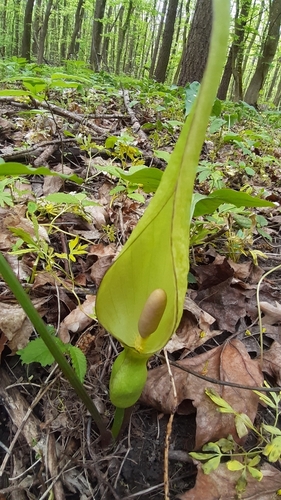
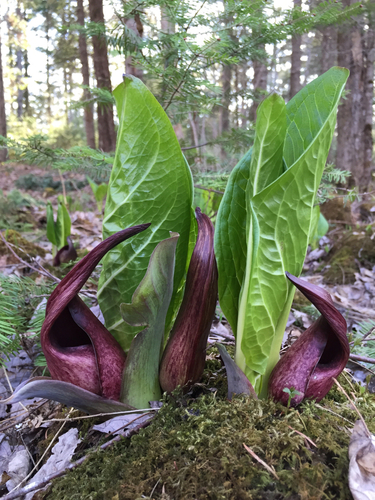
Symplocarpus foetidus, commonly called eastern skunk cabbage, grows from a thick rhizome that typically reaches 30 cm (0.98 ft) in length. It produces large leaves, each measuring 40–55 cm (16–22 in) long and 30–40 cm (12–16 in) wide. It blooms very early in spring, when only its blossoms are visible above mud. Each year as the plant develops, it is gradually pulled back into the earth. Its roots develop permanent wrinkles from contractile activity; these wrinkles often take on a distinct ring-like appearance, especially near the top or older end of mature roots. Over time, the entire stem becomes buried underground, making the plant extremely difficult to dig up. The plant’s inflorescence includes a 10–15 cm (3.9–5.9 in) tall, hood- or shell-shaped spathe that comes in a range of colors. Inside this spathe sits a 5–10 cm (2.0–3.9 in) long spadix that holds the individual flowers. Young spathes are yellowish-green, while older spathes turn darker overall with purple smears. The spathe has mottled patterning that closely matches the dappled sunlight and shifting hues found on forest underbrush when sunlight filters through the tree canopy above. This camouflage makes the plant hard to spot on the forest floor. Eastern skunk cabbage flowers are perfect, meaning each flower has both male and female reproductive organs. Like many blooming plants, it exhibits dichogamy (separating male and female fertility into different time periods) to avoid self-fertilization. This species is protogynous: the female pistils reach sexual maturity before the male stamens do. The small flowers are densely packed on the spadix, so the prominent spathe is the most visible part of the inflorescence. Inflorescences vary in size and number of flowers. Due to the dense crowding of flowers, they do not produce floral parts in multiples of three (the typical pattern for monocots), and instead have four perianth parts. These perianth parts are nearly cuboidal and overlap to form a box-like arrangement. Stamens are positioned opposite the perianth parts. The two-celled anthers are extrorse and fairly flexible. The pistil has a distinctive structure: it has a cuboidal style, a single-celled ovary, and a three-lobed stigma. The plant has two whitish sheathing leaves with parallel veins, which is characteristic of monocots. The true leaves develop coiled tightly inside these sheathing leaves. When the leaf tips break through the surrounding sheaths, they are typically tinged purple, matching the color of the plant’s spathe. This purple tint may appear on the outer surface of the tips of the first and even second leaves. These inner true leaves do not follow typical monocot leaf venation, and instead have the netted veining more commonly seen in dicotyledonous plants. The first three leaves unfold to show a gradual shift toward the netted veining of mature leaves. In all cases, the venation is palmately netted. When viewed under a microscope, the leaves have large air spaces and loosely packed cell structure. Large bundle masses in the leaf contain numerous rhaphides, alongside other crystal forms that can be cuboidal or even spherical. Symplocarpus foetidus reproduces via hard, pea-sized seeds. After developing inside the spadix, mature seeds fall onto the surrounding slimy substrate, and can then be spread by birds, small animals, and floods. Eastern skunk cabbage is native to eastern North America. Its native range covers eastern Canada, the northeastern United States, extends south to the U.S. states of Tennessee and North Carolina, and west to Minnesota. In Canada, its distribution stretches from western Nova Scotia to southeastern Manitoba. In Tennessee, the species is protected as an endangered. It grows in moist habitats including marshes, wet forests, and stream banks. Like other members of the arum family, eastern skunk cabbage grows best in areas with high moisture. Eastern skunk cabbage is one of the rare group of thermogenic plants. It can generate temperatures 15–35 °C (27–63 °F) above air temperature through cyanide-resistant cellular respiration (via alternative oxidase), which allows it to melt through frozen ground. Because of this thermogenic property, spathes can melt a circle of ice surrounding themselves. The spadix maintains consistent heat via thermogenic oscillation: independent of light, it uses an oscillatory temperature-sensing system to regulate temperature under changing external conditions, keeping an equilibrium between heat production and heat loss from radiation, evaporation, conduction, and convection. Airflow around the spathe also helps preserve the heat produced by the spadix. Eastern skunk cabbage blooms when snow and ice still cover the ground, and it is effectively pollinated by early emerging insects active at this time. Some research suggests that the heat produced by the plant not only lets it grow in cold environments, but may also help disperse its odor into the air. The plant produces a skunk-like floral odor that contains dimethyl disulfide, aliphatic hydrocarbons, carboxylic acids, and esters; only female plants produce aromatic hydrocarbons and indole compounds. The fact that the spathe is warmer than the surrounding air may encourage carrion-feeding insects to enter it multiple times, supporting pollination. Common pollinators of eastern skunk cabbage include blowflies such as Calliphora vomitoria. Spider webs are frequently observed at the entrance to spathes: the flower’s carrion-like odor draws in flies, which become trapped in the webs and serve as food for the spiders. Raw eastern skunk cabbage is not recommended for direct human consumption. Its roots have antispasmodic, diaphoretic, diuretic, emetic, expectorant, and slightly narcotic properties. Large amounts of the root cause nausea, vomiting, headaches, and dizziness. Handling fresh leaves can cause skin burns, and poisoning symptoms also include swelling of the lip, throat, and tongue. These negative effects come from calcium oxalate crystals, which are moderately toxic to humans. Toxicity can be removed through careful processing, such as frequent water changes when boiling leaves, or thoroughly drying the plant. Eastern skunk cabbage has a history of use in traditional medicine. Many Native American cultures used the plant extensively as a medicinal herb, spice, and mystical talisman. It was used as an antispasmodic and expectorant; specifically, the Winnebago and Dakota tribes used it to help clear phlegm in people with asthma. Different groups also used it as a talisman and seasoning. From 1820 to 1882, it was used in pharmaceutical products as the medicine "dracontium" to treat respiratory conditions, neurological disorders, rheumatism, and dropsy.