About Struthio camelus Linnaeus, 1758
Scientific Name and Classification
The common ostrich, scientifically named Struthio camelus Linnaeus, 1758, is the tallest and heaviest living bird.
Adult Size
Adult males measure 2.1 to 2.75 m (6 ft 11 in to 9 ft 0 in) tall and weigh 100 to 130 kg (220 to 290 lb), while adult females are approximately 1.75 to 1.9 m (5 ft 9 in to 6 ft 3 in) tall and weigh 90 to 120 kg (200 to 260 lb).
Exceptional males of the nominate subspecies can reach up to 156.8 kg (346 lb), but some specimens in South Africa only weigh between 59.5 to 81.3 kg (131 to 179 lb).
Chick Appearance
Newly hatched chicks are fawn with dark brown spots.
Chick Plumage Development
They begin developing juvenile plumage after three months, which is gradually replaced by adult plumage during their second year.
Chick Growth Rate
By four to five months old, they are already about half the size of an adult; they reach adult height after one year, but do not gain full adult weight until 18 months old.
Adult Male Plumage
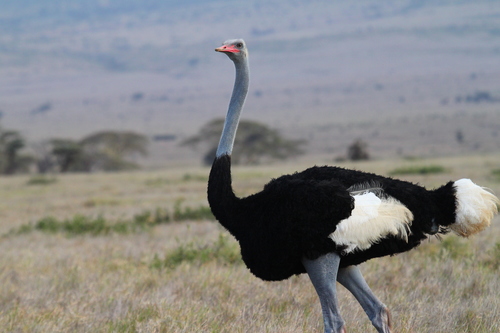
Adult males have mostly black feathers with white primaries and a white tail, though one subspecies has a buff-colored tail.
Adult Female and Juvenile Plumage
Females and young males are grayish-brown and white.
Head and Neck Traits
The head and neck of both sexes is nearly bare, with only a thin layer of down.
Neck and Thigh Skin Color
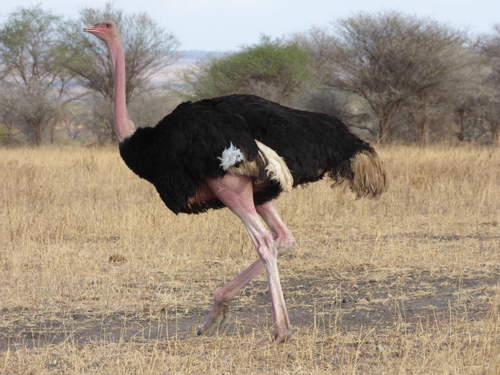
Female neck and thigh skin is pinkish gray, while male skin color is gray or pink depending on the subspecies.
Height and Head Position
The common ostrich's long neck and legs hold its head up to 2.8 m (9 ft 2 in) above the ground.
Eye Characteristics
Its eyes, the largest of any land vertebrate at 50 mm (2.0 in) in diameter, help it spot predators from great distances, and are shaded from overhead sunlight.
Bill Size
Relative to the bird's large body size, its head and bill are relatively small, with the bill measuring 12 to 14.3 cm (4.7 to 5.6 in).
General Skin Color Variation
Overall skin color varies by subspecies: some have light or dark gray skin, others have pinkish or even reddish skin.
Leg and Tarsus Scales
The common ostrich's strong legs are unfeathered with bare skin, and the tarsus (the lowest upright section of the leg) is covered in scales: red on males, black on females.
Tarsus Size
The common ostrich has the largest tarsus of any living bird, measuring 39 to 53 cm (15 to 21 in) long.
Foot Toe Structure
It is didactyl, meaning it has only two toes on each foot, while most birds have four.
The larger inner toe has a nail that resembles a hoof, and the outer toe has no nail.
Running Adaptation
The reduced number of toes is an adaptation that aids running, which helps the ostrich escape predators.
Running Speed and Stride
Common ostriches can run at speeds over 70 km/h (43 mph), and cover 3 to 5 m (9.8 to 16.4 ft) in a single stride.
Wing Size
Their wings reach a span of about 2 m (6 ft 7 in), with a wing chord measurement of 90 cm (35 in) — around the same size as the largest flying birds.
Feather Structure
Unlike flying birds, ostrich feathers lack the tiny hooks that lock external feathers together, so they are soft and fluffy and work as insulation.
Temperature Tolerance
Common ostriches can tolerate a wide range of temperatures; in much of their habitat, temperatures can vary as much as 40 °C (72 °F) between night and day.
Behavioral Thermoregulation
Their temperature regulation relies partially on behavioral thermoregulation: for example, they use their wings to cover the bare skin of their upper legs and flanks to conserve heat, or leave these areas exposed to release heat.
Wing Stabilizer Function
Wings also act as stabilizers to improve maneuverability while running; testing has shown wings are actively used during rapid braking, turning, and zigzag maneuvers.
Feather Count
Common ostriches have 50–60 tail feathers, 16 primary feathers, four alular feathers, and 20–23 secondary feathers on their wings.
Sternum Structure
The common ostrich has a flat sternum that lacks the keel that flying birds use to attach wing muscles.
Beak Structure
Its beak is flat and broad with a rounded tip.
Digestive System Traits
Like all ratites, the ostrich has no crop, and also lacks a gallbladder; its caecum measures 71 cm (28 in).
Excretion System
Unlike all other living birds, the common ostrich secretes urine separately from feces: all other birds store mixed urine and feces in the coprodeum, while the ostrich stores feces in the terminal rectum.
Pubic Bone Structure
It also has unique pubic bones that are fused to support its gut.
Male Reproductive Organ
Unlike most birds, males have a retractable copulatory organ that measures 20 cm (7.9 in) long.
Palate Structure
Its palate differs from other ratites in that the sphenoid and palatal bones are unconnected.
Historical Range
Historically, common ostriches ranged across Africa north and south of the Sahara, East Africa, African lands south of the rainforest belt, and most of Asia Minor.
Current Native Habitat
Today, common ostriches prefer open habitats and are native to the savannas and Sahel of Africa, both north and south of the equatorial forest zone.
In southwest Africa they live in semi-desert or true desert.
Feral Australian Population
Feral populations of farmed common ostriches have become established in Australia.
Extinct and Reintroduction Status
Arabian ostriches of the Near and Middle East were hunted to extinction by the middle of the 20th century, and attempts to reintroduce common ostriches to Israel have failed.
Red Sea Island Records
Common ostriches have occasionally been recorded living on islands in the Dahlak Archipelago, in the Red Sea near Eritrea.
Prehistoric Indian Ostrich Evidence
Research from the Birbal Sahni Institute of Palaeobotany in India found molecular evidence that ostriches lived in India 25,000 years ago.
Indian Ostrich Genetic Relationship
DNA testing of fossilized eggshells recovered from eight archaeological sites in the Indian states of Rajasthan, Gujarat and Madhya Pradesh found 92% genetic similarity between these eggshells and the North African ostrich, so these ostriches could have been fairly distant relatives.
Australian Introduction Background
Ostriches were introduced to Australia for farming, and a large feral population now lives in the Australian outback.
Non-breeding Social Structure
Common ostriches usually spend the winter months in pairs or alone; only 16 percent of common ostrich sightings are of groups larger than two birds.
Breeding Season Social Structure
During breeding season and sometimes during extended dry periods, ostriches form nomadic groups of five to 100 birds led by a top hen, and these groups often travel alongside other grazing animals such as zebras or antelopes.
Activity Patterns
Ostriches are diurnal, but may be active on moonlit nights; they are most active in the early and late parts of the day.
Male Territory Size
Male common ostricich hold territories of 2 to 20 km2 (0.77 and 7.72 sq mi).
Predator Detection
With their sharp eyesight and hearing, common ostriches can detect predators such as lions from far away.
Running Speed Records
When pursued by a predator, they can reach speeds over 70 km/h (43 mph), and possibly up to 80 km/h (50 mph), and can maintain a steady speed of 50 km/h (31 mph), making the common ostrich the fastest bipedal animal.
Anti-predator Hiding Behavior
When lying down to hide from predators, the birds flatten their heads and necks against the ground.
Combined with heat haze in their hot, dry habitat, this makes them look like a mound of earth from a distance.
Anti-predator Defense Mechanism
When threatened, common ostriches typically run away, but their powerful leg kicks can cause serious injury or death; ostriches can only kick forward, and a kick can produce a force of 225 kgf (2,210 N; 500 lbf).
Historical Human Uses
In Roman times, common ostriches were in demand for venation games, cooking, and medicine.
Feather Hunting and Farming Origins
They have been hunted and farmed for their feathers, which were at various times popular for ornamentation in fashionable clothing, such as hats during the 19th century.
Their skins are valued for leather.
18th–19th Century Farming History
In the 18th century they were hunted almost to extinction; commercial farming for feathers began in the 19th century.
Early 20th Century Farming Scale
By the start of the 20th century, over 700,000 common ostriches were held in captivity.
Late 20th Century Farming Trends
The feather market collapsed after World War I, but commercial farming for feathers, and later for skins and meat, became widespread during the 1970s.
South African Farming History
Common ostriches have been farmed in South Africa since the start of the 19th century.
Early Taming Practice
According to Frank G. Carpenter, the English are credited with first taming common ostriches outside Cape Town.
Farmers captured baby common ostriches and raised them successfully on their land, and could harvest a crop of feathers every seven to eight months instead of killing wild common ostriches for their feathers.
Feather Harvest
Feathers are still harvested commercially.
Leather Quality
Common ostrich leather is claimed to be the strongest commercial leather available.
Meat Nutritional Profile
Common ostrich meat tastes similar to lean beef, and is low in fat and cholesterol, as well as high in calcium, protein, and iron.
Meat Classification and Appearance
It is considered both poultry and red meat.
Uncooked, it is dark red or cherry red, slightly darker than beef.
Ostrich Meat Dish
Ostrich stew is a dish made with common ostrich meat.
Farm Agritourism
Some common ostrich farms also host agritourism, which can make up a substantial portion of the farm's income; agritourism activities may include farm tours, souvenirs, and even ostrich rides.