About Sterculia foetida L.
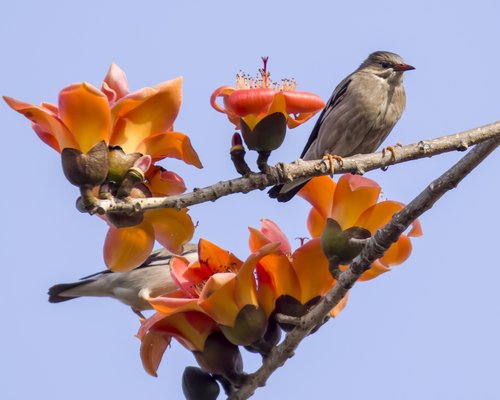
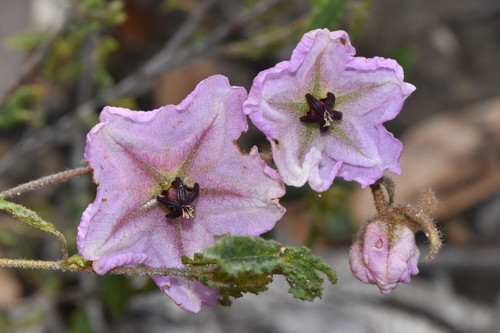
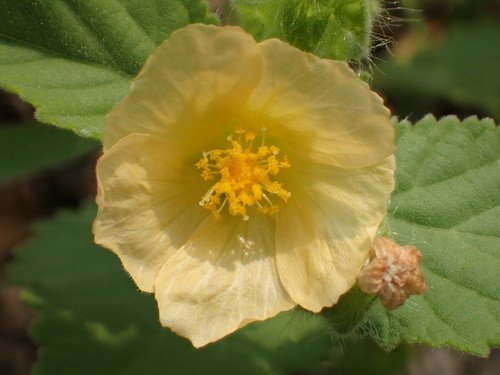
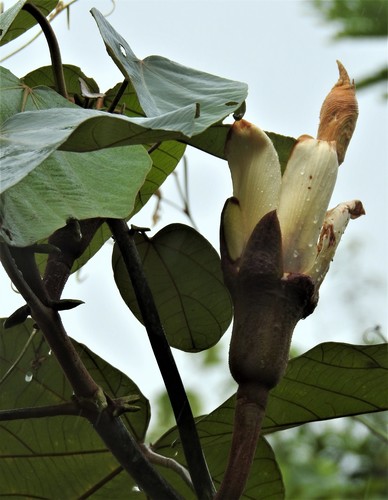
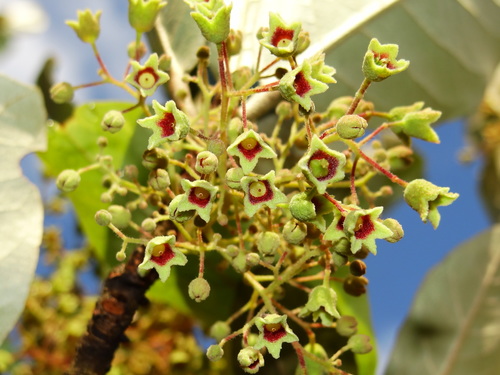
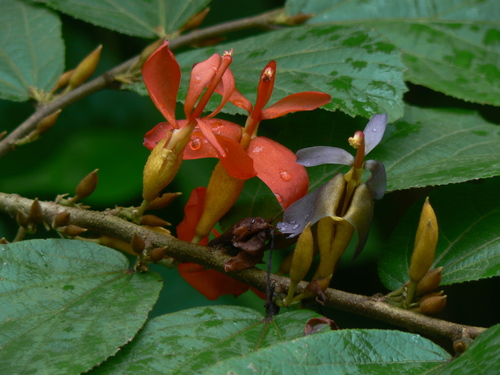
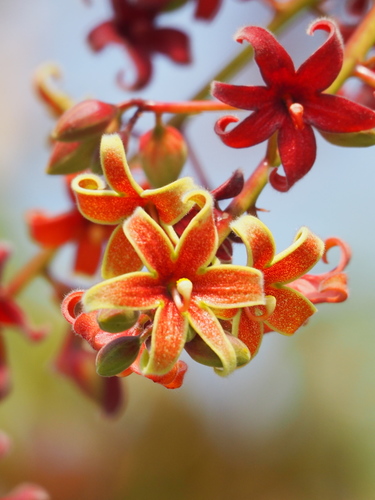
Sterculia foetida L. has horizontally spreading branches arranged in whorls. Its bark is smooth and gray. Leaves grow at the ends of branchlets, with petioles between 12.5 and 23 centimetres (4.9 and 9.1 inches) long. Leaf blades are palmately compound, holding 7 to 9 leaflets. The leaflets are elliptical, 100–170 mm long, and have short petiolules. Both the petioles and flowers of this plant produce a foul odor. Plant explorer David G. Fairchild, who personally smelled many of the world's foulest-smelling flowers, considered Sterculia foetida to have the worst smell of all. Its flowers are arranged in panicles 10–15 cm (4–6 in) long. The large green or purple flowers are unisexual, as the species is dioecious, meaning male and female flowers grow on separate individual trees. Its pollen grains are oval in shape, around 40 microns in length. The calyx is dull orange and split into five sepals, each 10–13 millimetres (3⁄8–1⁄2 in) long. The fruit is made up of four to five follicles, and each follicle usually contains 10 to 15 seeds. Ripe follicles are scarlet in color. In most of India, this species flowers in March, and new leaves emerge between March and April. In Hyderabad, India, flowering was recorded in September–October 2015, with ripe fruits on the upper sections of the tree and young unripe green fruits on the lower branches. Fruits ripen in February, 11 months after flowers appear. Sterculia foetida occurs naturally or has been found in India, Bangladesh, Taiwan, Indochina, the Philippines (where it is called kalumpang), Hawaii (United States), Indonesia, Ghana, Australia, Mozambique, and Togo. The oil from Sterculia foetida is comparable to sunflower, soybean, and grapeseed oils for use as a biofuel. This oil contains cyclopropene fatty acids (CPFA), specifically malvalic acid (8,9 methylene-heptadec-8-enoic acid) and sterculic acid (9,10-methylene-ocadec-9-enoic acid). Its measured flash point, iodine value, free fatty acid content, phosphorus content, cloud point, pour point, viscosity at 40 °C, oxidative stability at 110 °C, density, and trace metal content all fall within the ranges specified by ASTM and EN biofuel standards. Available evidence notes that the seeds are edible but have a purgative effect, and recommends roasting them before eating. One published review states that CPFA such as sterculic acid are carcinogenic and co-carcinogenic, and cause a range of biological effects in animals; according to this review, CPFA present in food is dangerous to human health. In Vietnam, this tree is called Trôm, and its sap is harvested to make a soft drink called "Mủ Trôm".