About Sterculia apetala (Jacq.) H.Karst.
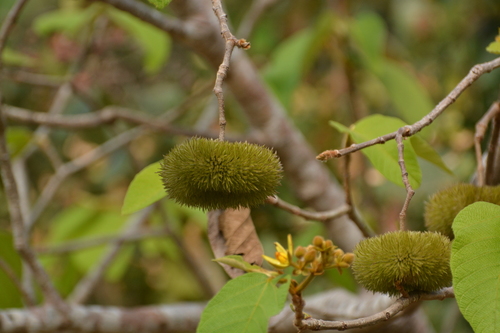
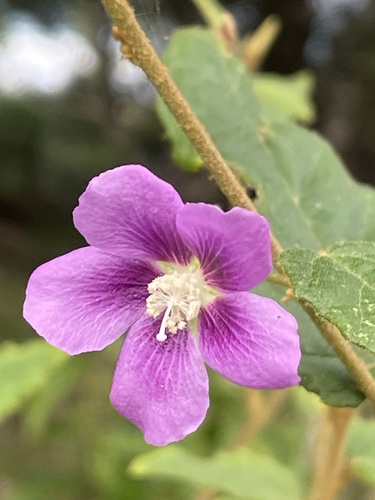
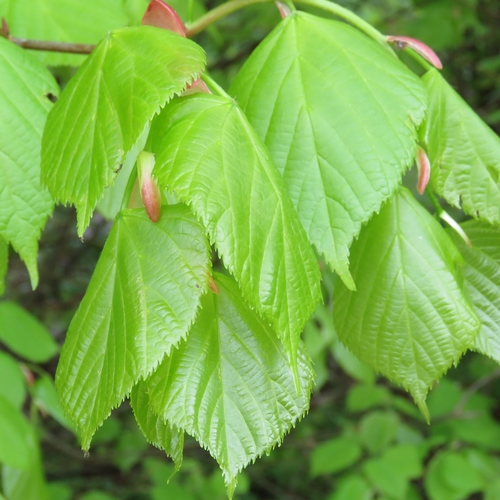
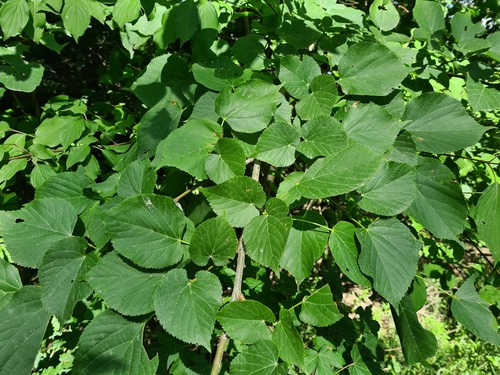
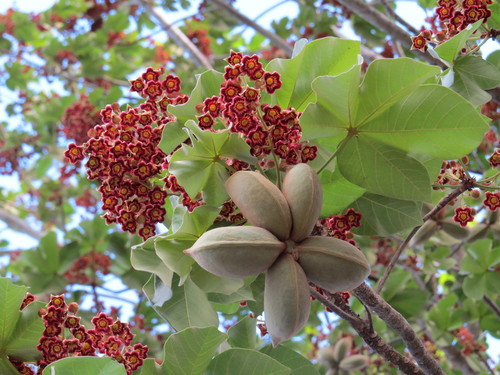
Sterculia apetala (Jacq.) H.Karst. is a perennial deciduous tree. It has a straight, cylindrical trunk with large buttresses at the base, and reaches a total height of 20 to 40 meters (66 to 131 feet). Its leaves are arranged alternately along branches, palmate with five lobes, and grow in dense clusters at branch ends. Including the petiole, leaves measure 15 to 50 centimeters (5.9 to 20 inches) in length. Flowers of S. apetala are purple and yellow, with five sepals. They do not produce true petals—petal-like structures on this species are actually modified sepals. Flowers are 2.5 to 3.5 centimeters (0.98 to 1.4 inches) in diameter, and are unisexual, meaning distinct male and female individual flowers are required for reproduction. The fruit of this species is a compound structure made up of up to five follicles, growing from peduncles that can reach 30 centimeters (12 inches) long. Inside the follicles are the tree’s seeds, along with orange urticating hairs that can cause pain when touched. Under natural conditions, the tree typically flowers and produces fruit between December and March. The seeds are black, ellipsoid in shape, and usually measure 2.5 cm × 1.5 cm (0.98 in × 0.59 in). They contain two cyclopropene fatty acids: sterculic acid and malvalic acid. Antioxidant compounds can be extracted from these seeds using either water or ethanol as a solvent, via either continuous or batch extraction methods. This species is distributed across tropical regions of Florida, Mexico, Central America, Trinidad and Tobago, Bolivia, northern Brazil, Colombia, Ecuador, Peru, and Venezuela, including the Venezuelan Antilles. The wood of Sterculia apetala is used to make cases, crates, industrial and domestic woodware, canoes, and tool handles. The tree is often cultivated for shade, thanks to its large leaves. In some regions, seeds are eaten after boiling or roasting, used to add flavor to chocolate, or fed to animals as fodder. The flowers are used as an antitussive.