About Stenocarpus umbellifer (J.R. & G.Forst.) Druce
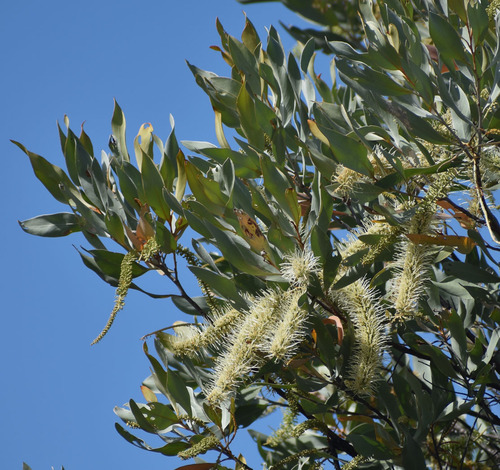
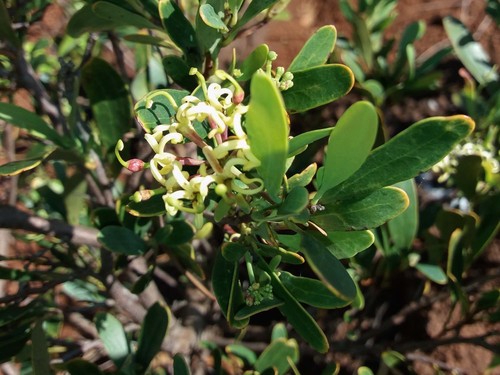
Stenocarpus umbellifer (originally published as Stenocarpus umbelliferus) is a flowering plant species belonging to the Proteaceae family, and it is endemic to New Caledonia. This species can grow with either a prostrate or an upright habit, reaching a maximum height of 5 metres. When young, its stems are flattened, and they become rounded as they mature. The leaves are thick and leathery with slightly wavy margins; they may take an ovate, elliptic, lanceolate, or spathulate shape, and have petioles between 3 and 12 mm long. Its white, cream, or pale yellow flowers grow in umbels, with 3 to 8 flowers per umbel. After flowering, it produces dark, hairless glabrous follicles that measure 25 to 80 mm long and 3 to 5 mm wide. Botanists Johann Reinhold Forster and his son Georg Forster collected this species during James Cook's second voyage, which took place from 1772 to 1775, and formally described the species in 1775. Two varieties are currently recognised: Stenocarpus umbelliferus var. billardieri (Brongn. & Gris) Guillaumin, and Stenocarpus umbelliferus var. umbelliferus (J.R. & G.Forst.) Druce. The species is common at altitudes ranging from 20 to 1300 metres, found on both the New Caledonian mainland and the Isle of Pines.