About Stellera chamaejasme L.
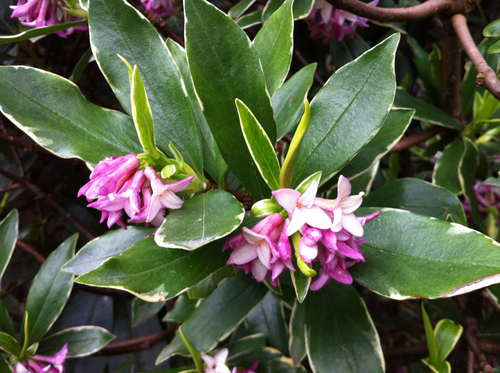
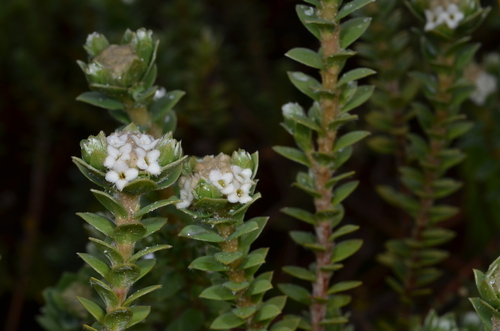
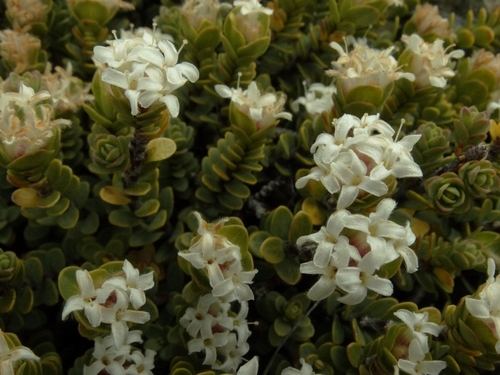
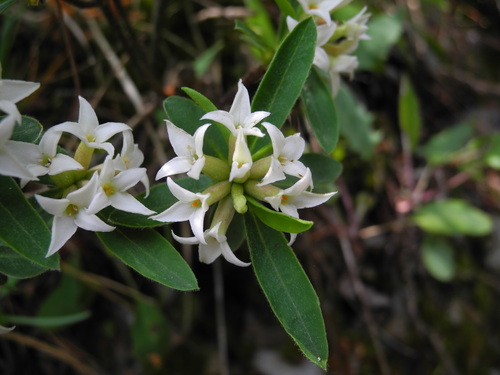
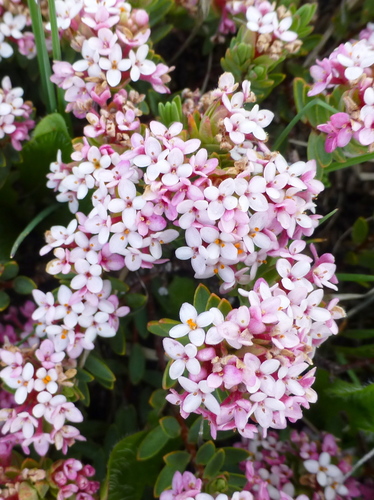
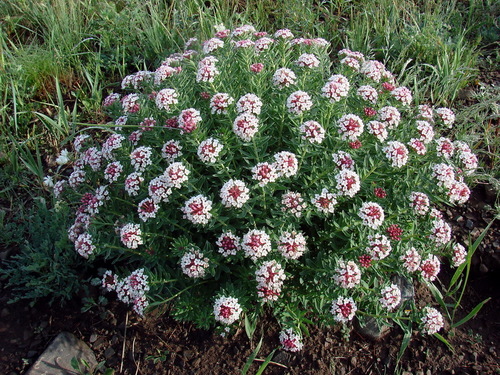
Stellera chamaejasme L. is a herbaceous perennial plant. Clusters of unbranched stems, 20–30 cm tall, grow from an underground rhizome. Narrow, overlapping leaves are borne along the stems; individual leaves are narrow and pointed, reaching up to 2 cm long. Flowers are arranged in rounded, tightly packed terminal heads. They do not have true petals, and instead have petal-like sepals that form a tube up to 1.5 cm long, usually with five short lobes (four or six are also possible). Flower color ranges from pink and white to yellow. Stamens number twice as many as calyx lobes, arranged in two series. The ovary has a single chamber (locule). The fruit is a dry drupe, enclosed by the remains of the calyx. Stellera chamaejasme is native to northern and western Tibet, the Himalayas (Nepal, Bhutan), the state of Uttar Pradesh in northern India, Russia, and Mongolia. In China, it grows on sunny dry slopes and sandy sites at elevations between 2600 and 4200 m. Russians living in Dauria have long valued this plant for its root, even though its strong toxic effects have killed many people. The root often resembles a crudely carved human figure more closely than the well-known Alraune (Mandragora), with clearly visible natural protuberances resembling a head, arms, and legs. This led local Russians to name it Muzhik koren, meaning "Man root". The oldest rootstocks can grow to the size of a large carrot, and produce extremely strong effects when used as medicine. These older roots can produce more than fifty, and sometimes as many as one hundred, flowering shoots. The beautiful, fragrant flowers these shoots bear give no indication of the violent, harmful toxicity in the plant's root. The exterior of the flower is usually dark reddish-purple, or more rarely sulfur-yellow, while the interior is white. When flowers open, they have a white border with a red or yellow patch in the center, giving them a very attractive appearance. Young Tungus boys traditionally weave whole flowering stems of the plant to make decorative hats for their bare heads. It is not uncommon to find fused flowers on this plant, where two normal flowers merge to form a structure with nine lobes and eighteen stamens arranged in two rows. This account is translated from French, and is closely based on the writing of Prussian naturalist and explorer Peter Simon Pallas. The plant is extremely poisonous, and has caused deaths in both humans and livestock. Powdered roots of the plant have been used as a laxative, a pesticide, and a fish poison. Small doses have also been used as a strong anthelmintic (dewormer) for sheep and goats. The plant is common in Western China, where it has the common name Langdu (狼毒花), literally meaning "wolf poison". It is used as a medicinal herb in China, but if it becomes overabundant it is considered a problematic weed: its large, water-thirsty roots accelerate the desertification of prairies. A Chinese medicinal plant guide written for farmers notes that Stellera is a very poisonous plant used as an insecticide, and that if consumed by an animal it will cause the intestines to disintegrate. Corroboration for this damaging effect on animal intestines from consuming plants in the family Thymelaceae is found in an account of Lasiosiphon kraussianus (a South African plant that may also be classified as a Gnidia species). This South African plant is extremely poisonous and quickly fatal to livestock; an animal's intestines perforate around one day after eating it. Certain African tribes use this lethal property by putting powdered root of the plant into poisoned waterholes during the rainy season. The poison remains potent for seven days, and kills any animal that drinks the contaminated water. The plant family that contains Stellera, Thymelaceae, is notable for having many poisonous species, and for sharing some chemical similarities with the family Euphorbiaceae. Both families include multiple genera that produce phorbol esters. In line with this similarity, traditional Chinese herbal medicine recognizes a similarity in effect between Stellera and certain Euphorbia species. Perry (1980) notes that in a 1959 Chinese materia medica, Stellera, Euphorbia fischeriana Steud. (synonym E. pallasii Turcz.) and Euphorbia sieboldiana Morr. & Decne. are listed under the same entry (number 86, langdu) as having the same or very similar medicinal properties. All three are pungent, poisonous plants used as cathartics, anthelmintics, and expectorants, and are also used topically to treat ulcers and skin diseases. Stellera chamaejasme is cultivated as an ornamental plant for rock gardens and alpine houses. It is considered difficult to grow, requiring a sunny position and gritty soil when grown outdoors, and a large pot when grown under cover. It is propagated by seed.