About Stachys thunbergii Benth.
Taxon Identity
Stachys thunbergii Benth. is a perennial herb with stout, four-angled, erect or ascending stems that can reach 2 m (6.6 ft) in length.
Stem Morphology
Its stems are sparsely branched, slightly woody, and bear strong backward-pointing prickles along the four angles and at the nodes; the rest of the stem surface is smooth.
Leaf Attachment
Leaves grow on short stalks, and have thick, somewhat wrinkled blades that turn dark brown when dried.
Leaf Blade Shape
Leaf blades range from ovate to lanceolate in shape, measure 30–60 mm (1.2–2.4 in) long, and have a heart-shaped base, an acute tip, and finely scalloped margins.
Leaf Hairiness
Leaf surfaces are sparsely hairy to nearly hairless.
Inflorescence Structure
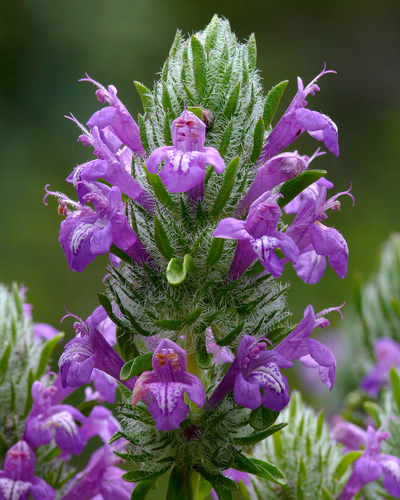
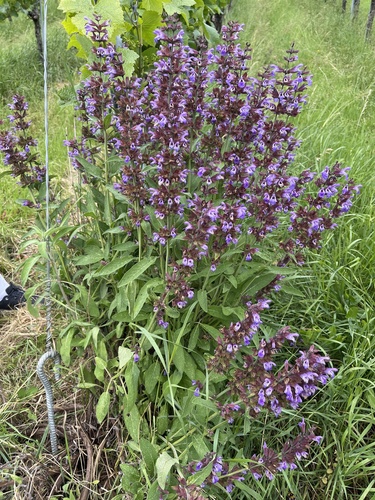
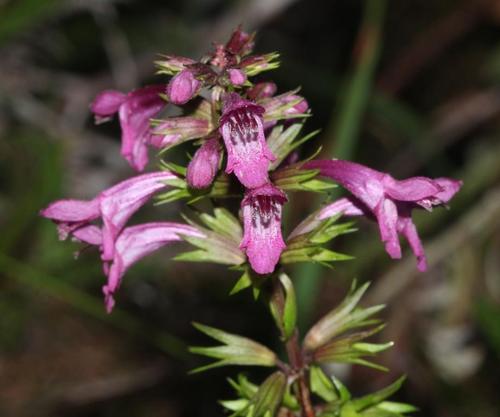
Flowers are arranged in loose to fairly dense spikes that are 60–150 mm (2.4–5.9 in) long, with 4 to 6 flowers growing in each whorl.
Calyx Morphology
The calyx is slightly hairy and ends in a spine tip.
Corolla Morphology
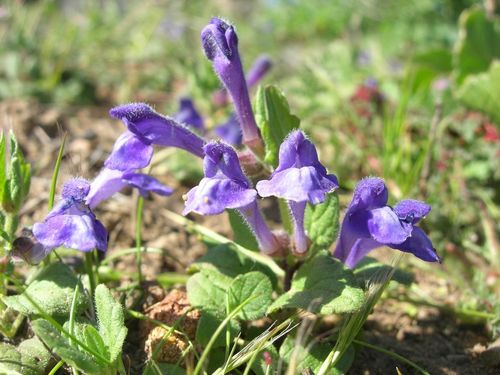
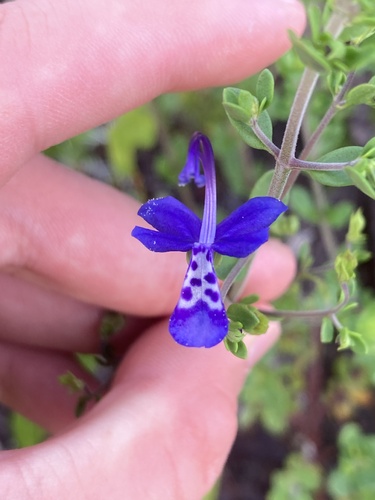
The corolla is red, magenta, or purple, has a gently curved tube and two distinct lips, with the lower lip slightly longer than the upper lip.
Flowering Period
This species flowers from September to March.
Eastern Cape Distribution
Most populations of Stachys thunbergii are located in South Africa's Eastern Cape province, where it grows at forest margins and in closed woodland at altitudes between 120 m (390 ft) and 950 m (3,120 ft), in the area from George to Humansdorp.
Western Cape Distribution
In the Western Cape province, the species is most often found on the south-eastern slopes of Devil's Peak and adjacent mountains within Table Mountain National Park.
Disjunct Population Records
Scattered records of the species also exist between these two main population centres.