About Salvia officinalis L.
Cultivar Trait Variation
Salvia officinalis L. cultivars vary widely in size, leaf and flower color, and foliage pattern, with many having variegated leaves.
Wild Type Size
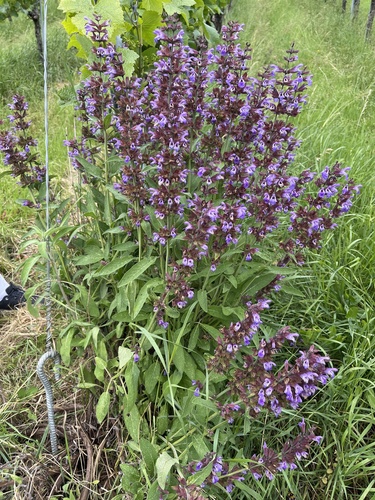
The unmodified Old World type grows to around 60 cm (2 ft) tall and wide.
Flower Characteristics
Its most common flower color is lavender, but flowers may also be white, pink, or purple, and bloom in late spring or summer.
Leaf Shape and Dimensions
Its leaves are oblong, growing up to 65 mm (2+1⁄2 in) long by 25 mm (1 in) wide.
Wild Type Leaf Coloration
Leaves are grey-green, rugose on the upper surface, and nearly white underneath due to a dense covering of short soft hairs.
Cultivar Leaf Coloration
Modern cultivars produce leaves with purple, rose, cream, and yellow coloring in many different variegated combinations.
Color Name Origin
The distinctive grayish-green leaf color of common sage is the origin of the color name "sage".
Native and Naturalized Range
Common sage is native to the Mediterranean region, and has become naturalized in many locations around the world.
Garden Growth Habit
In favorable garden conditions, S. officinalis can grow to a substantial size of 1 square metre or more, but many cultivars are more compact.
Compact Cultivar Uses
These compact cultivars are valued as small ornamental flowering shrubs rather than for herbal use.
Ground Cover Cultivars
Some cultivars work as low ground cover, particularly in sunny, dry environments.
Cultivation Vulnerabilities
Like many other herbs, common sage can be killed by a cold, wet winter, especially if planted in soil that does not drain well.
Propagation Methods
It is easily propagated from summer cuttings, and some cultivars are grown from seeds.
Named Cultivar List
Named cultivars of common sage include: 'Alba', a white-flowered cultivar; 'Aurea', golden sage; 'Berggarten', a cultivar with large leaves that rarely blooms, extending the useful lifespan of its leaves; 'Extrakta', which has leaves with higher essential oil concentrations; 'Icterina', a cultivar with yellow-green variegated leaves; 'Lavandulaefolia', a small-leaved cultivar; 'Purpurascens' ('Purpurea'), a purple-leafed cultivar; and 'Tricolor', a cultivar with white, purple and green variegated leaves.
Horticultural Awards
'Icterina' and 'Purpurascens' have been awarded the Royal Horticultural Society's Award of Garden Merit.
Ancient Medicinal Uses
Salvia officinalis has been used since ancient times to treat snakebites, increase women's fertility, and for a range of other purposes.
Roman Cultural Significance
The Romans called sage a "holy herb" and used it in their religious rituals.
Theophrastus' Sage Classifications
Theophrastus wrote of two different types of sage: a wild undershrub he called sphakos, and a similar cultivated plant he called elelisphakos.
Pliny the Elder's Sage Notes
Pliny the Elder noted that Romans called the cultivated plant salvia, and used it as a diuretic, a local skin anesthetic, a styptic, and for other uses.
Early Medieval Cultivation
In the early Middle Ages, Charlemagne recommended common sage for cultivation, and it was grown in monastery gardens across the Carolingian Empire.
Walafrid Strabo's Description
Walafrid Strabo described it in his poem Hortulus, noting it has a sweet scent and is useful for many human ailments; he used the name lelifagus, drawing from the plant's Greek naming roots.
Medieval Medicinal Reputation
Throughout the Middle Ages, common sage had a strong reputation for its healing properties and value, and many proverbs reference these qualities.
Medieval Common Name
It was sometimes called S. salvatrix, meaning "sage the savior".
Classical Medicinal Recommendations
Dioscorides, Pliny, and Galen all recommended sage as a diuretic, hemostatic, emmenagogue, and tonic.
Medieval Culinary Uses
Le Menagier de Paris recommends sage for cold sage soup, sage sauce for poultry, and a sage infusion for hand washing at the table.
John Gerard's Herbal Claims
John Gerard's 1597 Herball states that sage is uniquely good for the head and brain, quickens the senses and memory, strengthens the sinews, restores health to people with palsy, and stops tremors of the limbs.
Gervase Markham's Recipe
Gervase Markham's 1615 work The English Huswife includes a recipe for tooth powder made from sage and salt.
Four Thieves Vinegar Ingredient
Common sage is an ingredient in recipes for Four Thieves Vinegar, a herbal blend believed to protect against plague.
Additional Historical Uses
In past centuries, it was also used for hair care, treating insect bites and wasp stings, managing nervous and mental conditions, creating oral preparations for inflammation of the mouth, tongue and throat, and reducing fevers.