About Stachyridopsis pyrrhops (Blyth, 1844)
Taxonomic Classification
The black-chinned babbler (scientifically known as Cyanoderma pyrrhops, also previously called Stachyridopsis pyrrhops) is a babbler species that belongs to the family Timaliidae.
Geographic Range
It lives in the Himalayan foothills, ranging from the Murree Hills of Pakistan all the way to eastern Nepal.
Habitat and Altitude
It inhabits subtropical and temperate forests, found at altitudes between 245 and 2,750 metres (which equals 804 to 9,022 feet).
Ecology and Conservation Status
It is a terrestrial species, and is currently listed as Least Concern on the IUCN Red List.
Physical Characteristics
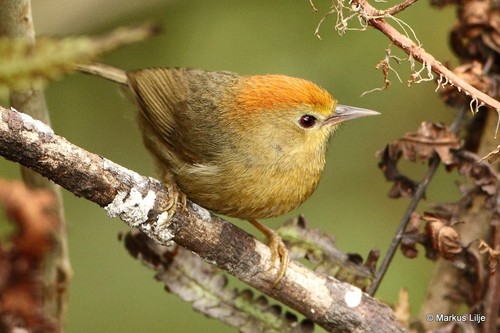
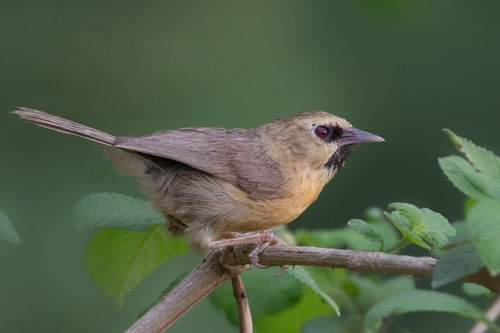
In terms of physical appearance, it has a biscuit-coloured body, a black chin and black lores, a buffy grey crown, reaches 10 cm (3.9 in) in total length, and weighs between 8 and 12 g (0.28 to 0.42 oz).
Diet
Its diet is omnivorous.
Original Taxonomic Description
Edward Blyth first proposed the scientific name Stachyris pyrrhops for this species in 1844, when he described a greenish olivaceous babbler with a black chin and black lores collected from Nepal.
Subsequent Taxonomic Placement
Later, the species was moved to the genus Stachyridopsis.